
trace-mcp
Framework-aware code intelligence MCP server that indexes a codebase into a local graph so AI coding agents query it instead of re-reading files.
At a Glance
Self-hosted trace-mcp core under the MIT license; code stays local, no API keys required.
Engagement
Available On
Listed Nov 2026
About trace-mcp
trace-mcp is an open-source (MIT) MCP server by Nikolai Vysotskyi that indexes a repository once into a local dependency graph and serves it to AI coding agents. Instead of re-reading files each turn, an agent calls graph tools such as get_change_impact, find_usages or get_call_graph. The project lists 81 languages, 91 framework integrations and 182 MCP tools, and the latest release shown is v3.43.1.
What It Is
trace-mcp is a code-intelligence layer for MCP-capable clients such as Claude Code, Cursor, Windsurf, Codex and Claude Desktop. It parses source with tree-sitter, resolves framework-specific edges through plugins (routes to controllers, Inertia to Vue, ORM models to migrations), and can optionally enrich call resolution with language servers such as tsserver, pyright and gopls. The result is stored locally in SQLite with FTS5 and kept fresh by a file watcher with incremental, content-hashed reindexing.
How the Workflow Runs
Install the CLI with npm, run trace init once per machine to detect and wire MCP clients, install a guard hook and add routing rules, then run trace add in each project to detect frameworks and build its index. Agents then use tools for structure-aware search, file outlines, usages, call graphs, change impact and dry-run codemods. Embeddings are bundled via ONNX, so semantic search works offline by default; Ollama or OpenAI can be configured for optional summarization.
Memory, Subprojects and Reports
Beyond code navigation, trace-mcp offers decision memory that mines past agent sessions for decisions and links them to symbols so they surface in impact analysis. Subproject support links separate repositories through API contracts for cross-service impact analysis. A trace ci-report command produces per-pull-request reports covering blast radius, test gaps, risk and architecture violations. The same engine can also index markdown vaults such as Obsidian and Logseq.
Desktop App and Measurements
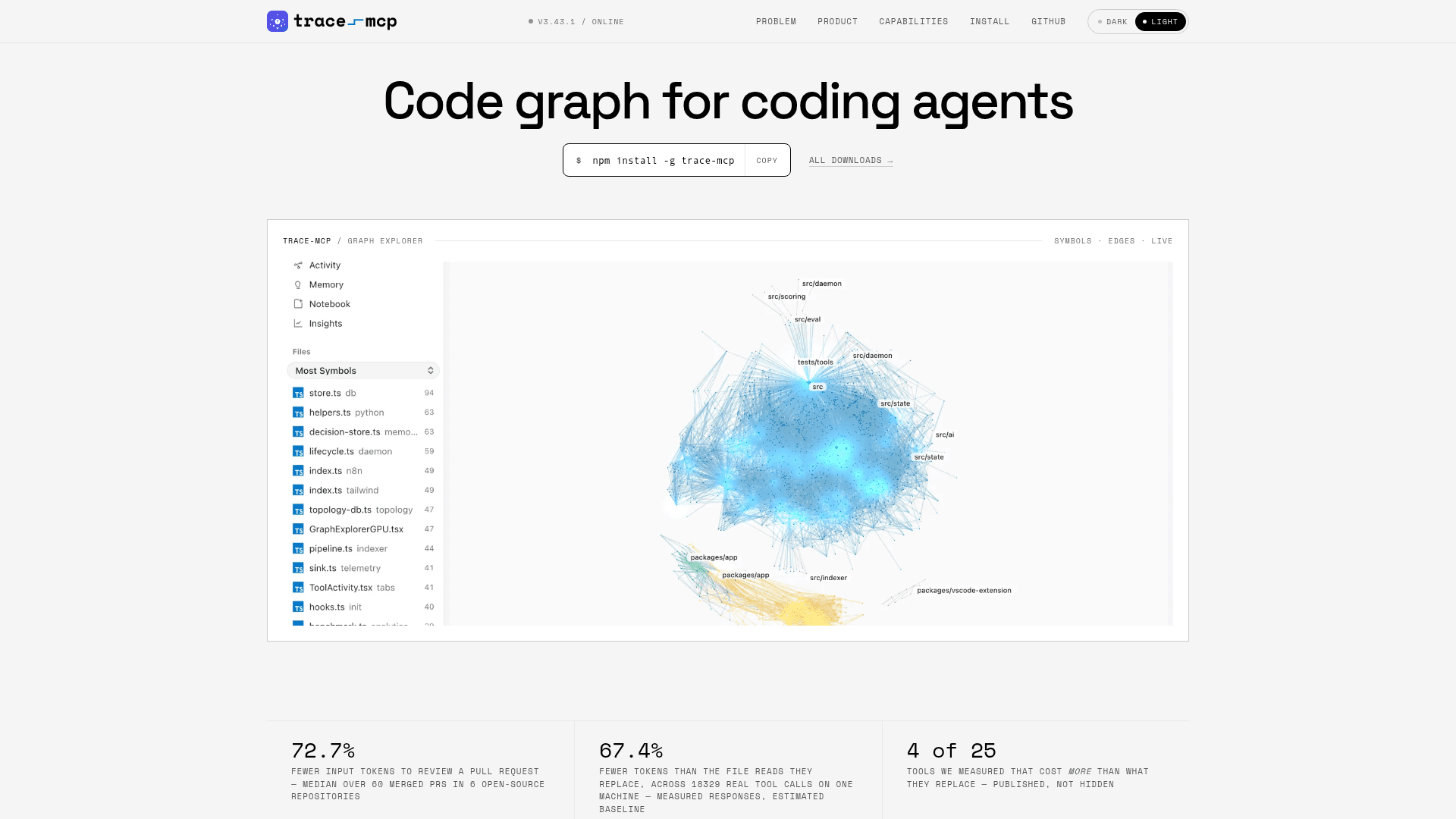
An optional Electron desktop app provides project management, MCP client wiring and a GPU-accelerated graph explorer over the same index. The vendor reports a 72.7% median reduction in input tokens for pull request review context across 60 merged PRs in six open-source repositories, and a 67.4% reduction across 18,329 recorded tool calls on one machine measured against an estimated baseline. It also says four of 25 measured tools cost more than what they replace.
Community Discussions
Be the first to start a conversation about trace-mcp
Share your experience with trace-mcp, ask questions, or help others learn from your insights.
Pricing
Open Source (MIT)
Self-hosted trace-mcp core under the MIT license; code stays local, no API keys required.
- MIT License
- Install via npm install -g trace-mcp
- Zero API keys
- Your code stays local
- 182 tools, 81 languages, 91 framework integrations
Capabilities
Key Features
- Precomputed cross-language code graph served over MCP
- 182 MCP tools including search, get_outline, find_usages, get_call_graph and get_change_impact
- 81 languages via tree-sitter and regex-based extraction
- 91 framework integrations capturing routes, models, components and migrations
- Optional LSP enrichment for call resolution
- Incremental content-hashed reindexing with file watcher
- Dry-run codemods and reversible refactors with guard hook
- Decision memory linked to code symbols
- Cross-session search of past conversations
- Multi-service subproject topology and cross-service impact analysis
- CI/PR change impact reports
- Markdown vault indexing (Obsidian, Logseq)
- Offline semantic search with bundled ONNX embeddings
- Optional desktop app with GPU graph explorer
- OpenTelemetry spans for MCP tool calls