
SMS Gateway for Android
An open-source Android app that turns your smartphone into an SMS/MMS gateway, enabling programmatic message sending and receiving via a REST API.
At a Glance
Completely free, no restrictions or limits, direct device communication, no internet required.
Engagement
Available On
Alternatives
Listed Aug 2026
About SMS Gateway for Android
SMS Gateway for Android is an open-source Android application, licensed under Apache 2.0, that converts any Android 5.0+ smartphone into a fully functional SMS and MMS gateway. It exposes a REST API for sending and receiving messages programmatically, making it practical for developers who need SMS capabilities without relying on third-party SMS aggregators. The project is actively maintained by GitHub user capcom6 and, as of August 2026, has reached version v1.72.0.
What It Is
SMS Gateway for Android sits in the category of self-hosted communication infrastructure. Instead of paying per-message fees to a cloud SMS provider, you install the app on an Android device you already own, and that device becomes the gateway. The app runs a local HTTP server on the device and optionally connects to a cloud relay server when direct device access is not possible. Developers interact with the gateway through a standard REST API or a CLI tool, and the app handles the actual SMS/MMS transmission over the device's cellular connection.
Deployment Modes
The app supports four distinct deployment configurations:
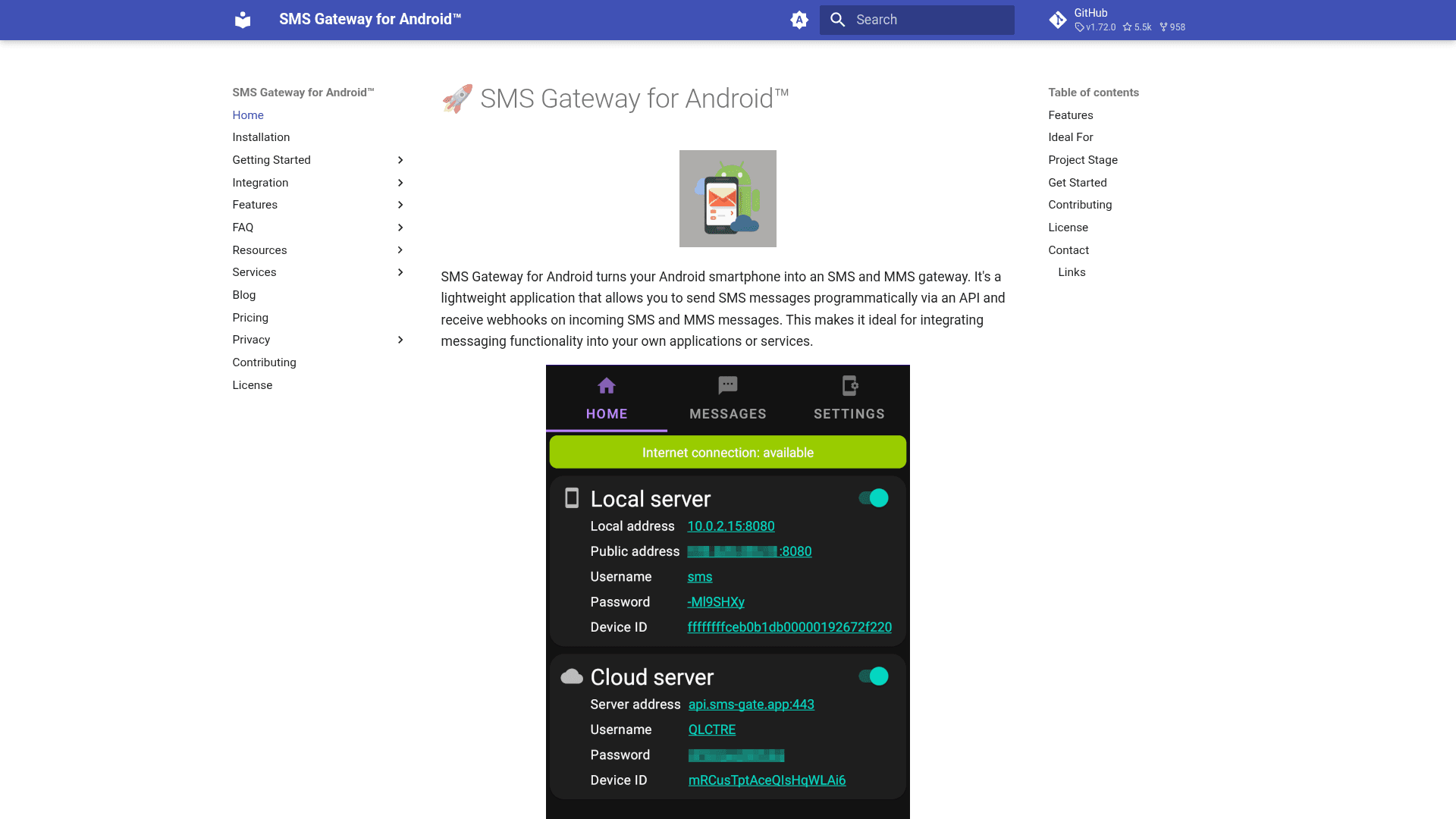
- Local Server — The device runs an HTTP server on port 8080, accessible over the local network. No internet required, no account needed. Ideal for LAN-based automation.
- Cloud Server — The device connects to
api.sms-gate.appas a relay, enabling API access from anywhere without a static IP. Free to use with soft limits for very high-volume senders. - Private Server — Users self-host the backend server in their own infrastructure. Push notifications are still relayed via the cloud component, but message content stays on-premises.
- Custom Gateway — Fully self-hosted with no official support, for teams that need complete control and have the technical expertise to manage it.
Integration Surface
The gateway exposes multiple integration points beyond the core REST API:
- REST API with Swagger/OpenAPI documentation served directly from the device
- Webhooks for real-time event delivery (SMS received, sent, delivered, failed, cancelled; MMS received and downloaded; data SMS; batched variants; app started; system ping)
- SMPP v3.4 server to bridge existing SMPP-compatible clients and SMS aggregators
- SMTP bridge (Email to SMS) so any email-capable system can trigger SMS delivery
- Twilio Fallback Service to route Twilio SMS through the gateway when Twilio is unavailable
- CLI tool (
smsgate) for scripting and batch operations - Client libraries for common programming languages
- Agent Systems integration documented for AI agent workflows
Key Features
- No registration or email required in local mode
- End-to-end encryption of message content and recipient phone numbers before transmission to the API
- Multi-SIM card support with per-SIM routing
- Multi-device support: multiple Android devices can share one account, with messages distributed across all connected devices
- Scheduled messages and working-hours delivery windows
- Send rate limiting to avoid carrier throttling
- Message cancellation for queued messages
- Data SMS support for binary payloads (IoT commands, encrypted data)
- MMS send and receive with attachment webhook delivery
- Batch webhook events to reduce request volume
- Health check and ping endpoints for monitoring
Update: v1.72.0
The latest release, v1.72.0, was published on August 21, 2026. The repository shows active development with the last push on August 26, 2026. The project's own documentation notes it is in the "active development stage" with some production deployments already in use. The GitHub repository has accumulated over 5,500 stars and nearly 1,000 forks, reflecting meaningful community adoption for a self-hosted SMS tool.
Tradeoffs to Know
Because SMS is transmitted over the device's own cellular connection, the Android device must remain powered on and connected. The app's documentation explicitly advises against bulk/batch sending due to potential mobile carrier restrictions. Android 15+ introduces additional permission constraints that the FAQ addresses separately. The private and custom server modes require self-hosting expertise and may introduce delivery delays compared to the cloud relay mode.
Community Discussions
Be the first to start a conversation about SMS Gateway for Android
Share your experience with SMS Gateway for Android, ask questions, or help others learn from your insights.
Pricing
Local Server
Completely free, no restrictions or limits, direct device communication, no internet required.
- No registration required
- No internet required
- Direct device communication
- No restrictions or limits
- Full REST API access
Cloud Server
Completely free cloud relay with soft limits for very high-volume usage.
- Free cloud relay
- Individual limits only if affecting other users
- Recommended to notify support for >10k/day usage
Private Server
Self-hosted backend with unlimited messages and push notifications via cloud.
- Unlimited messages
- Push notifications via Cloud
- Requires self-hosting
- May introduce delays
Custom Gateway
Fully self-hosted with complete customization and no official support.
- Fully self-hosted
- Complete customization
- No official support
- Requires technical expertise
Capabilities
Key Features
- Send SMS via REST API
- Receive SMS and MMS via webhooks
- Local server mode (no internet required)
- Cloud server relay mode
- Private server self-hosting
- End-to-end encryption
- Multi-SIM card support
- Multi-device support
- Scheduled message delivery
- Working hours delivery windows
- Send rate limiting
- Message cancellation
- Data SMS (binary payloads)
- MMS send and receive
- SMPP v3.4 server bridge
- Email to SMS bridge
- Twilio fallback service
- CLI tool
- Swagger/OpenAPI documentation
- Webhooks for all message events
- Batch webhook events
- Health check and ping endpoints
- Multipart (long) message support
- Message status tracking
- No registration required in local mode