
Solarch
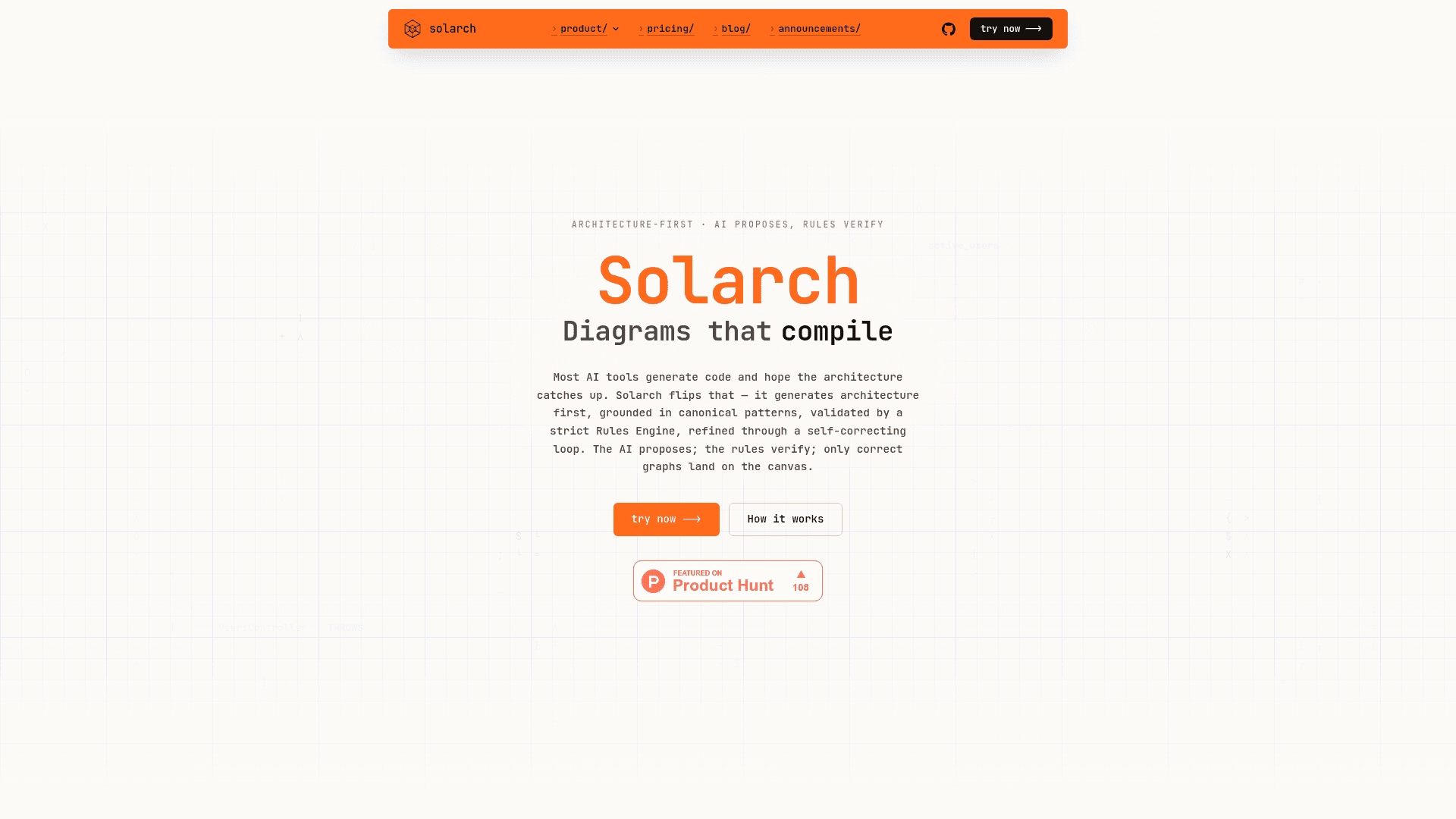
Solarch is a backend architecture tool that lets you draw your system as a validated node/edge graph, then generates type-safe code directly from that verified architecture.
At a Glance
Start sketching for free — the Rules Engine validates every connection.
Engagement
Available On
Listed Jun 2026
About Solarch
Solarch is a backend-architecture design tool that inverts the typical AI coding workflow: instead of generating code and hoping the architecture holds up, it generates and validates the architecture first, then compiles code from the verified graph. Built by Solarch (solarch.dev), the tool is live and accessible at app.solarch.dev, with a free tier and paid plans available.
What It Is
Solarch is a canvas-based diagramming and code-generation platform for backend systems. Users draw their system as a node/edge graph — controllers, services, repositories, tables, DTOs, queues — and a strict Rules Engine validates every connection in real time. The validated graph then drives a hybrid code engine that produces type-safe, architecture-aligned code. The tool positions itself as an "architecture-first" alternative to AI coding assistants like Copilot or Cursor.
How the Rules Engine Works
The Rules Engine is a default-deny validator at the core of Solarch. Every connection that is not explicitly whitelisted is forbidden. According to the product page, it enforces 7 anti-patterns and 3 conditional checks — for example, a Controller cannot reach a Table directly and must route through a Service or Repository. Illegal edges are rejected the moment you draw them, not after commits. Rejections feed back into the AI loop until the graph is clean, or the change never commits.
The Hybrid Code Engine
Solarch uses a two-stage code generation pipeline:
- Stage 1 (deterministic, 0 tokens): A compiler turns the graph into a skeleton — DTOs, entities, and constructor injection derived directly from the edges.
- Stage 2 (surgical AI, ~300 tokens/function): AI fills only the empty function bodies, not the entire file.
Exports include runnable code (ZIP), Mermaid diagrams, API contracts, and AI-readable vector memory formatted for Cursor and Claude.
Canvas Architecture and Graph Model
The canvas supports 21 node types across 8 families (Data, Business, Access, Infra, Client, Security, Config, Structure) and 16 typed semantic edges. Projects can be split into tabs, and each node lives in exactly one tab — other tabs import it as a ghost reference rather than a copy, preserving a single source of truth. A fractal graph feature enables semantic zoom from macro module views down to micro-graphs. The tool also integrates LangGraph and GraphRAG to ground AI proposals in a vector-indexed library of canonical architecture patterns.
Two Interaction Modes
Solarch exposes a single omni-bar with two modes:
- Agent mode: An autonomous builder that generates a full architecture from a natural-language prompt.
- Instruct mode: A conversational architect for iterative, guided design without leaving the canvas.
Both modes operate on the same validated canvas, so every AI-proposed change passes through the Rules Engine before it lands.
Current Status
Solarch is live as of 2026. The free tier requires no credit card and supports 2 projects with the AI architect and Rules Engine included. Paid plans (Draw, Build, Code) each include a 7-day trial. A Team plan (per seat) and an Enterprise plan (self-host, SSO, audit logs, custom rules matrix) are also listed; the Code plan is marked "coming soon" on the pricing page.
Community Discussions
Be the first to start a conversation about Solarch
Share your experience with Solarch, ask questions, or help others learn from your insights.
Pricing
Free
Start sketching for free — the Rules Engine validates every connection.
- 2 projects
- AI architect included
- Live node/edge canvas
- Default-deny rules validation
Draw
The drawing tool. Sketch backend architecture as a node/edge graph — the Rules Engine auto-validates every connection.
- Unlimited projects
- AI architect included
- 22 node types · 16 edges
- Default-deny rules validation
Build
Everything in Draw, plus AI that scaffolds your project — ~80% ships as boilerplate; the algorithmic logic stays yours.
- Everything in Draw
- Extended AI usage
- Code Generation + ZIP export
Code
Everything in Build, but Solarch writes the whole codebase — full generation, not just the skeleton. Coming soon.
- Everything in Build
- Solarch writes the whole codebase
- Maximum AI usage
- Extend limits at a discount
Team
Build together — shared projects with single-home nodes and ghost references across the org.
- Everything in Build
- Shared projects
- Single-home nodes with ghost references
Enterprise
Self-host, SSO, audit logs, a custom rules matrix, and dedicated support.
- Self-hosting
- SSO
- Audit logs
- Custom rules matrix
- Dedicated support
Capabilities
Key Features
- Live node/edge canvas for backend architecture
- Default-deny Rules Engine with 7 anti-patterns and 3 conditional checks
- 21 node types across 8 families
- 16 typed semantic edges
- Hybrid code engine: deterministic skeleton + surgical AI fill
- ZIP code export
- Mermaid diagram export
- API contract export
- Vector memory export (Cursor & Claude ready)
- Fractal graph with semantic zoom
- Single-home nodes with ghost references across tabs
- LangGraph + GraphRAG grounded AI proposals
- Agent mode (autonomous builder) and Instruct mode (conversational architect)
- Type-safe end-to-end from database schema to typed client
- Autonomous QA with red team, smart seeding, and time-travel snapshots