
Sourcegraph
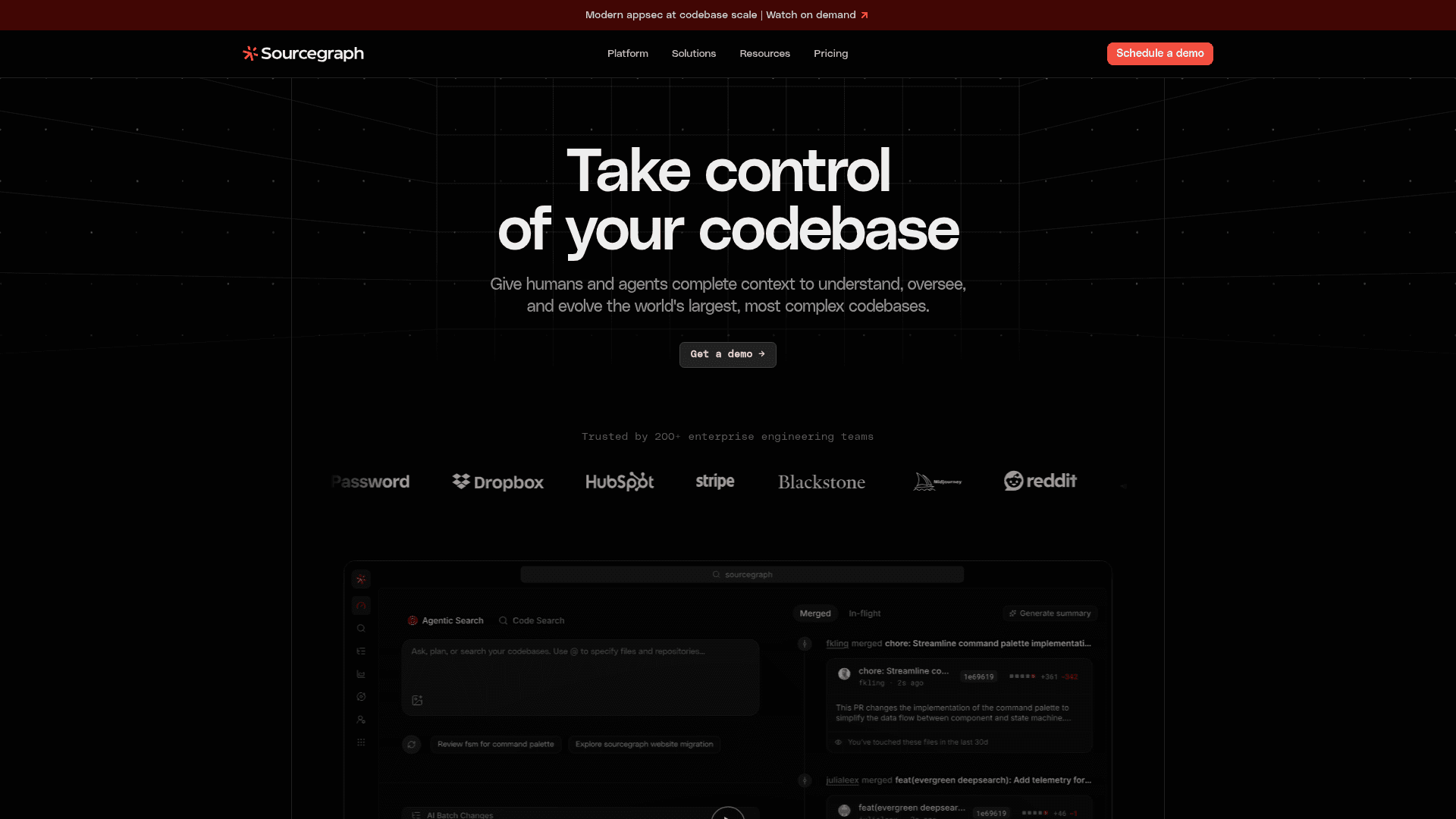
Sourcegraph is a code intelligence platform that gives engineers and AI agents complete codebase context for search, understanding, and large-scale code changes.
At a Glance
About Sourcegraph
Sourcegraph is a code intelligence platform built for enterprise engineering teams managing large, complex codebases. It indexes all repositories across every code host and delivers complete codebase context to both human developers and AI coding agents. The platform is actively used by organizations the company describes as "200+ enterprise engineering teams" and offers deployment as single-tenant cloud or self-hosted.
What It Is
Sourcegraph sits at the intersection of code search, AI-powered code understanding, and large-scale code change automation. Its core job is to make every part of a codebase — across thousands of repositories, branches, and code hosts — instantly searchable, navigable, and actionable. The platform serves both developers who need to understand unfamiliar code and AI agents that need full codebase context to produce reliable results.
Core Platform Capabilities
Sourcegraph bundles several distinct tools under one platform:
- Deep Search — An agentic, natural language search that answers complex questions about the codebase with citations, used by engineering, support, and go-to-market teams.
- Code Search — Exact, deterministic, and exhaustive search across all repositories and branches, described by Sourcegraph as trusted by enterprise teams for over a decade.
- Code Insights — High-level dashboards that track migrations, version adoption, vulnerability remediation, and ownership trends over time.
- Code Monitoring — Alerts engineers and agents when specific code patterns change, with integrations to Slack, PagerDuty, email, Jira, and webhooks.
- Agentic Batch Changes — An AI agent that executes large-scale code changes across every repository simultaneously, covering migrations, modernization, and security remediation.
- MCP Server — A Model Context Protocol server that gives external AI coding agents (Claude Code, Cursor, Codex, Amp, and others) SCIP-powered code graph context.
Agent Effectiveness and the MCP Angle
A central product direction for Sourcegraph is making AI coding agents more effective by solving the context problem. Without full codebase context, agents see only fragments and miss cross-cutting concerns like auth middleware, API response DTOs, audit logging, and integration tests. Sourcegraph's MCP server exposes its code graph to agents so they can search across thousands of repositories before making changes. The company cites Stripe's internal agent platform ("Minions") as a published example: Stripe's blog states that their agents are "connected to MCP… this is how they gather context: internal docs, ticket details, build statuses, and code intelligence via Sourcegraph search."
Enterprise Architecture and Security
Sourcegraph is built for "Big Code" — large monorepos and multi-repo architectures at enterprise scale. Key security and compliance properties include:
- SOC 2 Type II and ISO 27001 compliance
- Zero data retention on LLM inference
- No model training on user data
- Full IP indemnity for generated code
- Context Filters to exclude sensitive code from AI models
- Public code guardrails for OSS license compliance
- Enterprise SSO (SAML, OpenID Connect, OAuth), SCIM provisioning, and RBAC
- Audit logs for security and access events
- GDPR and CCPA compliance
Deployment and Integration
Sourcegraph deploys as a single-tenant cloud instance or as a self-hosted installation. It integrates with all major code hosts and exposes GraphQL and REST APIs plus a CLI for terminal access. The MCP server connects to any agent that supports the Model Context Protocol, including Claude Code, Cursor, Codex, and Amp. Code Monitoring integrates with Slack, PagerDuty, email, Jira, and webhooks.
Update: Agentic Batch Changes and MCP Server
Recent product additions highlighted on the Sourcegraph site include Agentic Batch Changes (labeled "New"), which brings an AI agent to large-scale code change execution, and the MCP server, which exposes Sourcegraph's SCIP-powered code graph to external AI coding agents. The changelog and homepage both reflect an active product direction toward agent effectiveness and codebase-scale AI tooling.
Community Discussions
Be the first to start a conversation about Sourcegraph
Share your experience with Sourcegraph, ask questions, or help others learn from your insights.
Pricing
Enterprise
Full platform access for enterprise engineering teams with single-tenant cloud or self-hosted deployment, enterprise security, and dedicated support.
- Deep Search (AI-powered)
- Code Search
- Symbol search
- Code navigation
- Code Insights
- Code Monitoring
- Batch Changes
- All major code hosts integration
- MCP server
- GraphQL and REST APIs
- CLI
- Works with Claude Code, Cursor, Codex, Amp, and more
- Single-tenant cloud
- Self-hosted
- Enterprise admin and security
- Credits included per user
- Org-wide credit pooling
- No monthly credit expiry
- Rollover on renewal
- 24×5 support
- Optional Customer Success Manager
- Optional Premium support
Capabilities
Key Features
- Deep Search (agentic natural language AI search)
- Code Search (exact, deterministic, exhaustive)
- Code Navigation (jump-to-definition, find references)
- Code Insights (dashboards for migrations, adoption, risk)
- Code Monitoring (alerts on code pattern changes)
- Agentic Batch Changes (AI agent for large-scale code changes)
- MCP Server (SCIP-powered code graph for AI agents)
- Living Documentation (continuously updated codebase knowledge base)
- GraphQL and REST APIs
- CLI
- Single-tenant cloud and self-hosted deployment
- SOC 2 Type II and ISO 27001 compliance
- Zero data retention on LLM inference
- Enterprise SSO (SAML, OpenID Connect, OAuth)
- SCIM provisioning and RBAC
- Context Filters for sensitive code
- Public code guardrails for OSS licensing
- Full IP indemnity for generated code
- Audit logs
- Org-wide credit pooling for AI features