
Stoa Exchange
An institutional marketplace for buying and selling GPUs and AI hardware with verified counterparties, price discovery, and structured settlement.
At a Glance
About Stoa Exchange
Stoa Exchange is an institutional marketplace for spot transactions in physical AI hardware — primarily GPUs — built to bring price discovery and verified counterparties to a market that has historically operated through private broker channels, spreadsheets, and direct messages. The platform is operated by Stoa Markets, Inc. and is currently available in the United States for institutional participants only.
What It Is
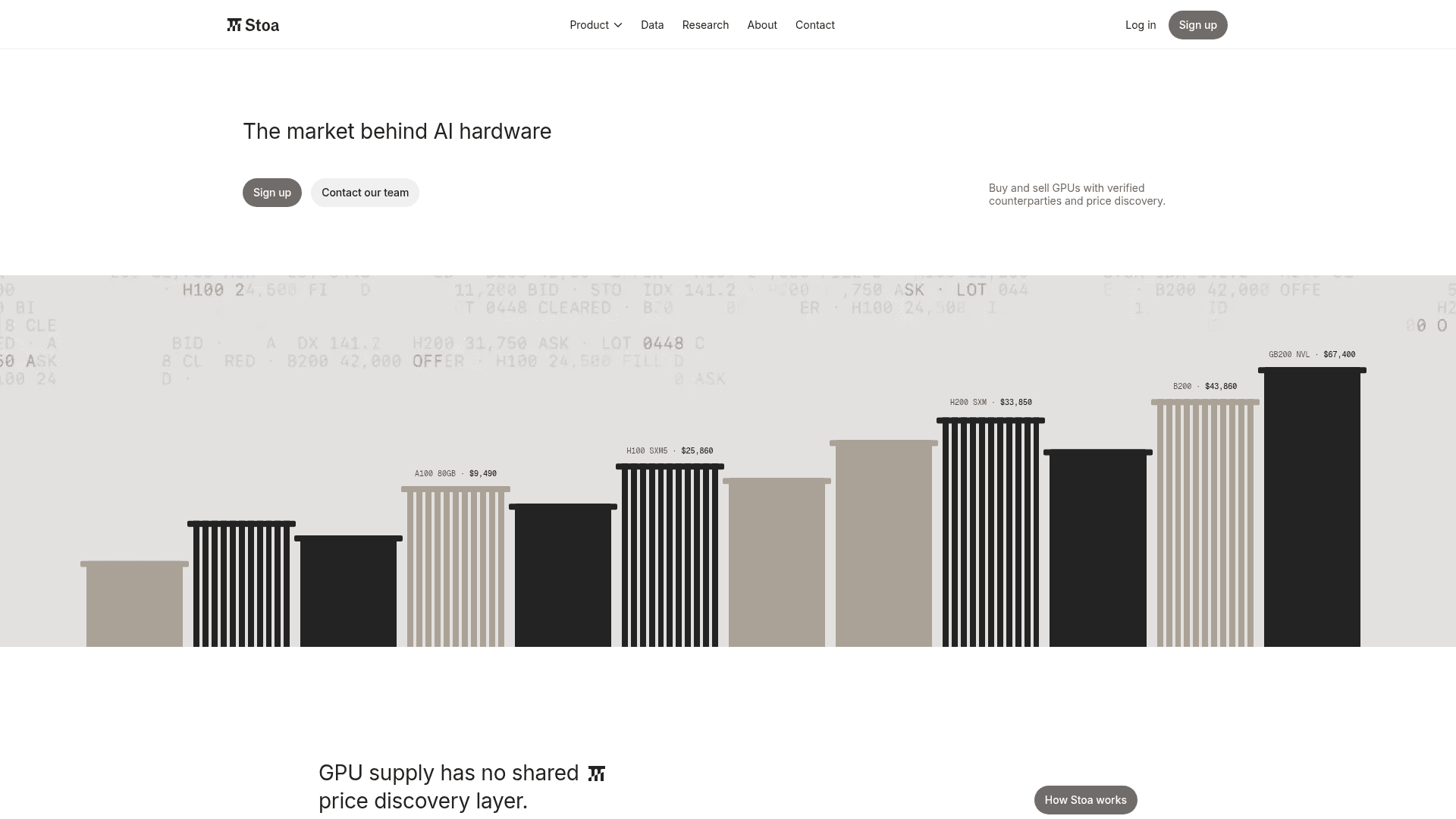
Stoa is a neutral trading venue that connects GPU buyers and sellers — including data center operators, hardware dealers, AI labs, cloud providers, OEMs, resellers, lenders, and funds — through a structured request-for-quote (RFQ) workflow. Rather than replacing bilateral relationships, Stoa adds a shared market layer: verified counterparties, firm quotes, contextual clearing prices, and a recorded settlement timeline. The platform covers current-generation NVIDIA accelerators such as the H100, H200, B200, A100, and related servers and clusters, across new, refurbished, and used conditions.
How the RFQ Workflow Works
Stoa routes every transaction through four explicit steps:
- Describe the trade — buyers describe hardware in plain language or attach a quote PDF; AI drafts the RFQ while the buyer controls every field.
- Review and send — terms, delivery, and deadlines are made explicit before anything goes out; accepting a quote creates a binding trade.
- Execute at a firm price — verified dealers respond with firm quotes; accepting one locks in grade, condition, and verification expectations.
- Settle step by step — settlement runs on a recorded timeline (confirmed → payment → shipped → delivered → inspected → settled), with evidence required at each stage and payment held until delivery is confirmed.
The Price Discovery Problem It Solves
GPU supply is fragmented across OEM allocations, cloud capacity, brokers, operators, and secondary sellers, each exposing a different slice of the market. Clearing prices depend on SKU, delivery timing, region, quantity, condition, financing, and urgency — context that rarely travels with a price. Stoa's position is that buyers and sellers currently rely on private quotes, stale lists, and partial broker color, and that a shared venue can surface clearing levels that reflect the full context of a transaction.
Who It Serves
Access is by application and limited to institutions acting in a commercial capacity. Stoa applies know-your-business (KYB) checks to confirm institutional status. The platform explicitly targets:
- GPU brokers and dealers seeking verified demand and clearing-level visibility
- Data center operators selling surplus or planning fleet rotations
- AI labs and enterprises comparing offers by SKU and region
- Cloud providers and neoclouds acquiring or placing excess capacity
- OEMs, VARs, and systems integrators routing allocation and secondary supply
- Resellers and liquidators moving used or refurbished hardware to verified buyers
- Lenders and lessors evaluating collateral and liquidation paths
- Funds and capital partners underwriting GPU-backed trades
Market Structure and Trust Model
Stoa positions itself as a neutral venue — it charges a platform fee on completed transactions and is not a party to any trade. It does not take custody of hardware. The platform's stated value proposition against off-market trading is the combination of verified counterparties, firm (not indicative) quotes, payment held until delivery confirms, and clean records from RFQ through delivery. The about page frames GPUs as "becoming balance-sheet assets before the market around them has fully formed," and describes Stoa's role as capturing market context at the point of trade to support liquidity, financing, and reference pricing for AI hardware.
Community Discussions
Be the first to start a conversation about Stoa Exchange
Share your experience with Stoa Exchange, ask questions, or help others learn from your insights.
Pricing
Platform Fee
Stoa charges a platform fee on completed GPU transactions. Access is by application for institutional participants only.
- Verified counterparty access
- RFQ workflow
- Firm quotes from verified dealers
- Structured settlement timeline
- Payment held until delivery confirmed
- KYB-verified institutional participants
Capabilities
Key Features
- Request-for-quote (RFQ) workflow for GPU transactions
- Verified counterparty onboarding with KYB checks
- Firm quotes from verified dealers
- Contextual price discovery by SKU, condition, region, and timing
- AI-assisted RFQ drafting from plain language or PDF
- Structured settlement timeline with evidence requirements
- Payment held until delivery confirmed
- Coverage of NVIDIA H100, H200, B200, A100, and related servers
- Support for new, refurbished, and used hardware conditions
- Market data and research products
- Institutional-only access by application