
Tambo AI
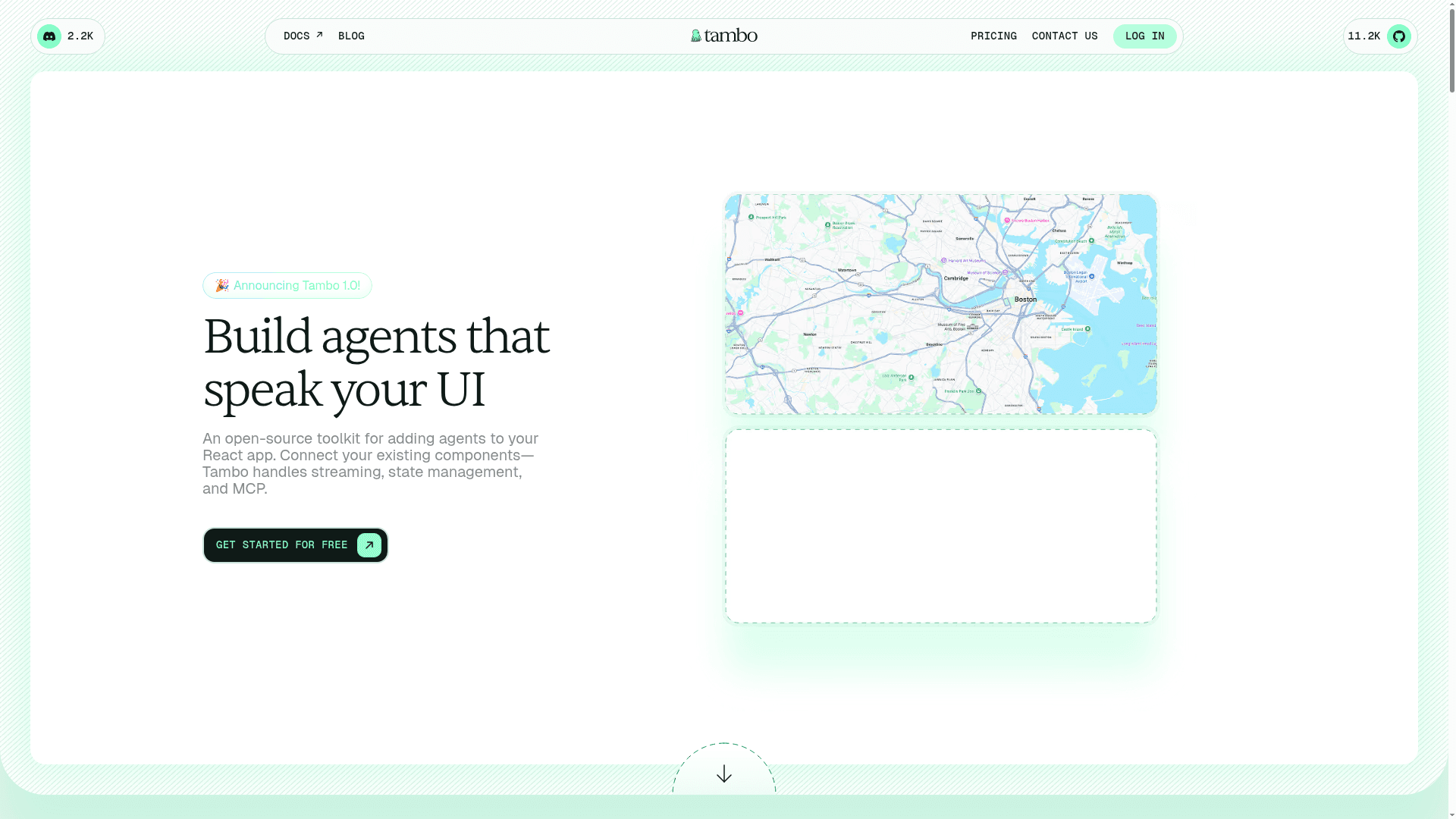
An open-source generative UI toolkit for React that lets you build AI agents that render and stream your own components based on user intent.
At a Glance
Free to use, modify, and distribute under the MIT License. Self-host the backend on your own infrastructure.
Engagement
Available On
Alternatives
Listed May 2026
About Tambo AI
Tambo is an open-source React toolkit for building agents that render UI — also known as generative UI. You register your React components with Zod schemas, and Tambo's agent picks the right component and streams props to it in real time, so users can interact with dynamic, AI-driven interfaces. It ships with a hosted backend (Tambo Cloud) or a self-hostable option via Docker, and supports MCP, multiple LLM providers, and persistent stateful components out of the box.
- Generative Components — Register components with Zod schemas; the agent selects and streams props to render charts, summaries, and data visualizations automatically.
- Interactable Components — Use
withInteractableto create persistent, updatable components like task boards, shopping carts, and spreadsheets that respond to user refinements. - Streaming Infrastructure — Props stream to components as the LLM generates them; cancellation, error recovery, and reconnection are handled automatically.
- MCP Integration — Connect to Linear, Slack, databases, or custom MCP servers using the full MCP protocol including tools, prompts, elicitations, and sampling.
- Local Tools — Define browser-side functions (DOM manipulation, authenticated fetches, React state access) that the AI can call as tools.
- Multi-Provider LLM Support — Works with OpenAI, Anthropic, Google Gemini, Mistral, Cerebras, and any OpenAI-compatible provider.
- Tambo Cloud or Self-Host — Cloud is a hosted backend free to start with credits; self-hosted runs the same backend on your own infrastructure via Docker.
- Context, Auth & Suggestions — Pass user state, app settings, and OAuth tokens as context; generate clickable prompt suggestions based on what users are doing.
- Pre-built Component Library — Access agent and generative UI primitives at ui.tambo.co, plus starter templates for chat interfaces and analytics dashboards.
- Get Started in 5 Minutes — Run
npm create tambo-app my-tambo-app, wrap your app withTamboProvider, register components, and start building.
Community Discussions
Be the first to start a conversation about Tambo AI
Share your experience with Tambo AI, ask questions, or help others learn from your insights.
Pricing
Open Source (MIT)
Free to use, modify, and distribute under the MIT License. Self-host the backend on your own infrastructure.
- Full React SDK (MIT license)
- Self-hostable backend via Docker
- Generative and interactable components
- MCP protocol support
- Multi-LLM provider support
Tambo Cloud Free
Hosted backend free to get started with credits included.
- Hosted conversation state management
- Agent orchestration
- Streaming infrastructure
- Free credits to start building
Capabilities
Key Features
- Generative UI component rendering
- Streaming props to React components
- Interactable persistent components
- MCP protocol support (tools, prompts, elicitations, sampling)
- Local browser-side tool execution
- Multi-LLM provider support (OpenAI, Anthropic, Gemini, Mistral, Cerebras)
- Tambo Cloud hosted backend
- Self-hosted Docker backend
- Zod schema-based component registration
- Conversation state management
- User authentication via userKey or userToken
- Context helpers for passing app metadata to AI
- AI-generated prompt suggestions
- Pre-built component library (ui.tambo.co)
- Starter templates (chat, analytics dashboard)
- Agent framework compatibility (LangChain, Mastra)