
TensorRT LLM
Open-source NVIDIA library that optimizes LLM and visual generation inference on NVIDIA GPUs with custom kernels, an efficient runtime, and a PyTorch-based Python API.
At a Glance
Self-hosted TensorRT LLM core library released under the Apache 2.0 license.
Engagement
Available On
Listed Oct 2026
About TensorRT LLM
TensorRT LLM is an open-source library from NVIDIA for optimizing LLM and Visual Generation model inference on NVIDIA GPUs. It combines custom kernels for common operations, runtime optimizations, and a PyTorch-based Python LLM API. The documentation site lists 1.4.0rc0 as the current docs version, and the repository README shows release 1.4.0rc1.
What It Is
TensorRT LLM is an inference optimization and serving library. The README says it provides custom kernels for operations such as attention, GEMMs, and MoE, plus runtime optimizations including prefill-decode disaggregation, Wide Expert Parallelism, and speculative decoding. Its high-level Python LLM API supports setups from a single GPU to multi-GPU and multi-node deployments. Its PyTorch-native architecture is designed to be modular and easy to modify, and several popular models are predefined and can be customized with native PyTorch code.
Workflow and Tooling
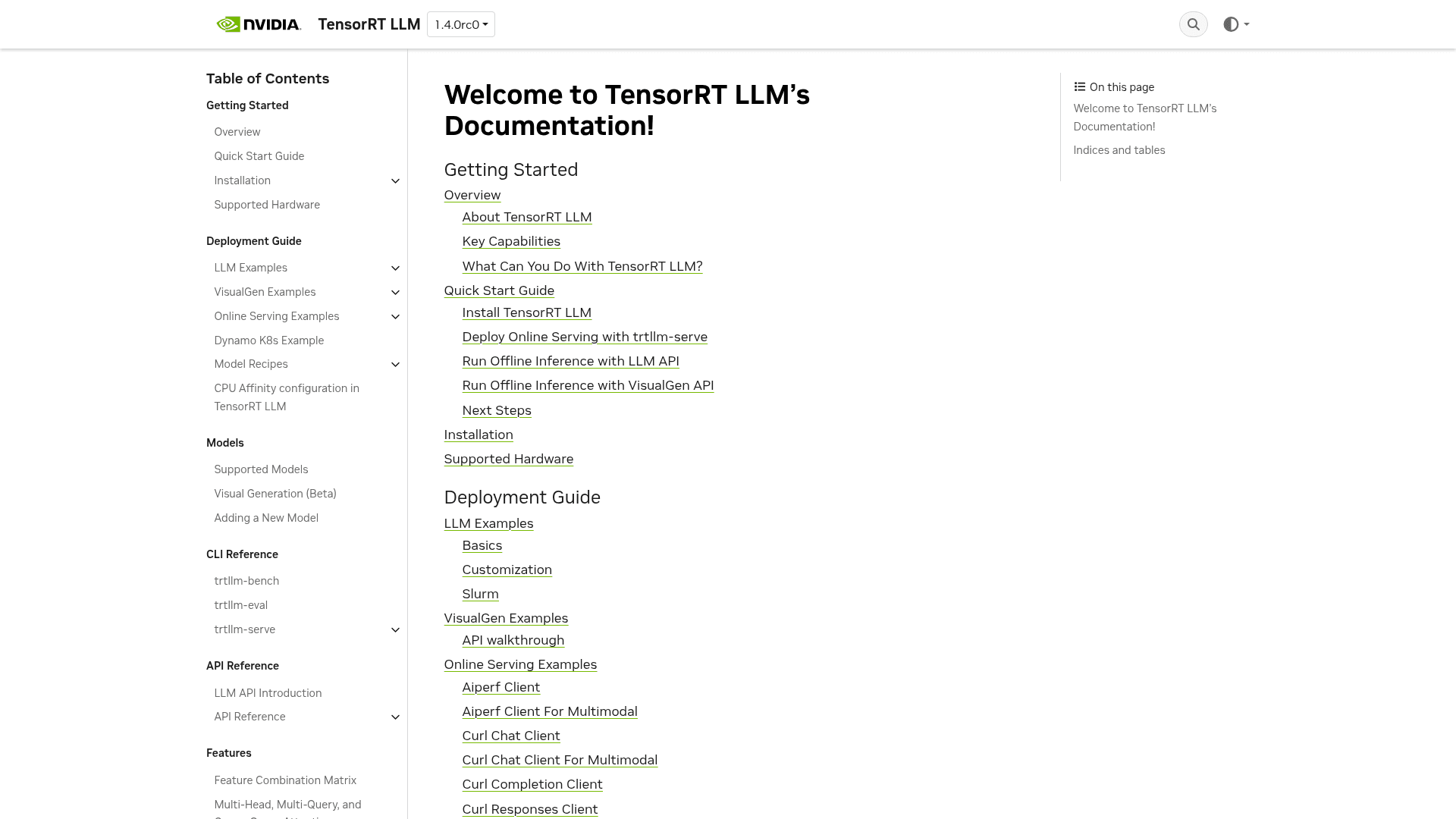
The documentation describes several ways to run models:
- Online serving with
trtllm-serve, with client examples for OpenAI-style chat, completion, and responses endpoints, plus multimodal and LoRA examples. - Offline inference through the LLM API, and through a VisualGen API for visual generation.
trtllm-benchfor benchmarking andtrtllm-evalfor evaluation.- Slurm examples for multi-node runs.
- Installation through pip, container images, or building from source.
The README states that the LLM API integrates with the wider inference ecosystem, including NVIDIA Dynamo and Triton Inference Server.
Performance and Serving Features
Documented features include in-flight batching with paged attention, KV cache reuse, compression, offloading and connectors, quantization, speculative decoding, guided decoding, LoRA, sparse attention, long-sequence support, and multiple parallelism strategies such as Helix parallelism. The docs also cover disaggregated serving, sub-agent routing, embeddings for encoder-only models, multimodal support, and a Ray orchestrator marked as a prototype. Model recipes cover models such as Nemotron, GPT-OSS, and Qwen3. Visual generation support is labeled Beta in the docs.
Telemetry and Licensing
The README says anonymous telemetry is collected by default and can be disabled with environment variables, a file, a Python API setting, or a CLI flag. The project is licensed under Apache 2.0, with some bundled third-party components under other licenses.
Community Discussions
Be the first to start a conversation about TensorRT LLM
Share your experience with TensorRT LLM, ask questions, or help others learn from your insights.
Pricing
Open Source (Apache 2.0)
Self-hosted TensorRT LLM core library released under the Apache 2.0 license.
- Licensed under Apache 2.0
- Some portions derive from other open source projects with different licenses (MIT, BSD 3-Clause)
- LTX-2 Community License Agreement applies only to code in tensorrt_llm/_torch/visual_gen/models/ltx2/
- Python API, C++ and Python runtimes for LLM inference on NVIDIA GPUs
Capabilities
Key Features
- Custom kernels for attention, GEMMs, and MoE
- Python LLM API for single-GPU to multi-node inference
- trtllm-serve online serving with OpenAI-style endpoints
- trtllm-bench benchmarking and trtllm-eval evaluation CLIs
- In-flight batching with paged attention
- KV cache reuse, compression, offloading, and connectors
- Quantization support
- Speculative decoding
- Guided decoding
- LoRA adapter support
- Sparse attention
- Disaggregated serving
- Multiple parallelism strategies including Wide Expert Parallelism and Helix
- Multimodal support
- Visual generation (Beta)
- Embeddings for encoder-only models
- Prometheus metrics