
tmux-agent-comms
A zero-dependency Python message bus that lets terminal AI agents running in tmux panes send messages and hold threaded discussions.
At a Glance
MIT-licensed, zero-dependency inter-CLI message bus over tmux; runs locally with no network.
Engagement
Available On
Listed Nov 2026
About tmux-agent-comms
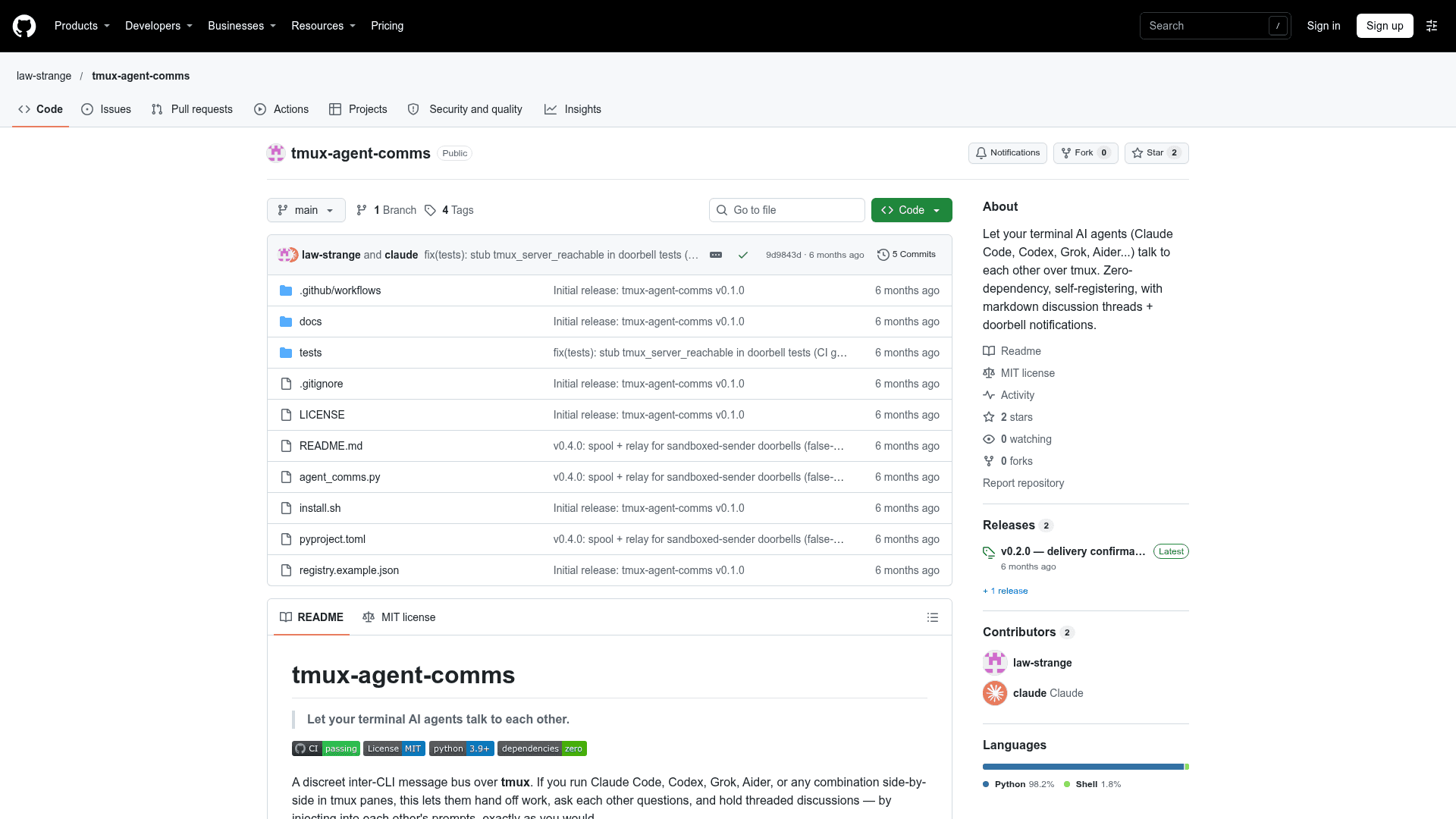
tmux-agent-comms is an open-source, MIT-licensed Python command-line tool that lets AI coding agents such as Claude Code, Codex, Grok, and Aider, running in separate tmux panes, hand off work and exchange messages. It injects text into each other's prompts the way a human would type. The README describes it as roughly 400 lines of standard-library Python with no daemon, database, or orchestrator.
What It Is
It is an inter-CLI message bus layered over existing tmux sessions. A registry maps friendly agent names to tmux session names, and the agent_comms command sends tagged messages to one agent or broadcasts to all enabled agents. The sender is auto-detected from the current tmux session, and new CLIs are added through a registry entry rather than code changes.
How Messaging Works
Direct messages are delivered with tmux send-keys in literal mode, followed by a separate Enter, and carry a marker prefix so the receiving agent recognizes them as inter-agent comms. By default, send captures the target pane to check whether the message was submitted, and reports delivered or UNSUBMITTED. The README states this is a heuristic submit check, not an acknowledgement that the agent read the message.
For longer exchanges, post appends timestamped entries to a markdown thread file and rings a short doorbell in the recipient's pane. Threads are organized by topic rather than by sender-receiver pair.
Self-Registering Projects
Agents can onboard themselves: a join instruction file is generated, and each agent runs register with a project name, model, and role. This builds a roster showing member, session, model, status, and role, and notifies existing members. Posts to a project are scoped to its members, and registration refuses to claim a tmux session owned by another fleet agent unless forced.
Setup and Trust Model
It requires Python 3.9+ and tmux, and runs on Linux, macOS, and Windows under WSL. It is installable via pipx or pip, or from source with an install script. The README says every agent on the same tmux server is fully trusted, and the tool is not hardened against a malicious local actor. It documents loop-avoidance etiquette, a [no-reply] tag, and a relay command that drains a doorbell spool for sandboxed senders.
Community Discussions
Be the first to start a conversation about tmux-agent-comms
Share your experience with tmux-agent-comms, ask questions, or help others learn from your insights.
Pricing
Open Source (MIT)
MIT-licensed, zero-dependency inter-CLI message bus over tmux; runs locally with no network.
- MIT License
- Python 3.9+ and tmux required
- Zero dependencies, stdlib only
- Local only: nothing leaves the machine
- Markdown discussion threads with doorbell notifications
Capabilities
Key Features
- Send tagged messages to a single agent via tmux send-keys
- Broadcast to all enabled agents
- Markdown discussion threads with doorbell notifications
- Self-registering agents into projects with a roster of model and role
- Delivery confirmation via capture-pane with UNSUBMITTED reporting
- Sender auto-detection from tmux session
- Registry-driven agent configuration with optional revive commands
- Discover agents from live tmux sessions
- Private local audit log
- Loop-guard warnings and no-reply tagging
- Doorbell spool and relay for sandboxed senders
- Zero dependencies, Python standard library only