
Agent-to-agent messaging CLI that lets Claude Code and Codex sessions send messages to each other by name without typing into terminals.
At a Glance
peer is MIT-licensed, free to use, copy, modify and distribute. Requires Python 3.9+; tmux optional.
Engagement
Available On
Alternatives
Listed Nov 2026
About peer
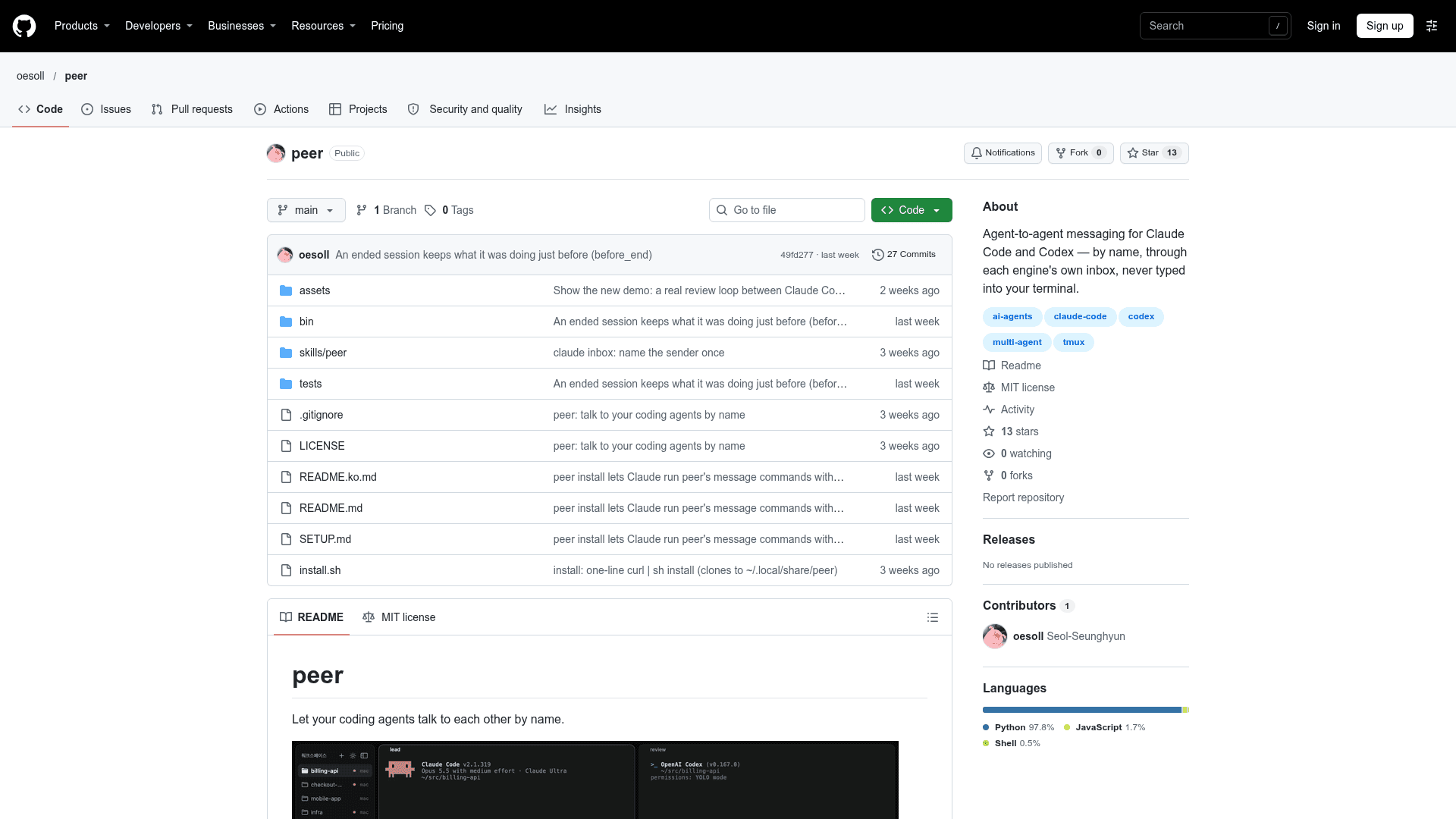
peer is an open-source command-line tool from oesoll that lets Claude Code and Codex sessions message each other by name. Instead of typing into another terminal, it hands each message to the engine's own input path and reports whether it arrived. It is MIT licensed and not affiliated with Anthropic or OpenAI.
What It Is
peer is a messaging layer for people running several coding-agent sessions side by side. Running peer lists nearby sessions with real states such as working, blocked, idle, and waiting-on(name). peer say sends a message and peer ask waits up to 60 seconds for a reply. Replies appear in the sender's own conversation as [from name@host] ....
How Delivery Works
For Claude Code, peer uses its built-in cross-session inbox, which reaches running sessions whether idle or busy. For Codex, it uses the app-server's turn/start and turn/steer, for sessions started with peer run codex. This avoids screen-scraping problems such as an Enter keypress landing on an approval prompt or a message colliding with a half-typed draft. Messages to an agent waiting on its user are held and delivered once it is free. If a recipient's turn fails, for example from a rate limit, peer tells the sender why.
Multi-Machine and Setup
Other machines can be reached over ssh via a hosts.json file, through a relay hub with signed requests for machines that accept no ssh logins, or on the same network using peer pair and peer serve with TLS. Paired machines can only exchange messages, read recent answers, and post notices. Installation uses a curl script or an agent-driven SETUP.md, and needs Python 3.9+. tmux adds peer spawn and nearby-first listing. peer doctor reports what works and what is missing.
Tradeoffs to Know
The README notes that Claude's cross-session inbox is not a public API, so a Claude Code update can break the fast path, though peer falls back to hooks. Codex sessions are reachable only when started through peer, and Codex support is described as newer and less tested. Delivering to an idle Claude immediately requires the --accept-inbound setting, which the README says should be a deliberate choice.
Community Discussions
Be the first to start a conversation about peer
Share your experience with peer, ask questions, or help others learn from your insights.
Pricing
Open Source (MIT)
peer is MIT-licensed, free to use, copy, modify and distribute. Requires Python 3.9+; tmux optional.
- MIT License
- Agent-to-agent messaging for Claude Code and Codex
- Cross-machine messaging via ssh, relay or pairing
- Requires Python 3.9+; tmux optional for peer spawn
Capabilities
Key Features
- Send messages between agent sessions by name with peer say
- Ask and wait up to 60s for a reply with peer ask
- Real session states: working, blocked, idle, waiting-on(name)
- Delivery receipts showing whether a message arrived
- Read an agent's recent answers from engine history with peer read
- Spawn agents via tmux or sm with peer spawn
- Cross-machine messaging over ssh, relay hub, or paired TLS on same network
- Failure reporting to sender when a recipient's turn errors
- Custom launcher configuration
- Bundled agent skill and install hooks