
Toolport
A free, open-source local MCP gateway that lets every AI agent share one set of MCP servers with up to 91% fewer tokens via lazy tool discovery.
At a Glance
About Toolport
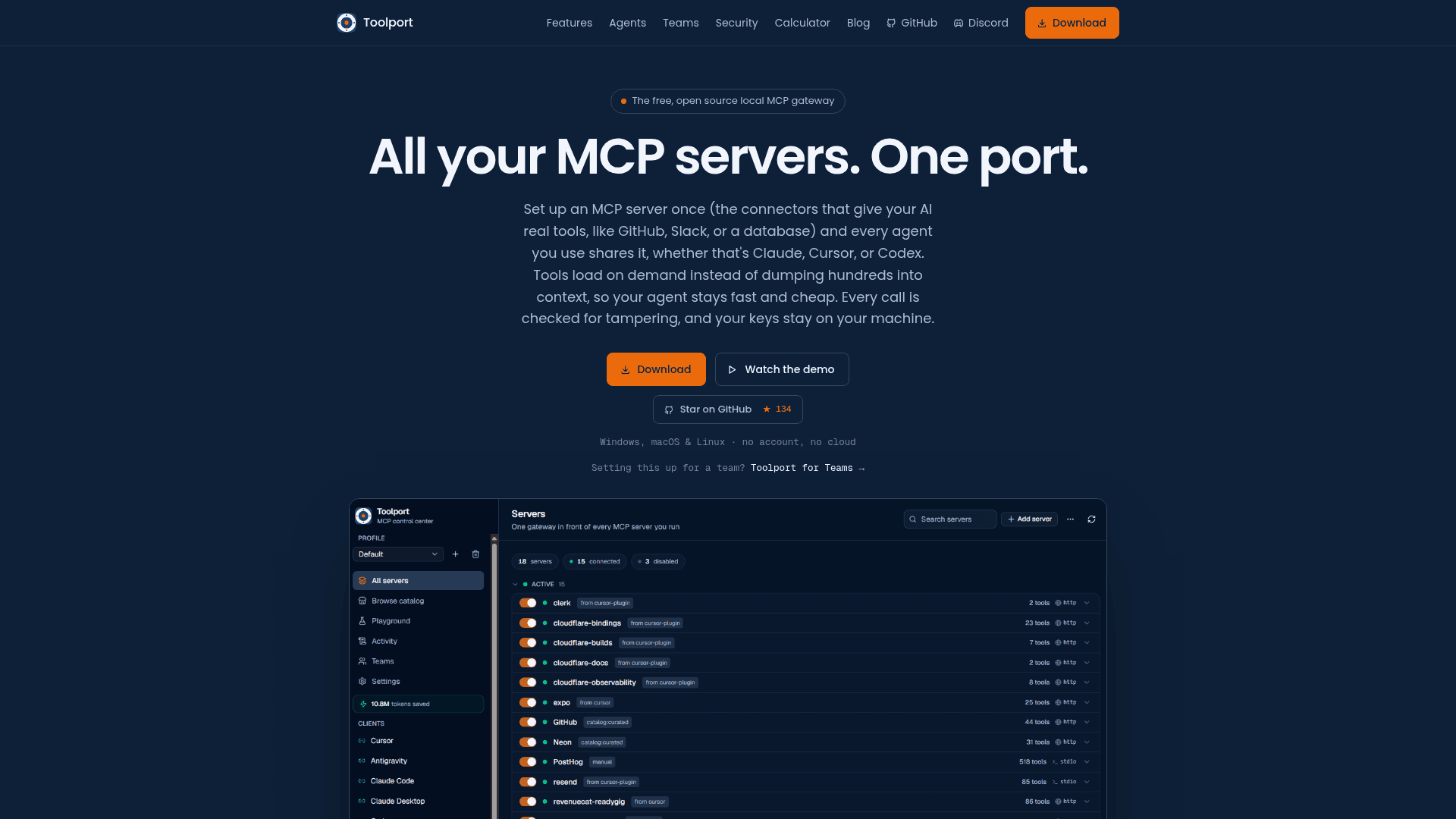
Toolport (previously named Conduit) is a free, open-source (MIT) local MCP gateway built by South Forge AI. It lets you configure each MCP server once and share it across every AI agent you use—Claude, Cursor, VS Code, Codex, Windsurf, and 29 more—without repeating setup or pasting API keys into each app. The desktop app is built with Tauri and React, the gateway binary is written in Rust, and the project has 134 stars and 49 forks on GitHub as of August 2026.
What It Is
Toolport sits between your AI clients and your MCP servers as a local gateway. Instead of each agent loading the full tool list from every connected server on every request—which the project benchmarks at ~24,000 tokens for just three servers—Toolport exposes a handful of compact meta-tools (toolport_search_tools, toolport_call_tool, etc.) that the agent searches on demand. The project reports up to 91% fewer total tokens at the same task success rate, graded for correct answers, and 96% less tool-definition overhead per request, rising to 99.5% on a 415-tool catalog (see the published BENCHMARK.md).
How Lazy Discovery Works
The core mechanism is what Toolport calls "lazy discovery." Rather than dumping every downstream tool into context, the gateway advertises four compact meta-tools. When an agent needs a capability, it calls toolport_search_tools with an intent, and the gateway returns only the relevant tools from whichever servers are enabled. Tool names are namespaced per server (e.g., stripe__list_charges) so they never collide across servers. Optional semantic re-ranking via a local or hosted embeddings endpoint (LM Studio, Ollama, or a cloud provider) can surface paraphrased queries; it is off by default, with pure lexical ranking otherwise.
Security Architecture
Because Toolport sits on the path between agents and servers, it enforces several security controls entirely locally:
- Tool integrity (rug-pull + poisoning detection): Toolport fingerprints each tool at connection time and flags definition changes or hidden injection-like content in descriptions.
- Content defense (anti-agentjacking): When a tool returns untrusted content carrying injection-like instructions, Toolport flags it and marks it as external data rather than agent instructions.
- Human-in-the-loop approvals: Destructive tool calls can be paused for explicit approval in the app, with an OS notification. Deny actually blocks the call.
- Secrets in the OS keychain: API keys are stored in the OS keychain and injected at runtime; they never appear in client config files or the cloud.
- Per-tool governance: Any individual tool or all destructive tools can be toggled off fleet-wide with a single switch.
Supported Clients and Deployment
Toolport auto-detects and configures 33 AI clients, writing the correct config format (JSON, TOML, YAML, JSONC) for each. Supported clients include Claude Desktop, Claude Code, Cursor, VS Code, Windsurf, Codex, Copilot CLI, Cline, Roo Code, Warp, Amazon Q, Zed, LM Studio, Goose, and more. The gateway also speaks HTTP/OpenAPI natively, so Open WebUI, n8n, LibreChat, and custom agents can connect over HTTP instead of stdio. A prebuilt Docker image (ghcr.io/tsouth89/toolport-gateway:latest) supports headless and container deployments.
Installation is available via Homebrew on macOS, a shell script for macOS/Linux, .deb and AppImage packages for Linux, and a signed .exe installer for Windows. Both Windows and macOS installers are code-signed; macOS is also notarized.
Update: v1.11.0
The latest release is Toolport v1.11.0, published on August 1, 2026. The repository was last pushed on August 8, 2026, indicating active development. The project follows an open-core model: the desktop app and toolport-gateway are MIT-licensed and free forever, while Toolport for Teams (a shared, governed server set for organizations) is the commercial layer that funds the free app. Teams can be hosted by Toolport or self-hosted via Docker in about 15 minutes.
Community Discussions
Be the first to start a conversation about Toolport
Share your experience with Toolport, ask questions, or help others learn from your insights.
Pricing
Free (Desktop App)
The open-source desktop app and gateway, free forever with no account required.
- Local MCP gateway for all AI agents
- Lazy tool discovery (up to 91% fewer tokens)
- One-time server setup shared across 33 AI clients
- Tool integrity checks
- Human-in-the-loop approvals
Free
Toolport for Teams free tier: share one MCP server set across up to 5 people.
- Up to 5 people
- One shared MCP server set synced to everyone
- Each person's keys stay on their own machine
- Safety policy: destructive-tool gate + injection screening
- One signed security-alert webhook channel
Team
Toolport for Teams with access control, roles, rate limits, full audit, and webhooks. Up to 5 people base, then $12/person.
- Everything in Free
- Per-server access control (who can see which servers)
- Per-tool allow-lists and deny-lists on shared servers
- Roles: admin, billing, auditor, viewer
- Tool-call rate limits (day/month; team, member, group, or tool)
- Spend budgets with over-budget email alerts
- Policy coverage receipts
- Full audit trail, opt-in per-call export, config version history
- HMAC-signed webhooks (Slack, Discord, MS Teams, generic) + API tokens for CI
- Dashboard TOTP two-factor authentication
- 14-day free trial, no card required
Enterprise
For scale, compliance, and identity. Scoped with you before commitment.
- Everything in Team
- SSO with SAML or OIDC, plus SCIM provisioning (roadmap)
- Audit streaming to SIEM (Splunk, Datadog, S3)
- Dedicated or on-prem managed deployment
- DPA, security review, and data-residency review
- SLA and priority support
Capabilities
Key Features
- Local MCP gateway for all AI agents
- Lazy tool discovery (up to 91% fewer tokens)
- One-time server setup shared across 33 AI clients
- Tool integrity checks (rug-pull and poisoning detection)
- Content defense against indirect prompt injection
- Human-in-the-loop approval queue for destructive calls
- Secrets stored in OS keychain, never in config files
- Per-tool and per-server governance toggles
- Live observability: per-server latency, error rates, audit trail
- HTTP/OpenAPI endpoint for Open WebUI and custom agents
- Docker/headless gateway support
- Optional semantic search via embeddings endpoint
- Per-agent scoping with profiles
- Built-in tool playground
- Import existing MCP configs from any supported client
- Curated catalog of 40+ popular MCP servers
- Toolport for Teams: shared governed server set for organizations
- Self-hostable Teams server via Docker