
Toolroll
Open-source control plane that lets you delegate work to Claude Code, Codex and Gemini agents on your own machine and review results as diffs before accepting.
At a Glance
MIT-licensed Toolroll core, self-hosted on your own machine. Agents use your own Claude/Codex/Gemini subscriptions or API keys, which are external costs.
Engagement
Available On
Listed Nov 2026
About Toolroll
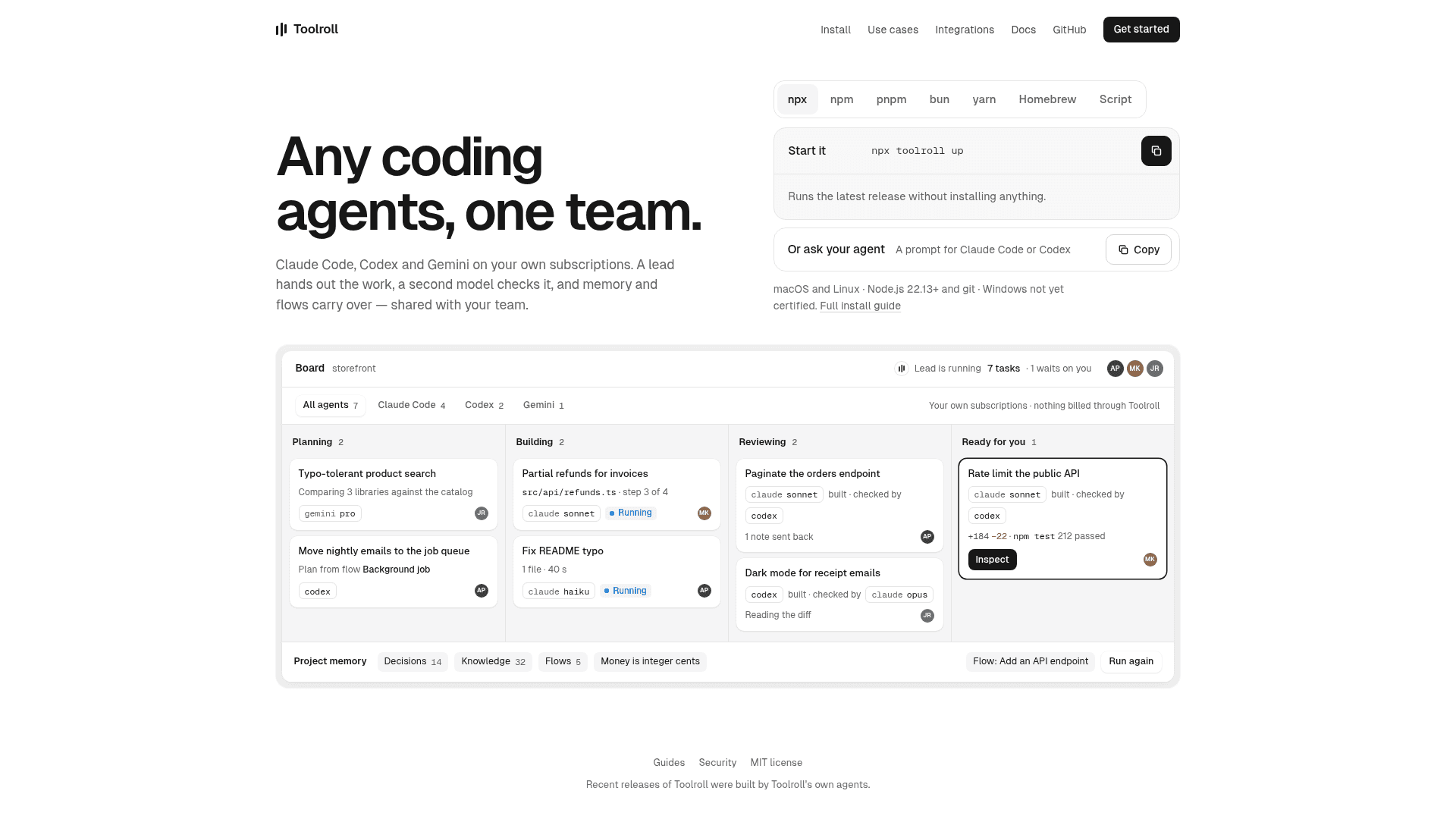
Toolroll is an open-source (MIT) control plane for coding agents, published by Aleksey Pelletier under the ap9000 GitHub account. It coordinates Claude Code, Codex and Gemini running on your own subscriptions: you approve the scope once, agents build on their own branches, and results come back marked Ready with the diff and check status. It runs from the terminal, with a browser console as an alternative.
What It Is
Toolroll is a task-delegation and review layer that sits above existing coding agents. You describe a change in a terminal workbench, choose Just code or Plan first, and review any proposed build terms before work starts. Agents work on separate branches, ask you questions when a judgement call comes up, and return a result for you to accept or send back for revision. The README states that data is kept in a single SQLite file on your disk.
How the Workflow Runs
Approval binds to the exact goal, bounds, criteria, agent and model. Ready results show the diff and the actual status of the project's configured check, and merging requires that check to pass on the exact result. The homepage describes a lead agent handing out work and a second model checking it. Models can be routed per phase across Claude Code, Codex, Gemini and OpenRouter.
Flows, Surfaces and Team Use
Flows let triggers such as schedules, GitHub, Linear, webhooks, email and chat start work, including AI triage of incoming issues. Plans, questions and results can be answered from Telegram, Slack, Discord or Teams, and the tool is also reachable by CLI and MCP. A team server supports OpenID Connect sign-in, per-person API tokens and project grants, with actions recorded in a hash-chained ledger.
Safety and Setup
Agents run inside an OS-level fence built on Anthropic's sandbox-runtime and Codex's sandbox, with per-scope network and write rules and keychain-sealed secrets. Setup targets macOS or Linux with Node.js and git, and Claude Code or Codex signed in locally; installation is available via npm, Homebrew or a shell script. Every command supports --json output for agent-driven use.
Community Discussions
Be the first to start a conversation about Toolroll
Share your experience with Toolroll, ask questions, or help others learn from your insights.
Pricing
Open Source
MIT-licensed Toolroll core, self-hosted on your own machine. Agents use your own Claude/Codex/Gemini subscriptions or API keys, which are external costs.
- MIT license
- Runs on your own machine; data stored in one SQLite file
- Claude Code, Codex, Gemini and OpenRouter agents
- Web console, CLI, Telegram, Slack, Discord, Teams, MCP
- Flows, team server, audit ledger and spend tracking
Capabilities
Key Features
- Digest-bound scope approvals
- Plan first or Just code task modes
- Agents work on separate git branches
- Ready results with diff and check status
- Per-phase model routing across Claude Code, Codex, Gemini and OpenRouter
- Flows with schedule, GitHub, Linear, webhook, email and chat triggers
- Telegram, Slack, Discord and Teams approvals
- Team server with OpenID Connect and per-person API tokens
- Hash-chained audit ledger
- Sandboxed agent fence
- Spend tracking by project, model, role and person
- Web console, terminal workbench and MCP access
- JSON output for every command