ToolUniverse
Open ecosystem of 1,000+ scientific tools and skills that lets any LLM act as an AI scientist via MCP, a Python SDK and a CLI.
At a Glance
About ToolUniverse
ToolUniverse is an open-source academic research project from the Zitnik Lab at Harvard Medical School, developed with MIT and other institutions. It gives LLM-based agents a standardized way to discover and call more than 1,000 scientific tools, including machine learning models, databases, APIs and scientific packages. It is available through an MCP server, a Python SDK and the tu command line interface.
What It Is
ToolUniverse is an ecosystem for building AI scientist systems on top of any large language model. Its AI-Tool Interaction Protocol standardizes how an LLM identifies tools, issues requests and receives results, so every tool is called with the same structure and returns consistent JSON. Tools cover data analysis, knowledge retrieval and experimental design across life science domains such as drug discovery, genomics, cheminformatics, clinical research and proteomics. The tool catalog is organized by type: API, Database, ML Model, Scientific Software Package, AI Agent, MCP and Compositional Tool.
How the Workflow Runs
A user can ask a question in natural language, for example about protein interaction partners or drugs for a target, and the agent selects tools to query live sources such as UniProt, PDB, NCBI and FDA data. Python developers load tools with ToolUniverse(), find tools with keyword, LLM or semantic Tool Finder, and run any tool with a name and arguments. Compact mode reduces the 1,000+ tools to a handful of discovery tools to save context window. Tools can be chained for sequential or parallel execution, long-running tasks run asynchronously, and results are cached in memory and in SQLite.
Agent Setup and Skills
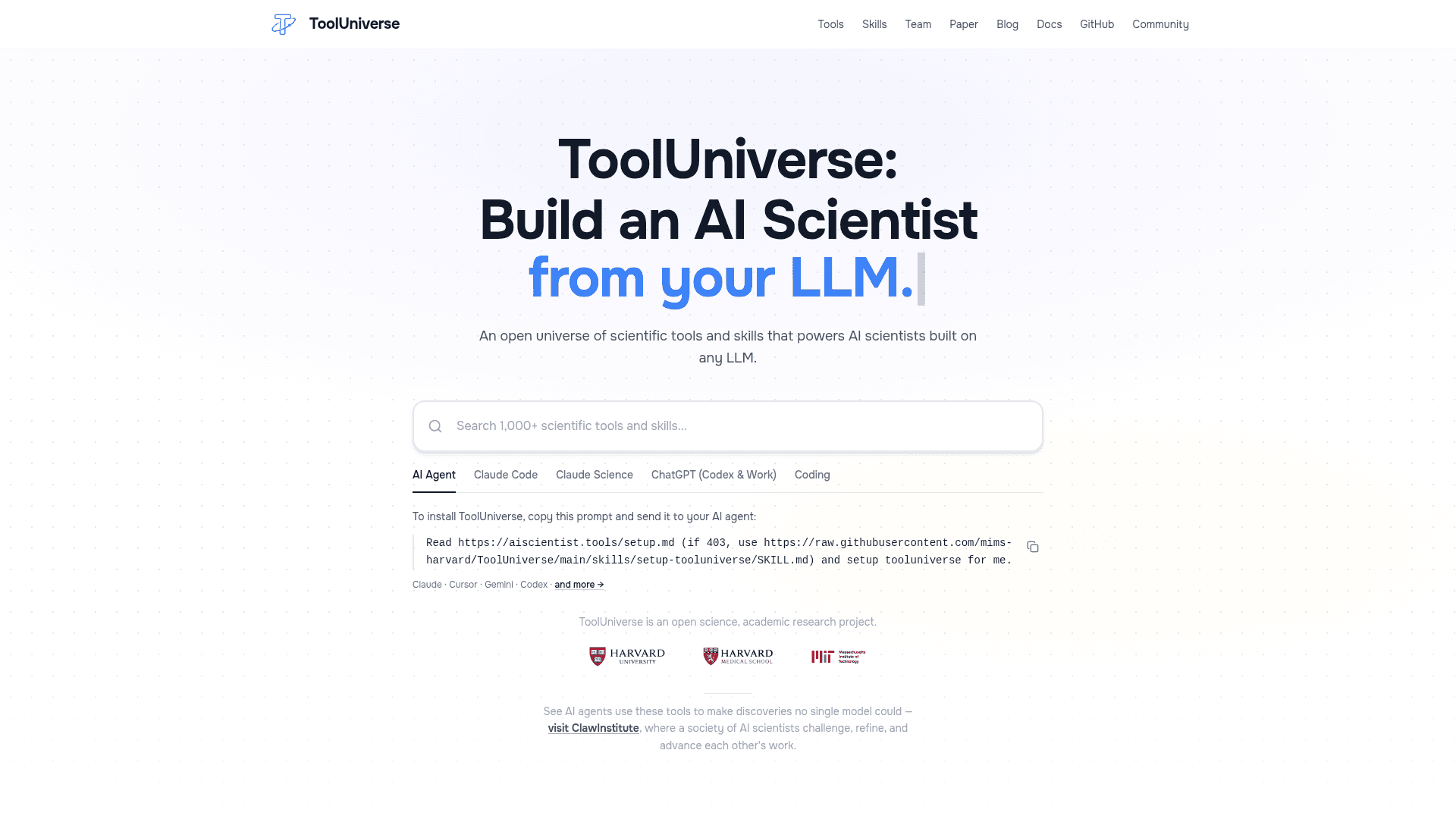
The recommended install is to tell an AI agent to read the setup guide, which configures MCP, API keys, skills and validation. Dedicated install paths exist for Claude Code and Codex plugins and for Claude Science. Documented integrations include Claude Desktop, Claude Code, Gemini CLI, Qwen Code, GPT Codex CLI and the ChatGPT API. The README lists 68 pre-built research workflows for areas such as drug discovery, precision oncology, rare disease diagnosis and pharmacovigilance. A Workflow Lab on the website offers guided case studies such as statin optimization.
Requirements and Privacy
The Python package needs Python 3.10 or newer, and Apple Silicon Macs need macOS 14 or newer. Optional extras add local ML, cheminformatics and plotting tools. According to its privacy policy, ToolUniverse runs locally with no telemetry, and tool arguments are sent only to the relevant data provider. The project is released under the Apache License 2.0.
Community Discussions
Be the first to start a conversation about ToolUniverse
Share your experience with ToolUniverse, ask questions, or help others learn from your insights.
Pricing
Open Source (Apache-2.0)
ToolUniverse core is released under the Apache License 2.0 and can be installed and run locally at no cost.
- Apache License 2.0 (OSI-approved)
- Runs locally; no telemetry or analytics collected
- Install via pip, uvx MCP config, or Claude Code plugin
- 1000+ tools, CLI (tu), Python SDK, MCP server
- Third-party data providers or LLM/API keys may carry their own costs
Capabilities
Key Features
- AI-Tool Interaction Protocol
- 1,000+ scientific tools, models, databases and APIs
- Native MCP server
- Python SDK
- tu CLI
- Tool Finder (keyword, LLM, semantic)
- Compact mode
- Tool composition
- Async long-running operations
- Two-tier result caching
- 68 pre-built agent skills
- Unified literature search
- Workflow Lab
- Register custom tools locally or remotely
Integrations
Demo Video