
Transformers - The Definitive Guide
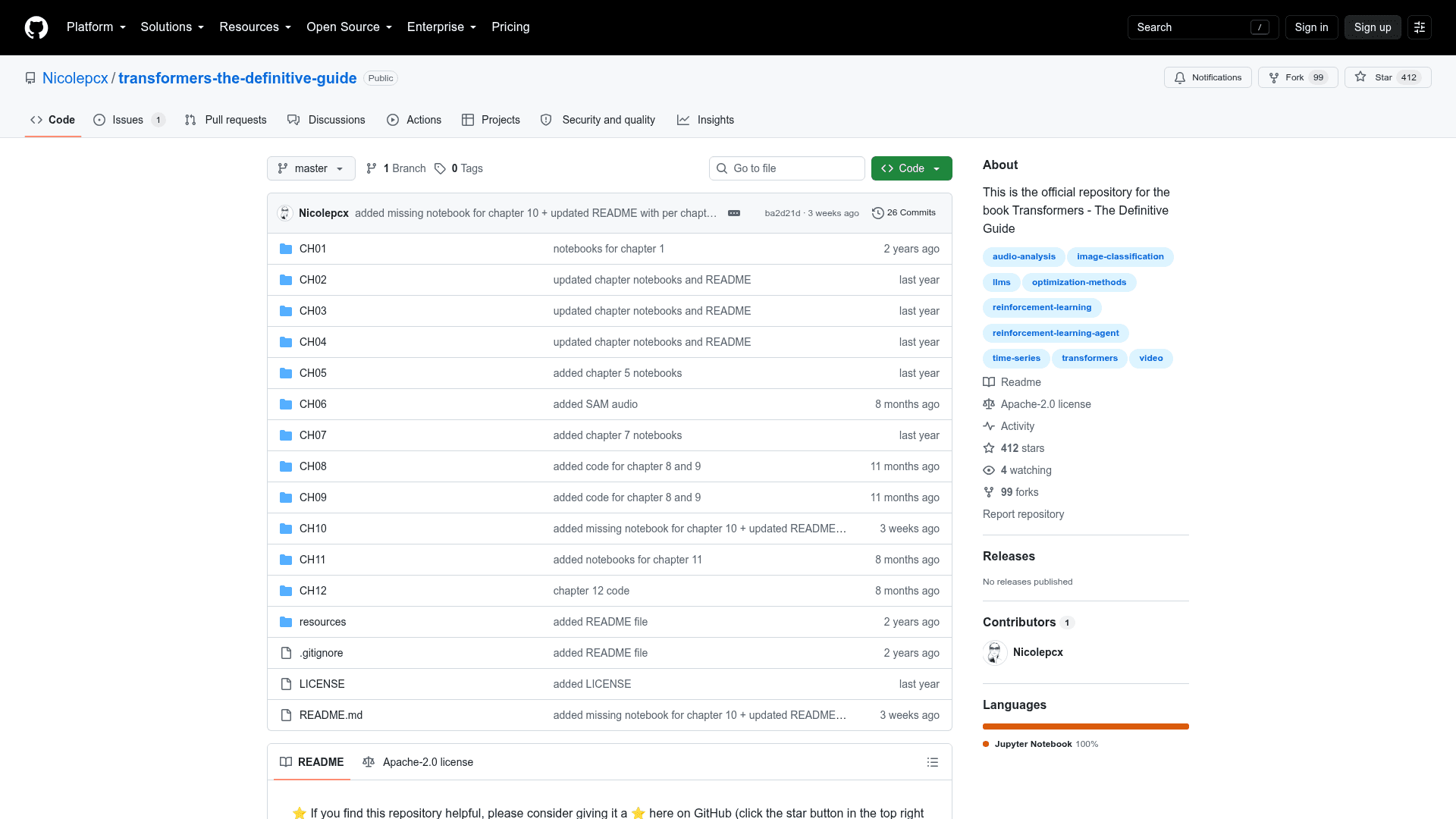
Official code repository for the O'Reilly book "Transformers - The Definitive Guide," containing Jupyter notebooks covering transformer architectures across vision, audio, video, RL, agents, and deployment.
At a Glance
Freely available on GitHub under Apache License 2.0. All notebooks and utilities are free to use, modify, and distribute.
Engagement
Available On
Alternatives
Listed Aug 2026
About Transformers - The Definitive Guide
This is the official companion code repository for the O'Reilly book Transformers - The Definitive Guide by Nicole Koenigstein. It provides 12 chapters of Jupyter notebooks covering transformer architectures and their applications across a wide range of domains, all runnable on Google Colab with GPU support. The repository is licensed under Apache License 2.0 and freely available on GitHub.
What It Is
This repository is a structured, chapter-by-chapter code companion to a published technical book on transformer models. Each chapter folder (CH01 through CH12) contains Jupyter notebooks that demonstrate specific transformer concepts and applications — from foundational attention mechanisms to deploying production models. The notebooks are designed to run on cloud GPU environments (primarily Google Colab) rather than requiring local setup, making them accessible without specialized hardware.
Chapter Coverage and Scope
The repository spans a broad curriculum of transformer use cases:
- Chapter 1: Attention mechanism variations, embeddings, and perplexity
- Chapter 2: Time series transformers (Chronos, PatchTST, fine-tuning with PyTorch)
- Chapter 3: Vision tasks — image classification, ViT embeddings, SAM fine-tuning with W&B and Optuna, video segmentation with SAM 2
- Chapter 4: Image generation — DiT, KV compression, PixArt-Σ XL inference, quantizing text-to-image models
- Chapter 5: Video generation — LTX, Latte, Tora
- Chapter 6: Audio tasks — Kimi-Audio transcription, Qwen2-Audio, music generation, waveform and spectrogram analysis
- Chapter 7: Reinforcement learning transformers — STORM, Decision Transformer, replay buffers
- Chapter 8: Planning, reasoning, and coding — Qwen3, MCTS, TreeQuest, Kimi K2 Instruct
- Chapter 9: AI agents — LangGraph multi-turn conversation, multi-agent market research teams
- Chapter 10: Optimization — AdaptThink, ART·E with LangGraph, rLLM
- Chapter 11: Deployment — LLM performance evaluation, advanced LoRA fine-tuning, LangGraph code interpreter
- Chapter 12: Forward-looking topics — SAM 3 agent
How the Notebooks Are Organized
Each notebook follows a consistent naming convention (ch01_attention_mechanism_variations.ipynb) that ties it to its chapter and topic. Every notebook includes a self-cloning snippet that pulls the full repository into the Colab environment, giving access to shared utility functions and per-chapter requirements installation. A create_env.sh bash script is also provided for local virtual environment setup via conda or pipenv on Windows (WSL), macOS, or Linux, though local setup is described as optional since GPU cloud execution is the primary path.
Audience and Prerequisites
The repository targets practitioners and researchers who want hands-on code alongside the book's theoretical content. Readers are expected to have Python and ML familiarity; the notebooks handle dependency installation automatically per chapter. GPU access is required — the README explicitly notes that notebooks are designed for cloud services with GPU support.
Current Status
The repository was created in March 2024 and last pushed in August 2026, indicating active maintenance. As of the latest data, it has accumulated 412 stars and 99 forks on GitHub. The project is open source under the Apache License 2.0, authored by Nicole Koenigstein.
Community Discussions
Be the first to start a conversation about Transformers - The Definitive Guide
Share your experience with Transformers - The Definitive Guide, ask questions, or help others learn from your insights.
Pricing
Open Source
Freely available on GitHub under Apache License 2.0. All notebooks and utilities are free to use, modify, and distribute.
- All 12 chapters of Jupyter notebooks
- Google Colab integration
- Utility functions and shared classes
- Virtual environment setup script
- Apache 2.0 license
Capabilities
Key Features
- 12 chapters of Jupyter notebooks covering transformer architectures
- Google Colab-ready notebooks with one-click launch badges
- Covers vision, audio, video, time series, RL, agents, and deployment
- Automatic repo cloning and per-chapter dependency installation
- Local virtual environment setup script (conda/pipenv)
- Apache 2.0 open-source license
- Utility functions and custom classes shared across notebooks
- GPU-optimized for cloud execution