
Tura
Tura is a local, open-source coding agent that uses macro CLI commands and backward reasoning to complete long-horizon development tasks with significantly fewer model turns and tokens than conventional tool-calling agents.
At a Glance
Fully free and open-source under AGPL-3.0. Install via npm or source checkout.
Engagement
Available On
Alternatives
Listed Jul 2026
About Tura
Tura is a local, open-source coding agent built for developers who want evidence-backed performance rather than vague skill claims. It is written in Rust, licensed under AGPL-3.0, and installable via npm or source checkout on Windows, macOS, and Linux. The project publishes its benchmark artifacts publicly so results can be independently reviewed.
What It Is
Tura is a harness-based coding agent that replaces the conventional tool-calling loop with a macro command architecture. Instead of exposing dozens of small tools to the language model — each requiring a separate LLM turn — Tura exposes a single command_run macro that lets the agent build a multi-step execution tree and run patching, compiling, testing, and linting in one model round. The project positions itself as an agent harness framework, not a plugin or extension, and explicitly avoids skills, context-compaction turns, and tool-calling overhead.
Benchmark Evidence
The project publishes a community benchmark covering 348 long-horizon sessions across DeepSWE, rewrite, and design task categories. The primary comparison holds the model and reasoning label fixed — Tura Balanced High, Tura Direct High, and the official Codex CLI High configuration — all running GPT-5.6 SOL at High reasoning effort on the same 20 DeepSWE task IDs across 60 sessions each.
According to the published benchmark artifacts:
- Tura Balanced reached an 80.0% verifier success rate on DeepSWE, compared with 60.0% for Codex CLI High — a 20 percentage point difference — while using 49.6% fewer tokens and 66.8% fewer model rounds.
- Tura Direct prioritizes cost reduction: 83.5% fewer aggregate tokens and 84.0% fewer model rounds than Codex CLI High, with a 65.0% verifier success rate versus 60.0%.
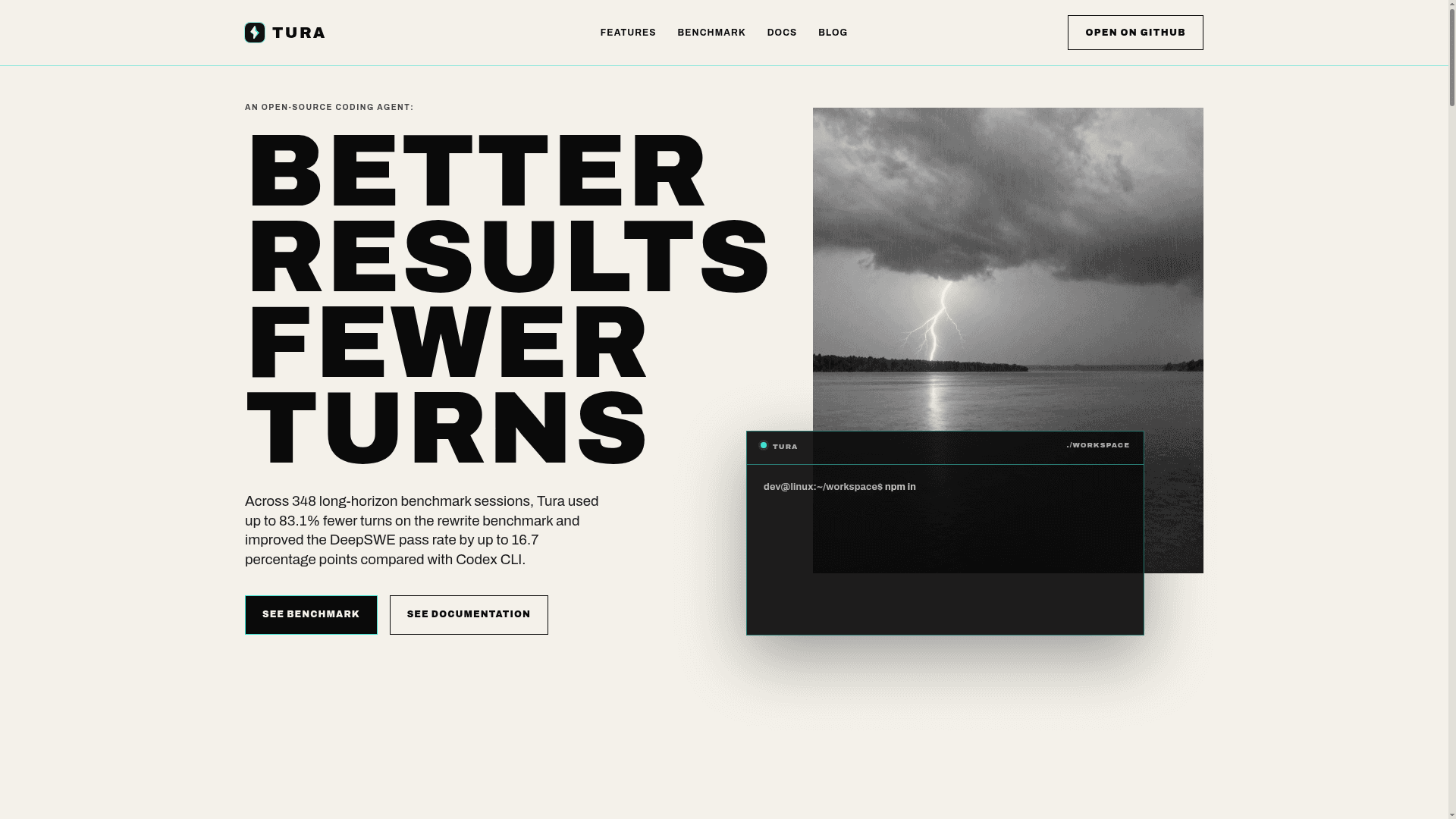
- On the rewrite benchmark, Tura used up to 83.1% fewer turns.
- The published cohort averages 43.5 agent turns per session across 15,138 total agent turns.
The project notes that these results are system-level associations, not causal estimates for any individual feature, and that broader provider coverage (Anthropic/Claude, Google/Gemini, local providers) and cross-OS measurements remain on the documented roadmap.
Three Core Mechanisms
Tura's architecture centers on three systems:
- Macro CLI Command Run: The
command_runtool accepts a structured JSON execution tree, allowing inspect, patch, build, test, and lint steps to execute in a single LLM turn rather than five separate ones. - Backward Reasoning: Rather than reasoning forward from current state to goal, Tura guides the LLM to estimate the pre-goal state first, then reason backward. In coding tasks this means reconstructing the failure state and identifying the root cause before writing any code.
- Runtime Context and Prompt Manager: Context is treated as part of the runtime state machine. Task-specific manuals and CLI commands load through a recursive task tree; irrelevant context can be removed or compacted from the CLI. The checkpoint retains code locations, patches, tests, and task status rather than only a loose summary. In the published benchmark sessions, Tura resumed execution an average of 2.6 rounds after compaction.
Setup Path
Tura runs locally and does not bundle provider credentials. Users configure an LLM provider on first launch. Installation options:
- npm:
npm install tura-ai(Mac/Linux) ornpm install -g tura-ai(Windows) - Source: clone the repository and run
./scripts/install.sh(macOS/Linux) or.\scripts\install.ps1(Windows)
Common entrypoints include tura for the interactive TUI, tura exec "prompt" for a direct CLI runner, tura run "prompt" for a gateway-backed prompt with streaming and history, and tura_gui for the desktop GUI workspace client.
Update: v0.1.33
The latest release is v0.1.33, published on 2026-07-14. The repository was created in July 2026 and has been actively updated, with the last push recorded on 2026-07-18. The roadmap describes the current phase as 0.1.x stabilization, with a planned 0.2 task-planning workspace as the next major milestone. The project invites community benchmark contributions and accepts pull requests with evidence at the test layer.
Community Discussions
 YS
YSWhen Is GPT-5.6 Sol Max Worth 2.42× the Cost for a Coding Agent?
Disclosure: I maintain Tura, an open-source coding-agent project. This is a technical analysis of public benchmarks and our published artifacts, not an independent product review. The decision is task-shaped, not model-shaped “Use Max because it is stronger” is not a useful operating rule for coding…
Pricing
Open Source
Fully free and open-source under AGPL-3.0. Install via npm or source checkout.
- Macro CLI command run
- Backward reasoning
- Runtime context and prompt manager
- TUI, GUI, and CLI entrypoints
- Multi-session concurrent work
Capabilities
Key Features
- Macro CLI command run — multi-step execution tree in a single LLM turn
- Backward reasoning — guides LLM from goal state backward to root cause
- Runtime context and prompt manager — task-scoped context with CLI compaction
- Test-driven development — reproduces issues before patching
- Interactive terminal UI (TUI) and desktop GUI workspace client
- Multi-session concurrent work with HTML rich text support
- Local HTTP/SSE gateway with optional web GUI serving
- Custom providers, personas, agents, runtime prompts, and commands
- Session DB with per-round archived contracts and verifier results
- Community benchmark with publicly archived artifacts