UQLM
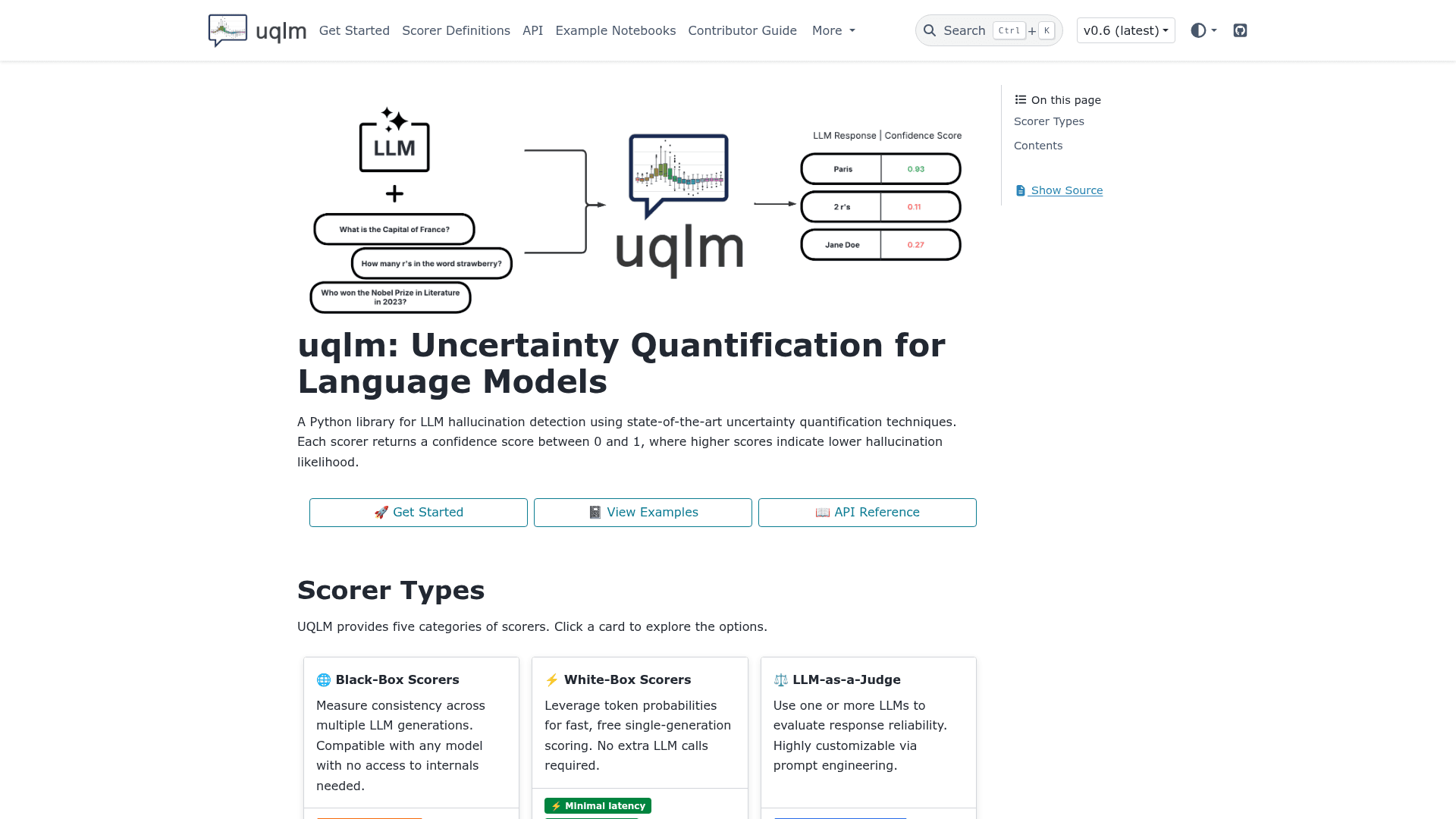
Python library for detecting LLM hallucinations using uncertainty quantification scorers that return confidence scores between 0 and 1.
At a Glance
About UQLM
UQLM is an open-source Python library from CVS Health for detecting hallucinations in large language model outputs using uncertainty quantification. Each scorer returns a confidence score between 0 and 1, where higher values indicate a lower likelihood of errors or hallucinations. It is installed from PyPI and works with LangChain chat models.
What It Is
UQLM is a developer library that wraps an LLM, generates responses to prompts, and scores how reliable each response is. Results are returned through a generate_and_score workflow and can be exported to a DataFrame. It also includes a mitigation option in which the response with the lowest uncertainty is selected.
Scorer Categories
The documentation groups scorers into five types:
- Black-box scorers measure consistency across multiple generations and work with any LLM. Examples include semantic entropy, non-contradiction probability, exact match, BERTScore and cosine similarity.
- White-box scorers use token probabilities for single-generation scoring and need access to logprobs. They include minimum token probability, sequence probability and P(True).
- LLM-as-a-judge scorers use one or more LLMs to evaluate a response, with categorical, continuous, Likert and panel-of-judges variants.
- Ensemble scorers combine scorers by weighted averaging. They can be used off the shelf or tuned on prompts with ground-truth answers.
- Long-text scorers score individual claims or sentences and can refine a response by removing low-confidence claims.
Code Generation and Long-Form Output
CodeGenUQ predicts whether LLM-generated code is functionally correct without executing it. It combines white-box scorers, code-adapted black-box scorers based on functional equivalence, and reflexive self-evaluation scorers. LongTextUQ decomposes a response into claims, scores each against sampled responses, and returns claim-level data along with a refined response.
Documentation and Learning Resources
The documentation site includes a quickstart, scorer definitions, an API reference, example notebooks, FAQs and release notes. The project is released under the Apache 2.0 license and is described in a JMLR software paper, with further TMLR and EMNLP papers on the methods.
Community Discussions
Be the first to start a conversation about UQLM
Share your experience with UQLM, ask questions, or help others learn from your insights.
Pricing
Open Source
UQLM Python library released under the Apache License 2.0; free to use, modify and distribute. Costs of any LLM calls made through the user's own providers are external.
- Apache License 2.0 (OSI-approved)
- Install via pip install uqlm
- Black-box, white-box, LLM-as-a-judge, ensemble and long-text scorers
Capabilities
Key Features
- Black-box consistency-based scorers
- White-box token-probability scorers
- LLM-as-a-judge and LLM panel scorers
- Ensemble scorers with optional supervised tuning
- Long-text claim-level scoring with response refinement
- CodeGenUQ for code correctness prediction without execution
- Confidence scores between 0 and 1
- Works with any LangChain chat model
- Example notebooks