Valmis
A self-hosted, open-source AI agent platform that connects LLM-powered agents to 100+ business integrations with AES-256-GCM encrypted credentials and isolated sandboxed execution.
At a Glance
Fully free and open-source under Apache License 2.0. Self-host via Docker Compose.
Engagement
Available On
Listed Jul 2026
About Valmis
Valmis is an open-source, self-hosted platform for building and running LLM-powered AI agents that interact with business and productivity applications. Released under the Apache License 2.0, it runs via Docker Compose and keeps all credentials and API keys on the user's own server. The project reached its first stable release (v1.0.0) in July 2026 and is maintained by the valmishq organization on GitHub.
What It Is
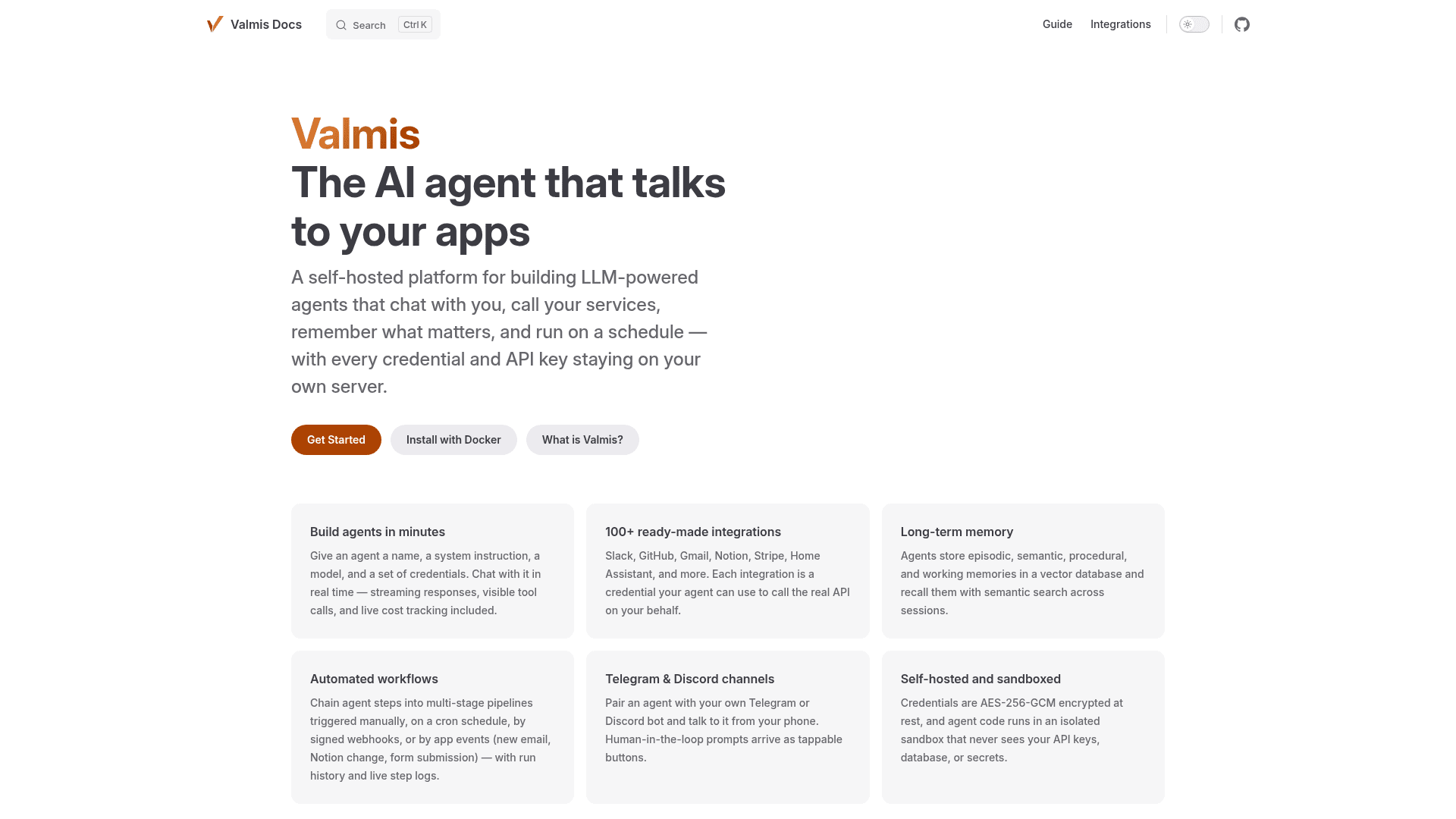
Valmis is a self-hosted agent framework designed for production work rather than personal experimentation. Users create agents by assigning a name, system instruction, LLM model, and a set of credentials. Agents then chat in real time with streaming responses, visible tool calls, and live cost tracking. The platform positions itself explicitly as a security-focused alternative to OpenClaw, addressing the concern that some agent platforms store credentials in plain text or pass them directly to LLM providers.
Security Architecture: The Proxy System
The defining technical design of Valmis is its proxy system. Dockerized agent runtimes never receive API credentials directly. Instead, agents request the host machine to make API calls by providing a credential ID; the host executes the actual HTTP request and returns only the JSON response. This applies even to LLM API calls. Key security properties include:
- Credentials encrypted at rest with AES-256-GCM
- Each agent runs in its own isolated container with its own file system
- Agent containers can theoretically operate with no internet access and still function
- Credential access is scoped per agent at the code level
Integrations and Connectivity
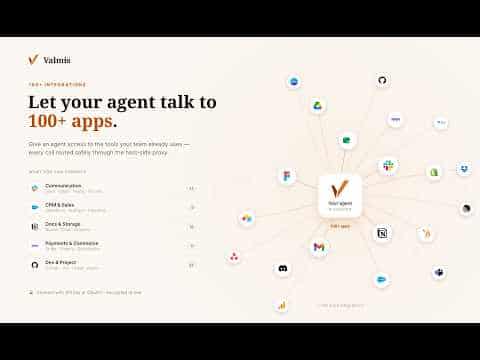
The platform ships with over 100 ready-made integrations covering Google Workspace (Drive, Gmail, Sheets, Calendar), Slack, Notion, Stripe, Shopify, Discord, Jira, Salesforce, HubSpot, Trello, Asana, Microsoft Teams, Outlook, Dropbox, Airtable, Telegram, Twilio, Calendly, monday.com, Linear, Canva, Cloudflare, Supabase, Reddit, QuickBooks, Xero, WooCommerce, BigCommerce, Intercom, Zendesk, Freshdesk, Pipedrive, ActiveCampaign, Klaviyo, SendGrid, Contentful, Webflow, WordPress, Ghost, Miro, ElevenLabs, Pinecone, GitHub, Confluence, ClickUp, Todoist, and generic HTTP connectors for custom APIs. Each integration is defined as a single YAML file, making the catalog straightforward to extend.
Memory, Workflows, and Channels
Valmis implements a four-category memory system inspired by cognitive-memory research: episodic (what happened), semantic (durable facts), procedural (rules and constraints), and working (short-lived context). Memories are stored in a pgvector-enabled PostgreSQL database and retrieved via semantic search using text embeddings. Memory persists across sessions and is automatically distilled at session end.
Workflow automation supports multi-step pipelines triggered by cron schedules, signed webhooks, or app events such as new emails, Notion changes, or form submissions. Conditions can be "smart" (described in natural language, evaluated by AI) or "strict" (programmatic value comparison). Loops are also supported, and run history with live step logs is included.
Agents can be paired with Telegram or Discord bots for mobile access, with human-in-the-loop prompts delivered as tappable buttons. Browser automation is available via a managed headless browser proxy, giving agents the ability to navigate, fill forms, click, read pages, and take screenshots while keeping browser sessions isolated from the host.
Update: v1.0.0 First Stable Release
The repository was created on May 29, 2026, and v1.0.0 was published on July 3, 2026, marking the first stable release. The project is written in TypeScript, has accumulated 86 stars and 7 forks on GitHub, and has zero open issues as of early July 2026. The README describes support for nearly 200 models from 20 LLM providers including OpenAI, Anthropic, Google, Mistral, and Cohere, with OpenRouter available for additional model choices.
Community Discussions
Be the first to start a conversation about Valmis
Share your experience with Valmis, ask questions, or help others learn from your insights.
Pricing
Open Source
Fully free and open-source under Apache License 2.0. Self-host via Docker Compose.
- Self-hosted deployment
- 100+ integrations
- Multi-agent support
- Workflow automation
- Four-category memory system
Capabilities
Key Features
- Self-hosted deployment via Docker Compose
- AES-256-GCM encrypted credential storage
- Proxy system: agents never access API keys directly
- Isolated agent containers with per-agent file systems
- 100+ business and productivity integrations
- Four-category memory system (episodic, semantic, procedural, working)
- pgvector-based semantic memory search
- Multi-step workflow automation with cron, webhook, and app event triggers
- Smart and strict workflow conditions
- Human-in-the-loop prompts with tappable buttons
- Telegram and Discord bot channel support
- Headless browser automation via proxy
- Knowledge base support (Google Drive, Dropbox, Notion, file upload)
- Skills system with third-party and self-evolving skills
- Support for ~200 LLM models from 20 providers
- Live cost tracking and streaming responses
- Workflow builder canvas UI
- Multi-agent collaboration with team lead authority
Integrations
Demo Video