
vibesenpai
Open-source Claude Code plugin that reads local sessions and shows the turns where the agent misread you, broke a rule or claimed work it hadn't done, with a fix to apply.
At a Glance
MIT-licensed Claude Code plugin; the free checks cost nothing. Optional model reads run on the user's own Claude Code account (external cost).
Engagement
Available On
Alternatives
Listed Nov 2026
About vibesenpai
vibesenpai is an open-source Claude Code plugin from the vibesenpai organization. It reads the session transcripts Claude Code already keeps on disk and surfaces the exact turns where an agent went wrong, quoted in the developer's own words, along with a fix that can be applied. The project is MIT licensed, and its latest listed release is v0.1.0.
What It Is
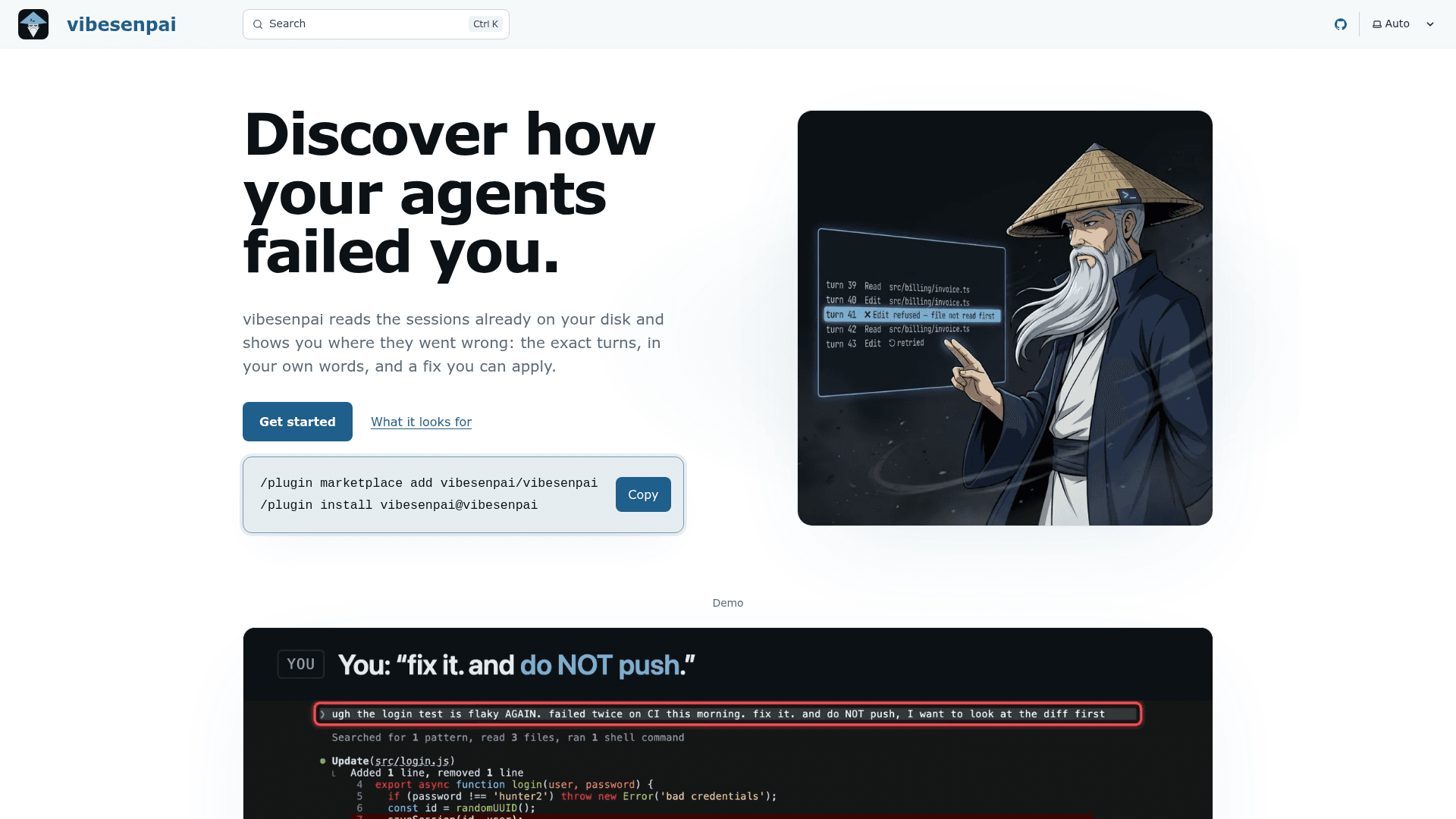
vibesenpai is a session-analysis and agent-observability tool for Claude Code. It does not score the developer or the agent. Each finding opens with the developer's words and the surrounding turns, then explains why it was flagged and proposes a change such as a rule, a permission prompt, a guard or a test. It reads Claude Code sessions only.
What It Looks For
The model reads cover five kinds of finding: constraint violation (a stated instruction not followed), misread intent, inaccurate self report (work or success claimed that did not happen), overreach (work nobody asked for that the developer pushed back on), and other real problems. Free checks run on every session without any model call. They catch refused edits that were retried, repeated identical calls with the same answer, and prompt-cache rebuilds.
How Fixes and Tracking Work
Apply drafts the fix into the Claude Code prompt box, and the developer's Enter confirms it. The agent makes the change under Claude Code's own permission prompt, so vibesenpai never writes files itself. After a fix is applied, the Fixes tab shows counts of the same issue before and since, as counts rather than percentages. The /vibesenpai:report command writes a self-contained HTML report of all findings, their turns and fixes, which opens offline.
Data Handling and Setup
Transcripts are read in place and never copied. Model reads are off until the user has seen exactly what would be sent. Once enabled, a redacted, length-capped copy of session text goes to Claude Haiku on the user's own Claude Code account, and the send stops if redaction left anything behind. The docs note that session text can include file contents and command output the agent saw. The reads run in the background after each turn, within about 2M tokens a day, and /vibesenpai:judge off stops them. Install it through the Claude Code plugin marketplace. It requires Node 22.13 or later and Claude Code 2.1.299 or later.
Community Discussions
Be the first to start a conversation about vibesenpai
Share your experience with vibesenpai, ask questions, or help others learn from your insights.
Pricing
Open Source (MIT)
MIT-licensed Claude Code plugin; the free checks cost nothing. Optional model reads run on the user's own Claude Code account (external cost).
- MIT License
- Free checks read every session locally
- Optional model reads on Claude Haiku via your own Claude Code plan or API key, within about 2M tokens a day (about $0.26 at API prices)
- Claude Code only
- Requires Node 22.13+ and Claude Code 2.1.299+
Capabilities
Key Features
- Reads local Claude Code sessions in place without copying them
- Findings cite the exact turns and the developer's own words
- Detects constraint violations, misread intent, inaccurate self reports and overreach
- Free checks for edit retries, repeated calls and cache rebuilds
- Apply drafts a fix into the prompt box for the user to confirm
- Before and since counts show whether an applied fix worked
- Self-contained offline HTML history report
- Background model reads with a daily token limit, stopped by one command
- Redaction of session text before any model read