
A local CLI tool that translates Claude's verbose token output into readable English by piping it through a local LLM, with no telemetry or external dependencies.
At a Glance
Fully free and open source under GNU GPLv3. Install via go install with no cost.
Engagement
Available On
Listed Aug 2026
About Vomit
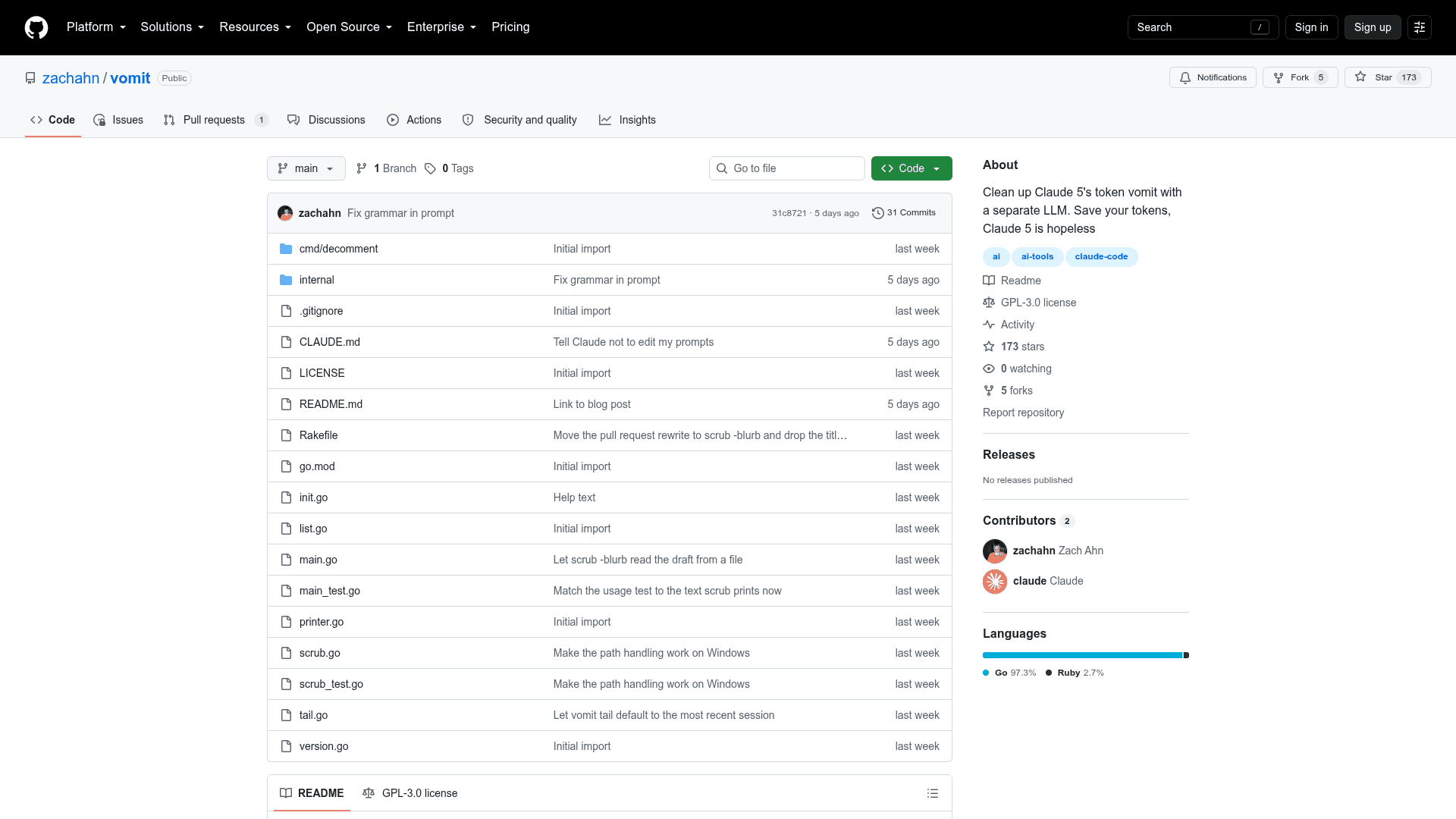
Vomit is a fully local, open-source command-line tool written in Go by developer zachahn. It addresses a specific pain point with Claude's agentic output: the model tends to emit verbose, hard-to-read "token vomit" during sessions, and Vomit pipes that output through a local LLM to produce cleaner, more readable English. The project is self-described as "totally vibe-coded" and primarily tested on Mac.
What It Is
Vomit sits between Claude's output and the user, intercepting session tokens and translating them via a locally running LLM. It operates entirely on-device — no telemetry, no external API calls, no cloud dependencies. The tool integrates with Claude via hooks, replacing Claude's raw output in the terminal with a more human-readable version. It can also run in a non-invasive side-by-side mode, letting users monitor Claude sessions without modifying the primary output stream.
How It Works
The workflow involves three steps: installing the binary via go install, running vomit init to configure the local LLM connection, and then running vomit scrub -claude to get instructions for wiring it into Claude's hook system. Key CLI commands include:
vomit list— lists Claude session identifiersvomit tail [<session_identifier>]— translates tokens for a specific session or follows the latest onevomit help— shows all available commands
The local LLM only sees what Claude tries to communicate — it has no access to actions or files — so some hallucination is expected. The author notes it is also "pretty slow."
Local LLM Compatibility
Vomit is designed to work with any LLM backend that exposes an OpenAI-compatible API. Explicitly supported backends include:
- Llama.app (the author's recommended starting point, with GPT-OSS 20B suggested as a model)
- Ollama
- Any service implementing the OpenAI API interface
Tradeoffs to Know
The README is candid about limitations: the local LLM can hallucinate because it only sees Claude's communicated tokens, not the full context of actions or files. There is also a possibility of completely missing Claude's message during translation. The author recommends using a tool like AgentsView alongside Vomit to retain access to original messages, since Vomit does not modify anything at runtime beyond writing temporary files to TMPDIR.
Current Status
The repository was created in August 2026 and last updated shortly after, with 173 stars and 5 forks as of the latest data. It is an early-stage, single-developer project released under the GNU GPLv3 license. The author published a companion blog post at zachahn.com describing the project's motivation and design.
Community Discussions
Be the first to start a conversation about Vomit
Share your experience with Vomit, ask questions, or help others learn from your insights.
Pricing
Open Source
Fully free and open source under GNU GPLv3. Install via go install with no cost.
- Full CLI tool access
- Local LLM translation of Claude output
- Claude hook integration
- Session listing and tailing
- No telemetry
Capabilities
Key Features
- Translates Claude's verbose token output into readable English
- Fully local — no telemetry, no external dependencies
- Integrates with Claude via hooks to replace output in-terminal
- Non-invasive side-by-side monitoring mode
- List and tail Claude session identifiers
- Compatible with Llama.app, Ollama, and any OpenAI-compatible API
- Writes only to TMPDIR at runtime — does not modify Claude sessions
- Simple setup via go install and vomit init