
Wallfacer
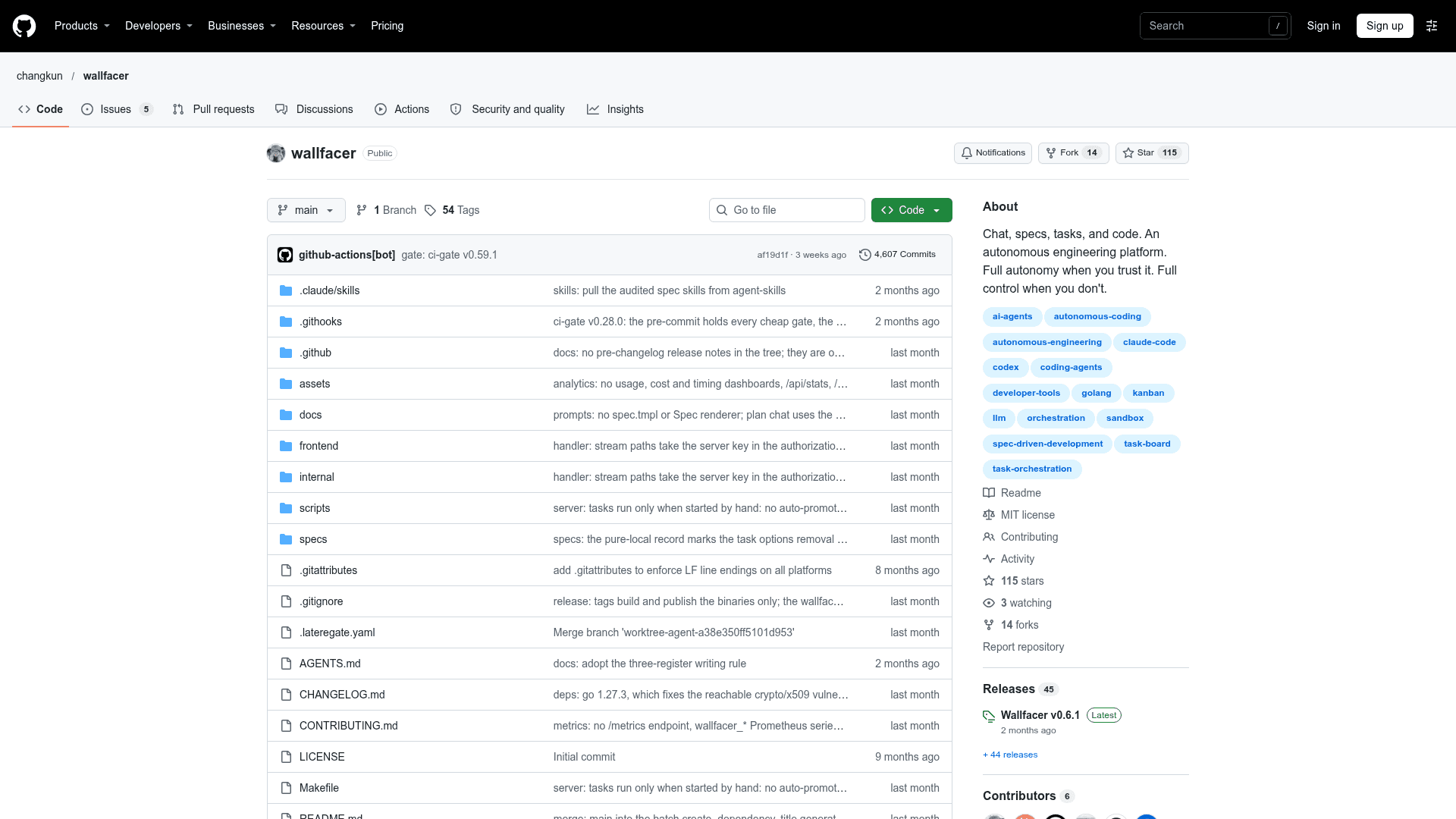
An open-source, locally run autonomous engineering platform that moves from chat to specs, tasks, and code with agents in isolated git worktrees.
At a Glance
Self-hosted, local-first autonomous engineering platform released under the MIT license. Users bring their own LLM provider credentials, which are an external cost.
Engagement
Available On
Listed Nov 2026
About Wallfacer
Wallfacer is an open-source autonomous engineering platform by changkun that runs locally and works with coding-agent CLIs already installed on the machine. It connects chat, structured specs, a task board, and code editing into one workflow, with agents operating at each level. The latest release listed is v0.6.1, and the README describes the project as pre-1.0.
What It Is
Wallfacer is a local task board and planning environment layered over coding-agent harnesses. Users describe an idea in chat, turn it into a recursive tree of markdown specs, break those specs into tasks, and let agents implement, test, and commit the work. Marking reviewed work done rebases it onto the default branch and merges it. It runs without an IDE dependency or a cloud dependency, and users bring their own LLM provider credentials.
How the autonomy spectrum works
The README frames work as moving between chat, spec, task, and code levels, with autonomy adjustable per task, spec, or project. Specs move through a seven-state lifecycle (vague, drafted, validated, testing, complete, plus stale and archived). The planning chat exposes slash commands such as /create, /validate, /break-down, and /dispatch. Each task runs as a host process in its own git worktree, so multiple agents can work in parallel without interfering.
Oversight and harnesses
Every task produces a structured event timeline, a diff against the default branch, and an AI-generated oversight summary. Token usage and cost are recorded per turn and per activity. A pluggable harness layer supports Claude Code, Codex, Cursor, OpenCode, and Pi, and a per-role setting can route individual agent roles (impl, test, commit-msg, title, oversight) to different harnesses.
Setup path
Install with the provided shell script, run wallfacer doctor to check prerequisites, then wallfacer run to start the server. A browser window opens and asks for a project folder, and credentials are added in Settings. Other commands are wallfacer status and wallfacer spec.
Community Discussions
Be the first to start a conversation about Wallfacer
Share your experience with Wallfacer, ask questions, or help others learn from your insights.
Pricing
Open Source (MIT)
Self-hosted, local-first autonomous engineering platform released under the MIT license. Users bring their own LLM provider credentials, which are an external cost.
- MIT License
- Runs locally with no cloud dependency
- Bring your own LLM provider
- Works with Claude Code, Codex, Cursor, OpenCode, and Pi harnesses
- Task board with per-task git worktrees
Capabilities
Key Features
- Planning chat with slash commands
- Recursive markdown spec tree with seven-state lifecycle
- Task board with parallel agent execution
- Per-task git worktrees
- Pluggable harness layer with per-role routing
- Live logs, event timelines, and diff review
- AI-generated oversight summaries
- Per-turn token usage and cost tracking
- File explorer with editor
- Native AGENTS.md/CLAUDE.md discovery
- Spec validation and dependency tracking
- Runs locally with bring-your-own LLM provider