
Web Speed
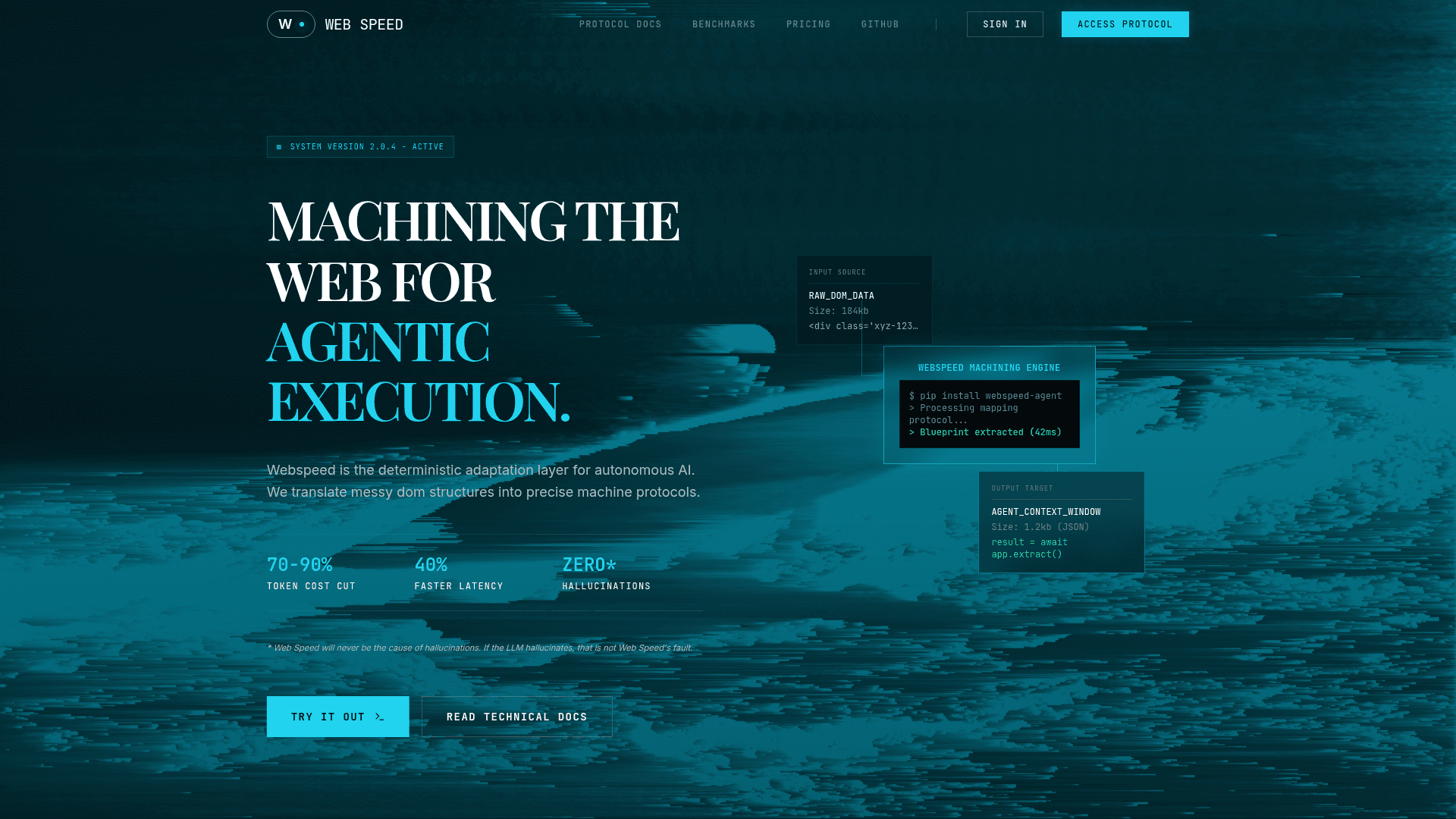
A deterministic adaptation layer that translates raw DOM structures into optimized JSON blueprints for autonomous AI agents, cutting token costs by 70-90%.
At a Glance
About Web Speed
Web Speed is a deterministic translation layer built for agentic AI systems, converting messy human-facing web pages into precise, structured JSON maps. Developed under the brand Webspeed Infrastructure, it is currently at System Version 2.0.4 and under active development. The tool targets the core inefficiency of AI agents consuming raw DOM trees — a process that wastes tokens and introduces hallucination risk — by stripping out HTML noise and delivering clean structural blueprints instead.
What It Is
Web Speed sits between the raw web and an AI agent's context window, acting as an infrastructure-level "adaptation layer." Rather than letting an agent parse hundreds of kilobytes of raw HTML, Web Speed fetches a page, extracts its structural map (navigation, forms, links, text blocks, headings), and returns a compact JSON object. The docs describe token savings of typically 75–97% per page fetch. The tool is available as both a self-hosted open-source MCP server and a managed hosted API.
How the Extraction Engine Works
Every Web Speed response follows a standardized JSON schema regardless of the target site's styling or layout changes. The schema includes:
- headings — structured by level
- navigation — labeled links with location context (header, footer, etc.)
- forms — field names, types, and placeholders
- content_links — total count and labeled items
- text_blocks — tagged paragraph content
- metadata — language and page-level attributes
This deterministic output means agent logic doesn't break when a site redesigns its CSS. The about page frames this as a "division of labour": Web Speed handles fetching, extraction, caching, and form submission; the agent handles goal-setting, planning, and judgment.
MCP-Native Session Handling
A notable feature highlighted on the homepage is the Native MCP integration for post-authentication workflows. Web Speed uses a local browser bridge to inject session tokens from the user's local keychain, enabling agents to operate behind login walls without routing credentials through a proxy. The homepage describes this as a "New Launch" capability, positioning it for use cases like navigating LinkedIn Jobs or other walled-garden platforms.
Deployment Model: Open Core
Web Speed follows an open-core model. The community edition is a self-hosted MCP server published on GitHub under the handle Dominic-Pi-Sunyer/web-speed-oss. It includes full JavaScript rendering, all 8 MCP tools, and a local 24-hour disk cache. The hosted API adds a shared map registry, priority support, and unlimited fetches at scale. The about page describes an "Open Core Flywheel" strategy, with the goal of partnering with agentic frameworks such as LangChain, CrewAI, and LlamaIndex to position Web Speed as a reliability layer across the agent ecosystem.
Update: System Version 2.0.4
The homepage displays "System Version 2.0.4 - Active" and the docs page notes "Active Development -- frequent updates," signaling ongoing iteration. The post-auth MCP session feature is labeled "New Launch" on the homepage, indicating it is a recently shipped capability. The project's GitHub repository serves as the primary distribution channel for the open-source edition.
Community Discussions
Be the first to start a conversation about Web Speed
Share your experience with Web Speed, ask questions, or help others learn from your insights.
Pricing
Hobbyist
Self-hosted forever, open-source MCP server for local development and individual agents.
- Self-hosted MCP server
- Full JavaScript rendering
- All 8 MCP tools
- Local 24h disk cache
- Community support
Pay As You Go
Prepaid credits, 1 credit = 1 map = 1¢. Credits never expire.
- 1 credit = 1 map = 1¢
- Credits never expire
- Shared map registry (cache hits free)
- JS rendering included
- Top up any time
Scale
Unlimited maps per month for production fleets.
- Unlimited fresh fetches
- Unlimited cache hits
- Shared map registry
- JS rendering included
- Priority email support
Enterprise
Annual contract with on-premise/VPC deployment and custom integrations.
- On-premise / VPC deployment
- Privacy-First Black Box integration
- Action Registry access
- Platinum engineered support
- SLA + custom integrations
Capabilities
Key Features
- Deterministic DOM-to-JSON structural mapping
- 70-90% token cost reduction
- 40% faster latency vs raw DOM parsing
- Zero-hallucination extraction (frozen structural maps)
- Full JavaScript rendering
- 8 MCP tools included
- Local 24h disk cache
- Shared map registry (hosted)
- Post-authentication execution via local browser bridge
- MCP-native session handling with local keychain
- SSRF protection
- Standardized JSON response schema
- Form discovery and submission
- Sitemap tool
- Action Registry for pre-optimized domain maps