OpenGoat
Open-source framework for building hierarchical AI agent organizations where a CEO, managers, and specialists coordinate work across tools like Claude Code, Codex, Cursor, and more.
At a Glance
About OpenGoat
OpenGoat is an open-source, MIT-licensed framework built by Mariano Pardo that lets you run a structured AI organization — complete with a CEO, managers, and specialist agents — from your own machine. It is powered by OpenClaw and runs entirely locally with no subscriptions or hosted lock-in. The project has 397 GitHub stars and 44 forks as of its last recorded update.
What It Is
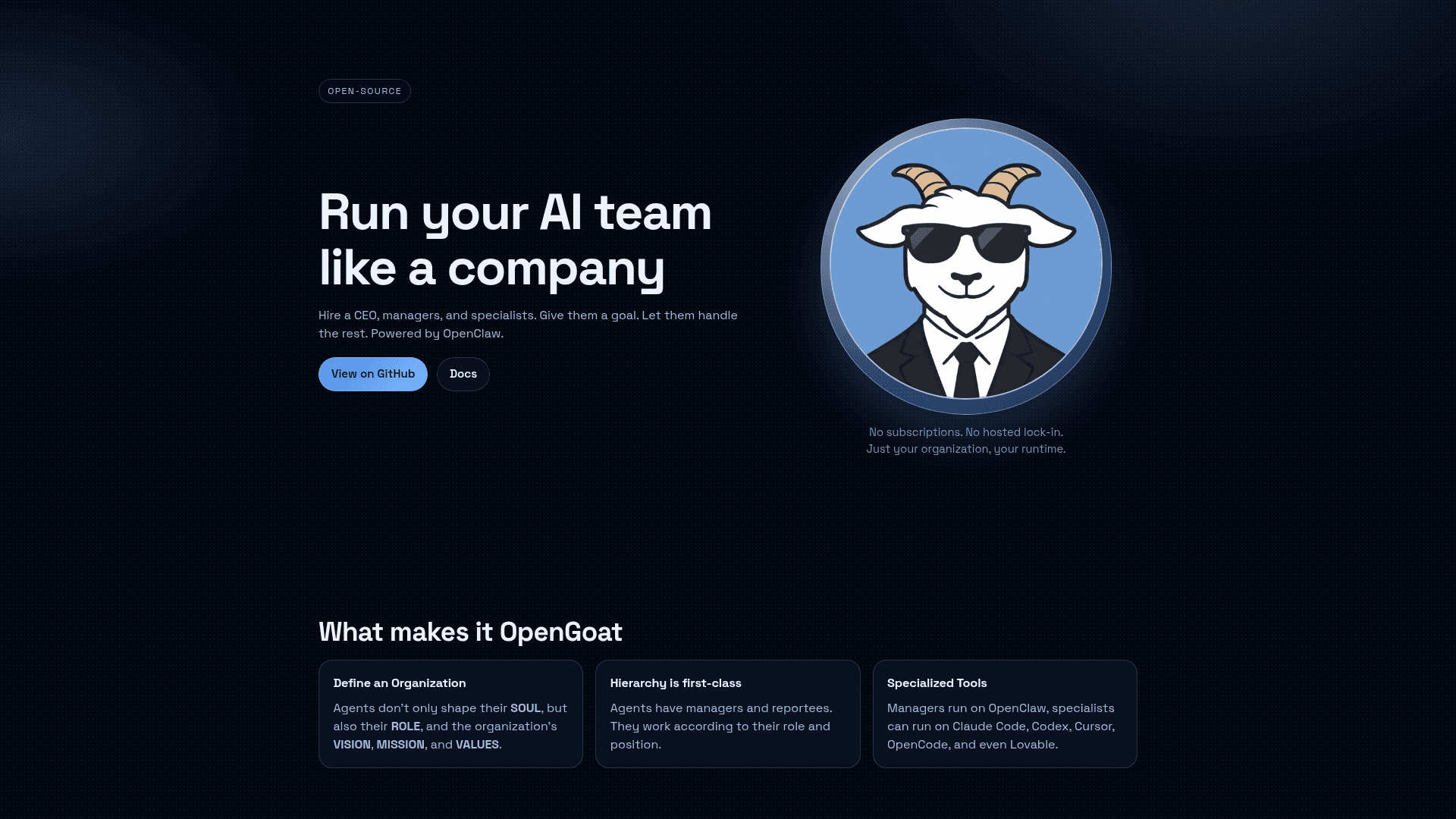
OpenGoat sits in the multi-agent orchestration category. Rather than a flat pool of AI agents, it enforces a company-like hierarchy: a top-level "Goat" agent acts as an AI co-founder, managers break down goals and delegate tasks, and individual specialists execute the work. Each agent is defined by its SOUL (personality), ROLE (function), and the organization's VISION, MISSION, and VALUES — making coordination more structured than typical agent frameworks.
Architecture and Runtime
OpenGoat is CLI-first and built on the OpenClaw runtime. Managers run on OpenClaw agents; specialists can run on Claude Code, Codex, Cursor, GitHub Copilot CLI, OpenCode, or Lovable. The tool ships as an npm package (opengoat) and also supports Docker deployment. A local web UI is served at http://127.0.0.1:19123 after startup, where users can message the CEO agent, shape the org, and monitor work. The primary language is TypeScript and Node ≥ 20.11 is required.
Key architectural traits:
- Hierarchy is first-class: agents have explicit manager and reportee relationships
- ACP support: Agent Communication Protocol for inter-agent messaging
- Session continuity: named sessions allow multi-turn conversations across CLI calls
- Skill system: installable skills (e.g.,
og-boards,jira-tools) extend agent capabilities per role
Typical Workflows
OpenGoat is designed around project-scoped work. A typical flow:
- Create a project from a URL — this provisions a CMO agent workspace and bootstraps it from the project context
- Build the org by creating agents with roles, manager relationships, and skills
- Assign tasks with owners and assignees; track status through
doing,done, and other states - Message agents directly via CLI or the web UI to drive work forward
The CLI supports session flags for continuity, external OpenClaw gateway configuration for team setups, and a default agent override for scripting.
OpenClaw Ecosystem Integration
OpenGoat is tagged as an openclaw-extension and openclaw-plugin on GitHub, placing it squarely within the OpenClaw ecosystem. It requires openclaw to be installed and onboarded before OpenGoat can start. Specialist agents can delegate execution to third-party coding tools, making OpenGoat a coordination layer rather than a replacement for existing AI coding assistants.
Update: v2026.4.12
The latest release is v2026.4.12, published on April 12, 2026. The repository was last pushed on the same date, with the project created in February 2026 — indicating rapid early development. The versioning scheme uses a date-based format (YYYY.M.DD), suggesting frequent releases tied to active development cycles.
Community Discussions
Be the first to start a conversation about OpenGoat
Share your experience with OpenGoat, ask questions, or help others learn from your insights.
Pricing
Open Source
Fully free and self-hosted under the MIT License. No subscriptions or hosted lock-in.
- Hierarchical AI agent organizations
- CLI and local web UI
- OpenClaw runtime integration
- Docker support
- ACP support
Capabilities
Key Features
- Hierarchical AI agent organizations (CEO, managers, specialists)
- CLI-first interface with local web UI at localhost:19123
- OpenClaw-powered manager agents
- Specialist agents on Claude Code, Codex, Cursor, GitHub Copilot CLI, Lovable, OpenCode
- Agent SOUL, ROLE, and organizational VISION/MISSION/VALUES definitions
- Task creation, assignment, and status tracking
- Named session continuity for multi-turn agent conversations
- Installable skill system per agent role
- Docker deployment support
- ACP (Agent Communication Protocol) support
- External OpenClaw gateway configuration
- Project-scoped CMO agent provisioning
- MIT licensed, fully self-hosted