
xsm
Cross-session messaging that lets Claude Code, Codex, Pi, OpenCode, Hermes and OpenClaw sessions find each other, exchange messages and collaborate.
At a Glance
xsm core is released under the MIT License and can be used, modified and distributed free of charge.
Engagement
Available On
Alternatives
Listed Nov 2026
About xsm
xsm (Cross-Session Messaging) is an MIT-licensed project by ysys143 that lets agent sessions you already run find each other and work together on one machine, across config homes and runtimes, and across machines. The current release is 0.6.0, which adds experimental Pi, OpenCode, Hermes and OpenClaw bindings alongside Claude Code and Codex.
What It Is
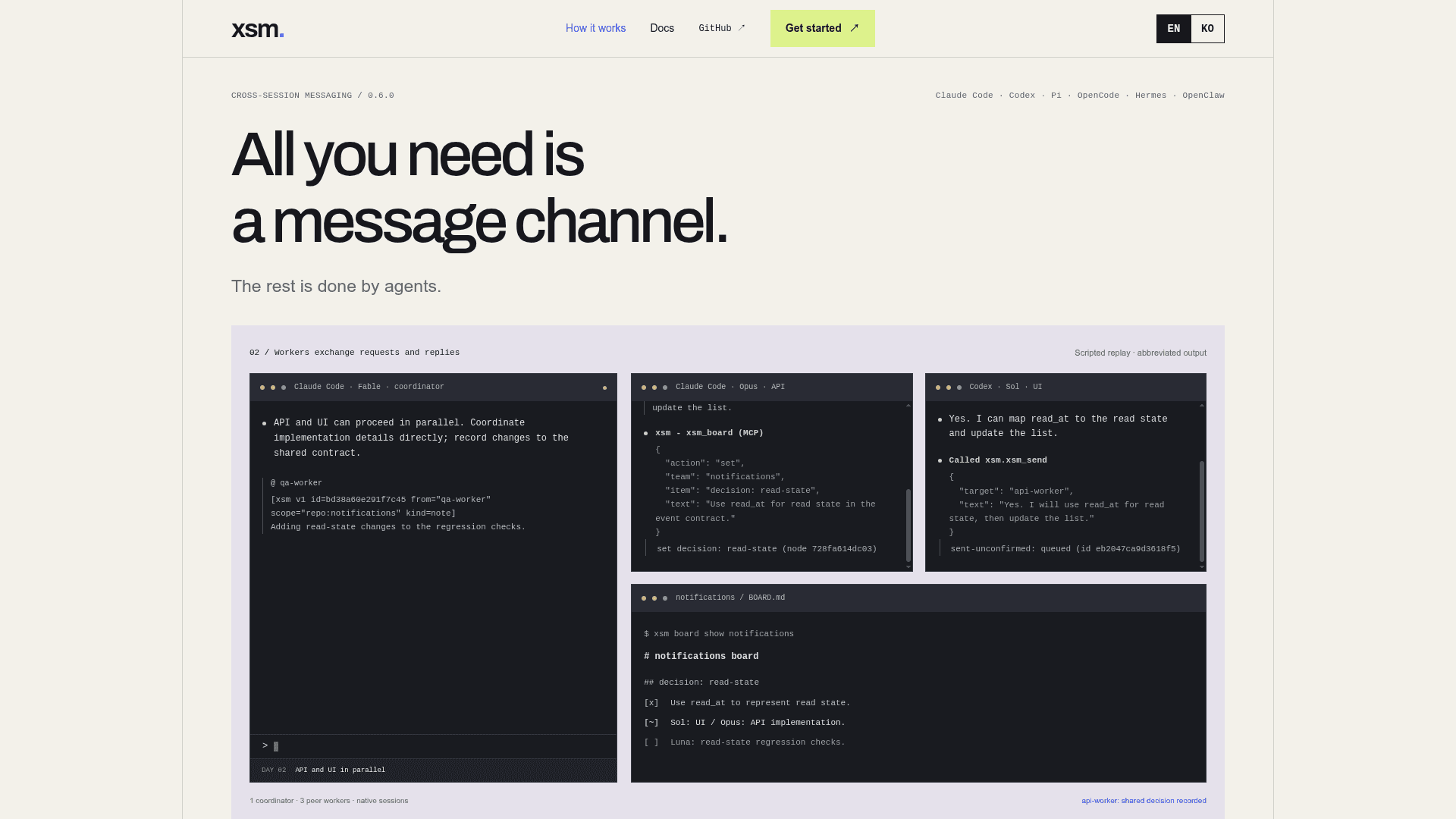
xsm is a message channel for coding-agent sessions. An agent finds a peer by what it is working on, connects to the one you pick, asks it a question and gets the actual answer back. It also reports what has and has not happened at each step. It does not wrap your agent CLI or ship its own runtime: you start sessions as usual, and xsm delivers messages through each runtime's native path, such as the Claude inbox socket and codex queue.
How messaging and teams work
A DM addresses one or more sessions. A team is a list of sessions with an optional lead, and each team has a board holding decisions, ownership and progress. Delivery is tracked as separate facts: stored, handed to the runtime, acknowledged after reading, and actually answered. Requests keep an ID so a lost response can be recovered. Attachments can be sent with a message. Discovery only shows sessions you published or those in the same repository, and widening scope requires your explicit approval.
Cross-machine and worker features
An opt-in P2P network connects machines using device keys and invitations, with a public or custom relay, and two-way SSH pairing also works. xsm can spawn workers in tmux and manage owned headless workers whose requests are journaled. Session handover and profile migration move work between conversations. Telemetry is recorded as OTLP spans and metrics and can be exported to a collector.
Setup path
xsm installs as a Claude Code plugin or a Codex plugin, or directly with xsm install. It runs on macOS and Linux and needs Unix sockets, ps, /dev/tty and tmux, so native Windows is not supported. The optional P2P engine needs a Rust toolchain to build. The README states that full parity across runtimes is not claimed and that the additional runtime bindings are experimental.
Community Discussions
Be the first to start a conversation about xsm
Share your experience with xsm, ask questions, or help others learn from your insights.
Pricing
Open Source
xsm core is released under the MIT License and can be used, modified and distributed free of charge.
- MIT License
- Cross-session messaging between Claude Code, Codex, Pi, OpenCode, Hermes and OpenClaw sessions
- Team board and DMs
- Opt-in P2P network across machines
- Runs on macOS and Linux (native Windows not supported)
Capabilities
Key Features
- Session discovery by repository, name, title or task
- DMs with delivery, acknowledgement and answer tracking
- Request IDs that recover lost responses
- Teams with optional lead and shared team board
- File attachments with messages
- Opt-in P2P network across machines
- Two-way SSH pairing
- Spawned and owned headless workers
- Session handover and profile migration
- OTLP telemetry export
- Experimental Pi, OpenCode, Hermes and OpenClaw bindings