
Zamak
A statically typed, Python-like programming language that compiles through C to standalone native executables, with tooling for AI coding agents.
At a Glance
Zamak compiler and toolchain, open source under the MIT or Apache License 2.0 (dual license).
Engagement
Available On
Alternatives
Listed Nov 2026
About Zamak
Zamak is an open-source, statically typed programming language created by rayL-K and developed under VeyraLux. Its syntax follows Python's readability, and its compiler produces standalone native executables. The current release is v0.1.1, which the README describes as an early release.
What It Is
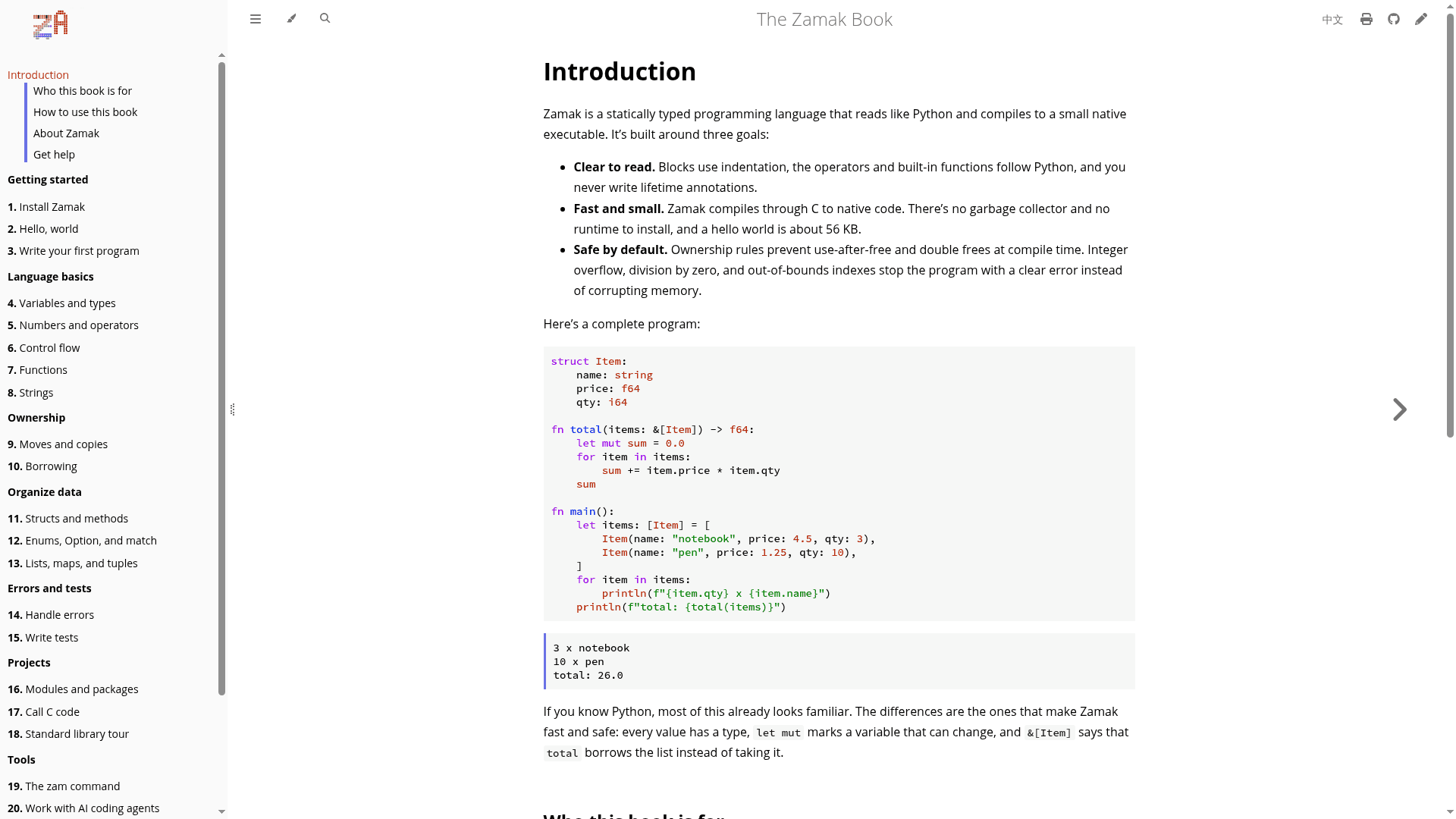
Zamak is a compiled language toolchain driven by the zam command. Programs use indentation-based blocks and Python-style operators and built-ins. The compiler generates C and builds it with MSVC, GCC, or Clang, so the resulting executable runs without Zamak installed. Ownership rules manage memory without a garbage collector, and the project says users never write lifetime annotations. Integer overflow, division by zero, and out-of-bounds indexes stop the program with a clear error.
Workflow and tooling
The zam command creates projects, checks types and ownership (zam check, which needs no C compiler), formats, tests, builds, runs, and generates HTML API docs. It also handles packages through a package index, with zam add, zam search, and zam publish. Modules are cached by content, so a one-line edit rebuilds only the changed module. A VS Code extension and the zam lsp language server provide diagnostics, completion, hover, go to definition, and formatting. C functions can be called through extern fn declarations.
Support for AI coding agents
Every diagnostic carries a stable code such as ZM301 and usually a suggested fix, and zam check --json emits diagnostics as JSON. zam new --template ai creates a project with a Claude Code skill file, an AGENTS.md guide, and an .mcp.json file. zam mcp runs an MCP server whose tools check, build, run, test, and format code, explain diagnostic codes, and look up docs.
Current Status
The README says syntax and cache formats might still change before 1.0 and recommends waiting before production use. It documents that threads and networking are not yet supported, C functions take and return only numbers, booleans, and strings, and there is no REPL. Performance and size comparisons against C, Rust, Go, Java, Node.js, and Python are project-published benchmark claims. The Zamak Book offers guided chapters in English and Chinese.
Community Discussions
Be the first to start a conversation about Zamak
Share your experience with Zamak, ask questions, or help others learn from your insights.
Pricing
Open Source
Zamak compiler and toolchain, open source under the MIT or Apache License 2.0 (dual license).
- Licensed under MIT or Apache-2.0, at your option
- Statically typed language compiling to native executables
- zam command-line tooling including zam mcp for AI agents
- Platforms: Windows, Linux, macOS
Capabilities
Key Features
- Python-like syntax with static typing
- Ownership-based memory safety without a garbage collector
- Compiles through C to standalone native executables
- Runtime checks for integer overflow, division by zero, and bounds
- Diagnostics with stable codes and JSON output
- Content-based module caching for fast rebuilds
- Built-in package management and package index
- C interop via extern fn
- Built-in test runner, formatter, and doc generator
- MCP server (zam mcp) for AI agents
- AI project template with skill file and AGENTS.md
- Language server and VS Code extension