zerostack
Minimal AI coding agent for the terminal written in Rust, featuring sandboxed execution, granular permissions, MCP support, and multi-provider LLM access.
At a Glance
Fully free and open-source under GPL-3.0. Install via Cargo, Homebrew, Nix, or curl script.
Engagement
Available On
Alternatives
Listed Sep 2026
About zerostack
zerostack is a lightweight, open-source AI coding agent built in Rust by Giuseppe Della Vedova, designed to run entirely in the terminal with a minimal resource footprint. It is licensed under GPL-3.0 and installable via Cargo, Homebrew, Nix, or a curl script. The project is actively maintained, with its latest release (v1.8.4) published in September 2026.
What It Is
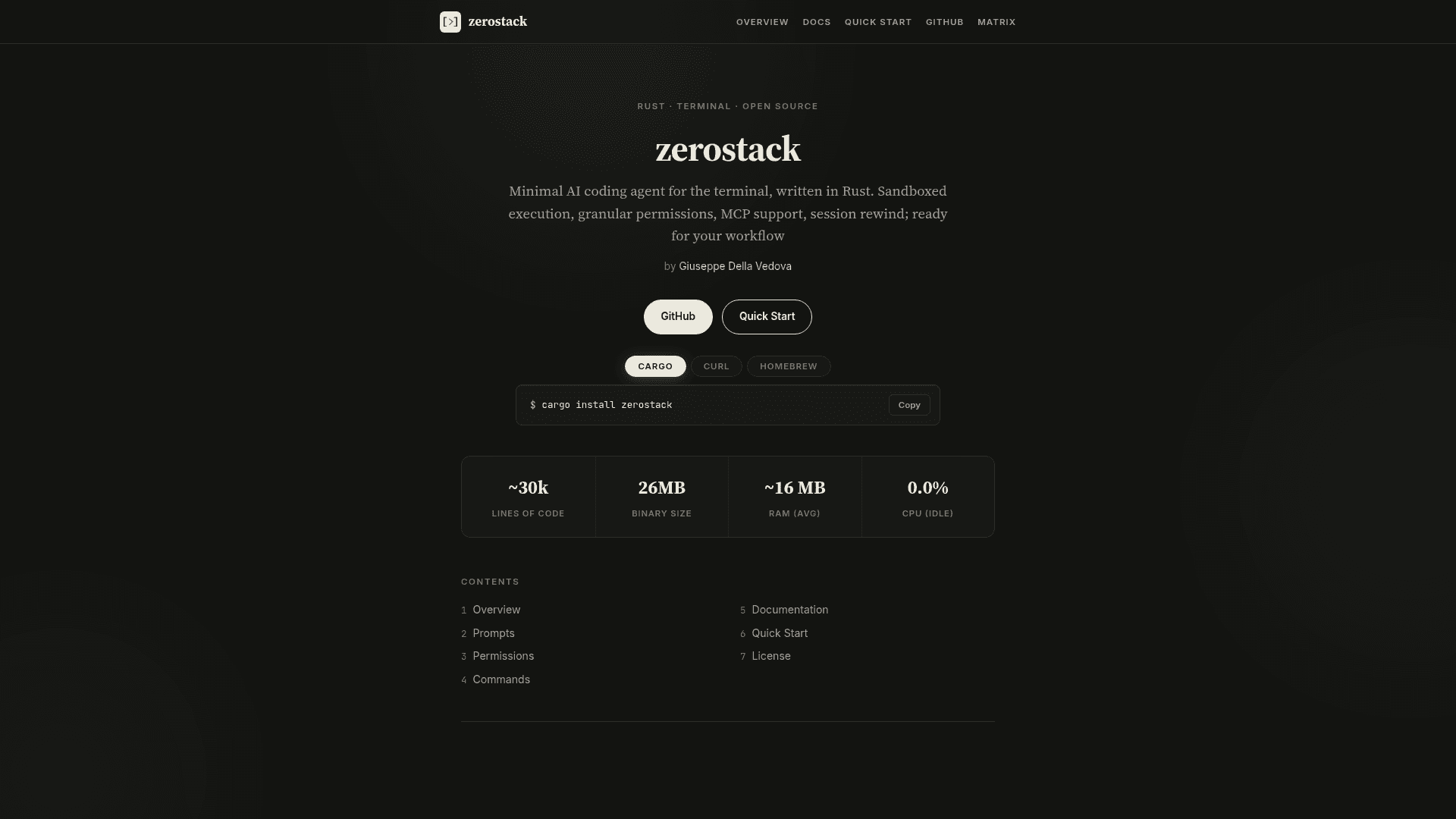
zerostack is a terminal-based coding agent that connects to multiple LLM providers and exposes a rich set of tools for reading, writing, editing, and executing code — all from a crossterm-based TUI with markdown rendering and mouse support. It is inspired by pi and opencode, and positions itself as a performance-conscious alternative to JavaScript-based coding agents. The README states a RAM footprint of approximately 16 MB on average (with peaks around 24 MB), compared to approximately 300 MB for opencode, and a binary size of 26 MB.
Architecture and Performance Profile
zerostack is written entirely in Rust, which the project credits for its low memory and CPU overhead. Key performance figures published in the README:
- ~30,000 lines of code (core, excluding tests)
- 26 MB binary size
- ~16 MB average RAM, ~24 MB peak
- 0.0% CPU at idle, ~1.5% when using tools (measured on an Intel i5 7th gen)
The agent runs as a single CLI binary and communicates with LLM providers over HTTP. It emits run-state events over a Unix domain socket (--status-socket) for integration with external status bars or tooling.
Permission System and Sandbox
One of zerostack's distinguishing design choices is its five-tier permission system:
- restrictive — asks for every operation
- readonly — allows only read/grep/list; denies writes, edits, and bash
- guarded — allows reads, asks for writes and bash
- standard (default) — allows path tools within the current working directory; safe bash commands auto-allowed
- yolo — allows everything, prompts only for destructive commands
Per-tool glob patterns, session allowlists, and doom-loop detection (identical tool calls repeated 3+ times trigger a warning or denial) are built in. An optional sandbox mode uses bubblewrap (Linux) or zerobox (macOS) to isolate bash commands, masking credential directories like ~/.ssh and ~/.aws by default.
Feature Set and Gated Capabilities
The default build includes multi-provider support (OpenRouter, OpenAI, Anthropic, Gemini, Ollama, and custom providers), MCP server integration, session save/load/resume with auto-compaction, 14 built-in switchable system prompts, Git worktree integration, parallel subagents, iterative coding loops, Exa web search, and prompt chaining (brainstorm → plan → code → review). Several advanced features are compile-time gated and require explicit feature flags:
- memory — plain-Markdown persistent memory across sessions
- hooks — lifecycle hooks compatible with Claude Code's
settings.jsonschema - advisor — a second model consulted mid-session for strategic guidance
- acp — Agent Communication Protocol server for editor integration (e.g., Zed)
- multimodal / pdf — image and PDF attachment support
Update: v1.8.4
The GitHub metadata shows the latest release is v1.8.4, published on 2026-09-07, with the repository last updated on 2026-09-14. The project has accumulated over 1,600 stars and 135 forks since its creation in May 2026. The developer has published blog posts covering the memory design, subagent architecture, and a "what we built in 2 weeks" retrospective, signaling rapid early development. A companion tool, multistack, is available separately for orchestrating multiple zerostack agents in parallel from the terminal.
Community Discussions
Be the first to start a conversation about zerostack
Share your experience with zerostack, ask questions, or help others learn from your insights.
Pricing
Open Source
Fully free and open-source under GPL-3.0. Install via Cargo, Homebrew, Nix, or curl script.
- Multi-provider LLM support
- Five-tier permission system
- MCP server integration
- Session management
- 14 built-in system prompts
Capabilities
Key Features
- Multi-provider LLM support (OpenRouter, OpenAI, Anthropic, Gemini, Ollama, custom)
- Five-tier permission system with per-tool glob patterns and session allowlists
- Sandboxed bash execution via bubblewrap or zerobox
- MCP server integration
- 14 built-in switchable system prompts (code, plan, review, debug, brainstorm, etc.)
- Session save/load/resume with auto-compaction
- Crossterm TUI with markdown rendering, mouse support, and scrollback
- Git worktree integration for branch-per-task workflow
- Parallel subagents for fast codebase exploration
- Iterative coding loops (Ralph Wiggum loops) for long-horizon tasks
- Prompt chaining (brainstorm → plan → code → review)
- Exa web search (WebFetch and WebSearch tools)
- Persistent memory across sessions (gated feature)
- Lifecycle hooks compatible with Claude Code settings.json schema (gated feature)
- Advisor: second model consulted mid-session (gated feature)
- ACP server for editor integration e.g. Zed (gated feature)
- Multimodal input: images and PDFs (gated feature)
- Status signals over Unix domain socket
- Doom-loop detection to prevent runaway agents
- Input queue for typing while agent is running
- Side questions via /btw without interrupting main agent
- Custom prompts via markdown files in XDG config directory
- ARCHITECTURE.md shared context file for all agents on a codebase