
Keen Code
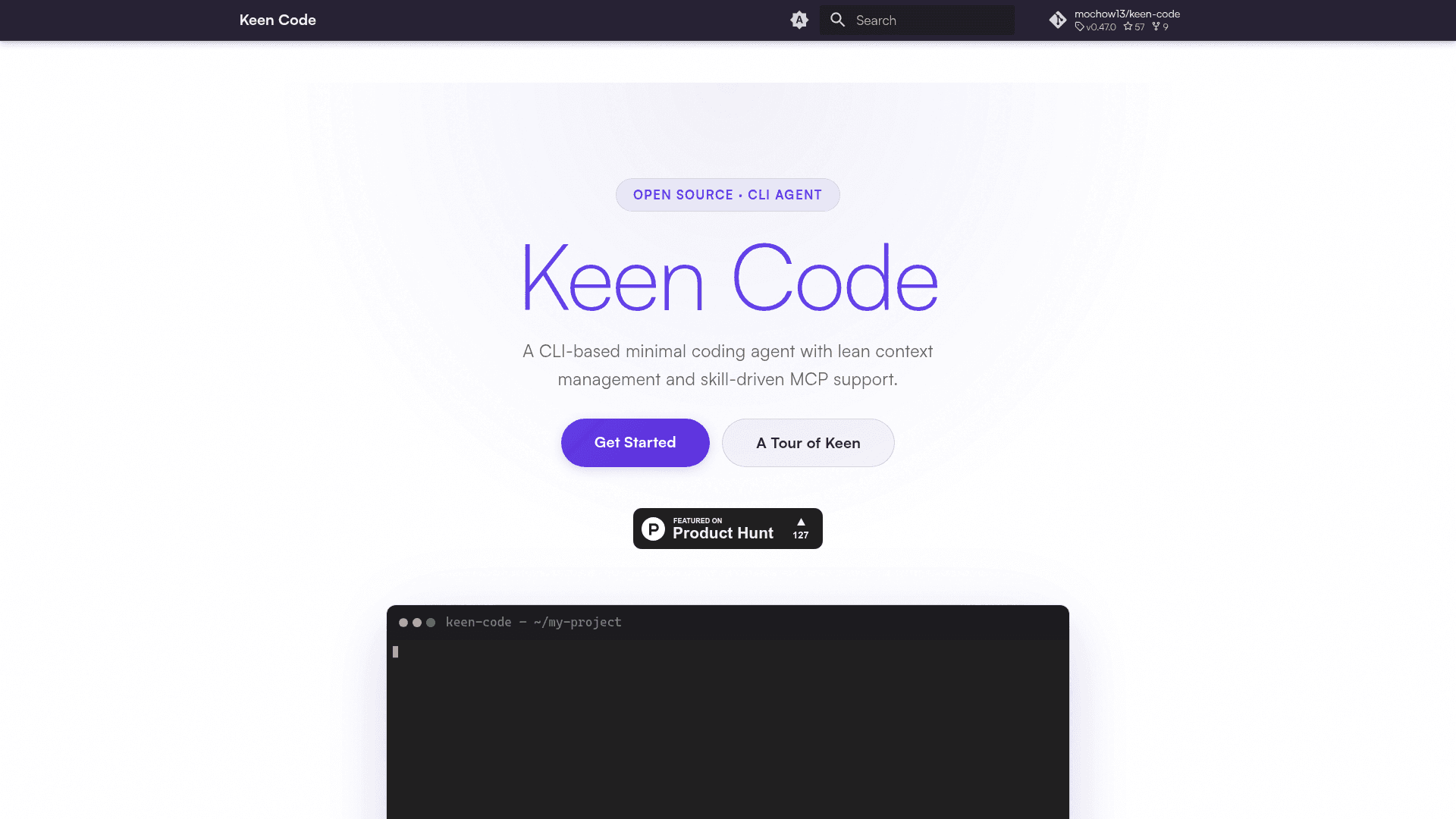
A terminal-based, open-source AI coding agent written in Go with lean context management, multi-provider support, MCP integration, and a skills system.
At a Glance
Fully free and open source under the MIT License. Install via script or npm.
Engagement
Available On
Alternatives
Listed Aug 2026
About Keen Code
Keen Code is a terminal-based AI coding agent written in Go, positioned as a simpler and lighter alternative to tools like Claude Code or Codex CLI. It is open source under the MIT License and available at version v0.47.0. The project was itself built using AI coding agents, making it both a functional tool and a showcase of agentic software development.
What It Is
Keen Code is a CLI coding agent designed for typical software engineering tasks — reading, writing, editing, searching, and running shell commands — with a deliberately minimal feature set. It connects to multiple AI providers, supports MCP (Model Context Protocol) servers, and introduces a skills system for specialized sub-agent workflows. The project's stated philosophy is to avoid unnecessary complexity and keep the agent harness as simple as possible.
Architecture and Context Management
One of Keen Code's defining design choices is its conservative approach to cross-turn context. Rather than carrying raw tool call results forward as conversation history, it attaches a bounded TurnMemory summary to assistant messages. This summary records where tools ran, their bounded inputs, status, and non-zero bash exit codes — but does not persist tool outputs or infer file-change outcomes. The tradeoff, as the project documentation describes it, is "smaller context and a better signal-to-noise ratio, at the cost of occasionally re-reading files or re-running searches when older observations are needed again."
Skills System and MCP Integration
Keen Code extends its core toolset through two layered mechanisms:
- Skills system — Custom slash commands that invoke specialized sub-agents for workflows like planning, debugging, refactoring, and code review.
- MCP Skills — A combination of slash commands with MCP server integrations, allowing external tools and data sources to be wired into skill-driven workflows.
- MCP OAuth — Supports OAuth-based authentication for MCP servers, including a browser-based ChatGPT/Codex OAuth flow that stores credentials locally.
Supported Providers and Built-in Tools
Keen Code supports a wide range of AI providers switchable at runtime with /model:
- Anthropic, OpenAI, Codex (ChatGPT OAuth), Google AI (Gemini), DeepSeek, Moonshot AI (Kimi), Z.ai (GLM), MiniMax, OpenCode Go, and Amazon Bedrock.
Six built-in tools ship out of the box: read_file, write_file, edit_file, glob, grep, and bash. The edit tool uses hash-anchored multi-op edits applied atomically, and the read tool uses N:HASH| line anchors for precise referencing.
Development Philosophy and Lineage
Keen Code was built using a strict spec → plan → task → review cycle, with all code written by AI agents under human orchestration. The human engineer's role was limited to specifying requirements, reviewing design documents, influencing design decisions, and testing. Nearly all prompts and AI-generated outputs are saved as markdown files in the .ai-interactions/ directory, making the project a transparent record of agentic software development in practice.
Update: v0.47.0
The latest release is v0.47.0, published on August 10, 2026. The repository shows active development with recent pushes and a public roadmap. Notable recent additions documented in the changelog and issue history include subagent support with multi-agent orchestration, auto-compaction, MCP OAuth, a webfetch tool, and a memory design system. The roadmap signals continued investment in agent capabilities and provider coverage.
Community Discussions
Be the first to start a conversation about Keen Code
Share your experience with Keen Code, ask questions, or help others learn from your insights.
Pricing
Open Source
Fully free and open source under the MIT License. Install via script or npm.
- All features included
- MIT License
- Self-hosted
- No usage limits imposed by the tool
Capabilities
Key Features
- Multi-provider AI support (Anthropic, OpenAI, Gemini, DeepSeek, Bedrock, and more)
- 6 built-in tools: read_file, write_file, edit_file, glob, grep, bash
- Skills system with custom slash commands for specialized sub-agents
- MCP server integration with OAuth support
- MCP Skills combining slash commands with external tool integrations
- TurnMemory lean cross-turn context management
- User-triggered context compaction with /compact
- Session management with persistent resume capability
- Thinking mode with configurable effort levels
- Subagents with multi-agent orchestration
- Switch models at runtime with /model
- Anonymous opt-out telemetry