Beam is America’s answer to Kimi, Qwen and GLM. Is it actually competitive?


Reflection’s Beam gives developers another model to consider for coding agents. The interesting question is whether it can finish useful work at a better cost, with deployment options that make it worth switching.
The evidence supports a narrower answer than the launch headline suggests: Beam looks competitive with some established open models on selected tests. It does not establish a new capability leader. Its efficiency claim is worth investigating, but developers still need access, reproducible evaluations and actual serving costs before they can judge the tradeoff.
This is an assessment of the public announcement as of October 6, 2026. We have not independently tested Beam.
An American alternative is a reason to look, not a benchmark result
“America’s answer” describes the proposed alternative to model families such as Kimi and Qwen. It doesn’t tell us whether an agent will produce a correct change, whether the model fits a deployment budget, or whether the license meets a company’s needs.
Those are separate decisions. A team that needs another deployment option may accept lower performance on some tasks. A team buying the highest task completion rate may make a different choice. A good comparison should name the requirement before it names the winner.
The distinction matters for coding agents because the model is only part of the system. The surrounding agent chooses tools, manages context, runs tests and decides when to stop. Moving a model into an unfamiliar agent can change the outcome even when its benchmark score looks strong.
What Reflection has actually announced
Beam is a text-only mixture-of-experts model with 501 billion total parameters and 23 billion active parameters. Access is selective through a waitlist. Reflection promises Apache 2.0 weights and developer artifacts later in October; those are planned releases, not a download available today. Public pricing is unavailable. Reflection’s announcement.
The current API docs list a 256K context window and 128K maximum output. The announcement’s 1M effective-context claim is a different figure; use the hosted limit when planning requests. Official model documentation.
That makes today’s practical decision whether to apply for access and prepare an evaluation. It is too early to write a production migration guide or assume that self-hosting is ready.
Open weights would let teams investigate and operate the model more directly. Whether that translates into an attractive deployment depends on the artifacts that arrive, their license terms, supported runtimes and the hardware required. Keep those questions on the checklist until the release is inspectable.
Recommended
VS Code Agents Can Now Work While You're Away
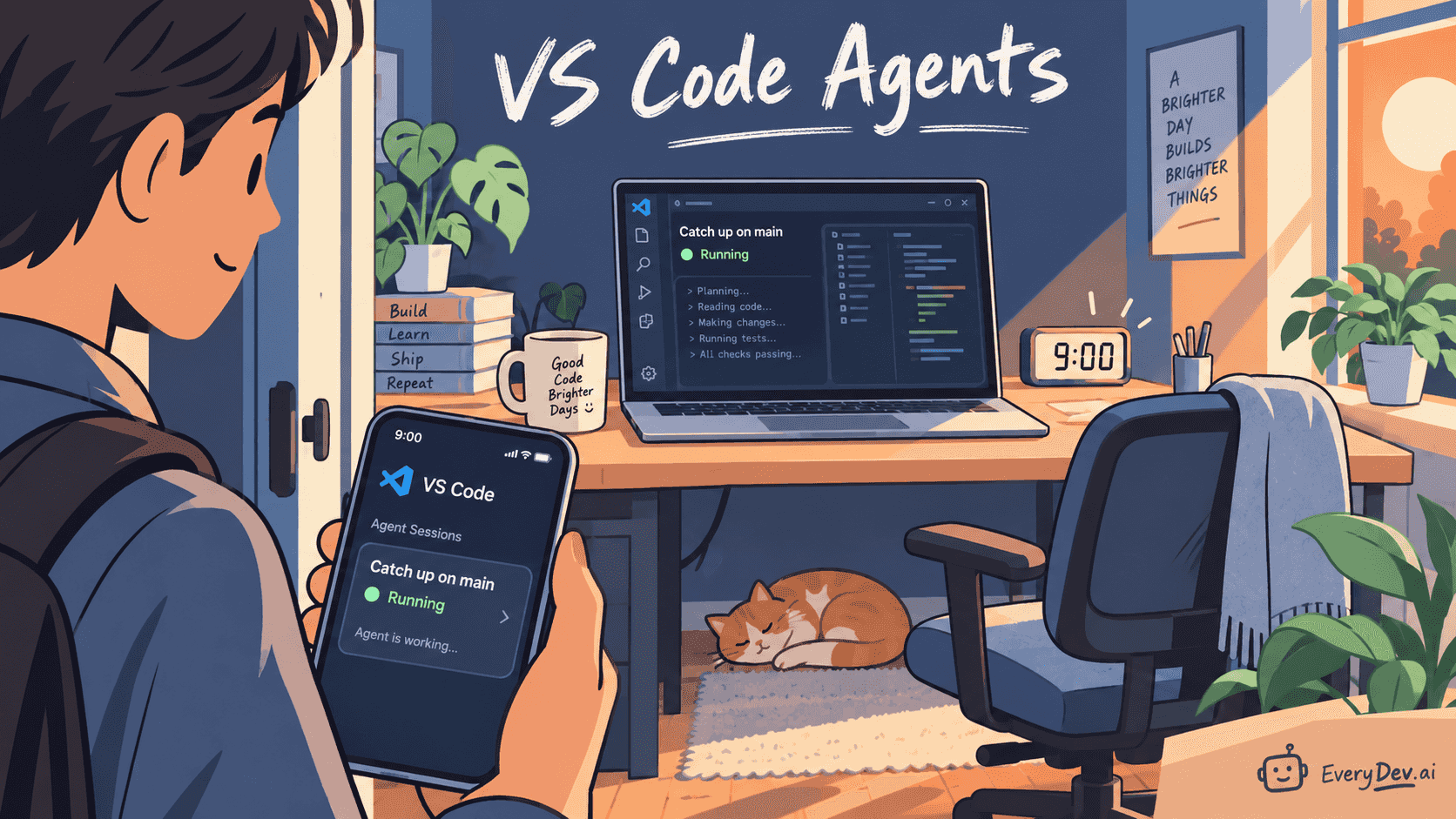
You can now ask a VS Code agent to check your repository every morning without starting the session yourself. On my machine, the Automations page in VS Code 1.140 offered a template called Catch up on main, set to run ev…
Read nextThe published scores show a contender, not a clean win
Here are two rows from Reflection’s comparison. Higher is better; missing results are not inferred.
| Evaluation | Beam | GLM 5.2 | GLM 5.3 | Kimi K3 | Qwen 3.8 Max |
|---|---|---|---|---|---|
| DeepSWE v1.1 | 44.4 | 44.0 | 61.0 | 68.0 | 51.0 |
| Terminal Bench v2.1 | 80.1 | 81.0 | 88.2 | 88.3 | 86.6 |
This is a vendor-published table assembled using multiple evaluation sources. It is not an independent, controlled comparison by EveryDev.ai. Source and methodology.
On these rows, Beam sits close to GLM 5.2 and behind the newer comparison models. The results justify trying Beam; they do not justify calling it the best open coding model.
Before comparing a number from this table with another leaderboard, match the benchmark version, agent, reasoning settings and budget. A similarly named benchmark can contain different tasks or use a different evaluation setup. Those details can change which result is useful for your decision.
Less estimated compute still needs a cost test
Reflection claims roughly three to four times less inference compute than GLM 5.2 on selected reasoning comparisons. Its estimate excludes prompt prefill, context-dependent attention and serving overhead. It is not measured API cost or latency. Methodology.
For a developer, the useful unit is the cost of an accepted change. A cheaper attempt can become more expensive if it needs another attempt, a longer test run or substantial human repair. Conversely, a slightly less capable model may be a good choice for a large volume of routine work if it finishes that work reliably and cheaply.
Measure both. Record model charges, agent runtime, tool costs, retries and reviewer time. Keep the final patch and test results so another person can check whether “completed” means what you intended.
The active parameter count also needs careful interpretation. It describes which parameters participate in token processing. It is not a complete memory requirement for loading the experts and handling context. Wait for runtime guidance and real hardware measurements before treating Beam as a small model you can run on a development laptop.
How to test whether it earns a place in your agent
Start with a small set of repository tasks that reflect your actual work: a bug with a regression test, a change spanning several files, a dependency upgrade and a task that requires finding the right code before editing it. Avoid selecting only tasks that one model already solved well.
Use the same agent harness and tool permissions for each model. If you use OpenCode, keep its configuration stable. Tools such as Kimi Code and Qwen Code are also useful products to explore, but comparing their complete experiences answers a different question from comparing models inside one harness.
Set a time and spending budget in advance. Allow each model the same opportunity to recover from failed tests. Repeat tasks enough to see whether a promising result is consistent rather than a lucky run.
Score outcomes with tests and human review. Track whether the patch solves the requested problem, introduces a regression, changes unrelated code or requires cleanup. Include failures and abandoned runs in the cost calculation.
Then examine the deployment requirement separately. For a hosted service, check access, rate limits, retention and operational reliability. For self-hosting, measure memory, throughput, long-context behavior and the engineering time needed to operate it. Avoid substituting a benchmark score for either review.
What would change the verdict?
A released checkpoint, usable runtime instructions and reproducible evaluations would let developers test the claim directly. Published pricing and measured serving performance would make the efficiency argument much easier to assess.
Independent results on repository work would matter more than another collection of attractive demos. The strongest evidence would show accepted patches, failure rates and total cost under comparable settings.
Beam has earned a place on the evaluation list. It has not yet earned a default recommendation over Kimi, Qwen or GLM. If the planned release makes it practical to deploy and its efficiency survives a real task budget, it could be valuable without winning every benchmark. That is the competitive question worth following.
Editorial checkpoint: Recheck access, weights, pricing and benchmark methodology before publishing. The listing uses a contact-for-pricing plan; no numerical price or free access is verified.
Comments
No comments yet
Be the first to share your thoughts