
ACRYL
Open-source platform and framework for building agentic apps from swappable plugins, each with a built-in coding agent.
At a Glance
ACRYL framework, launcher, and ADE are MIT-licensed open source; run locally on your own machine. Model provider keys are an external cost.
Engagement
Available On
Alternatives
Listed Nov 2026
About ACRYL
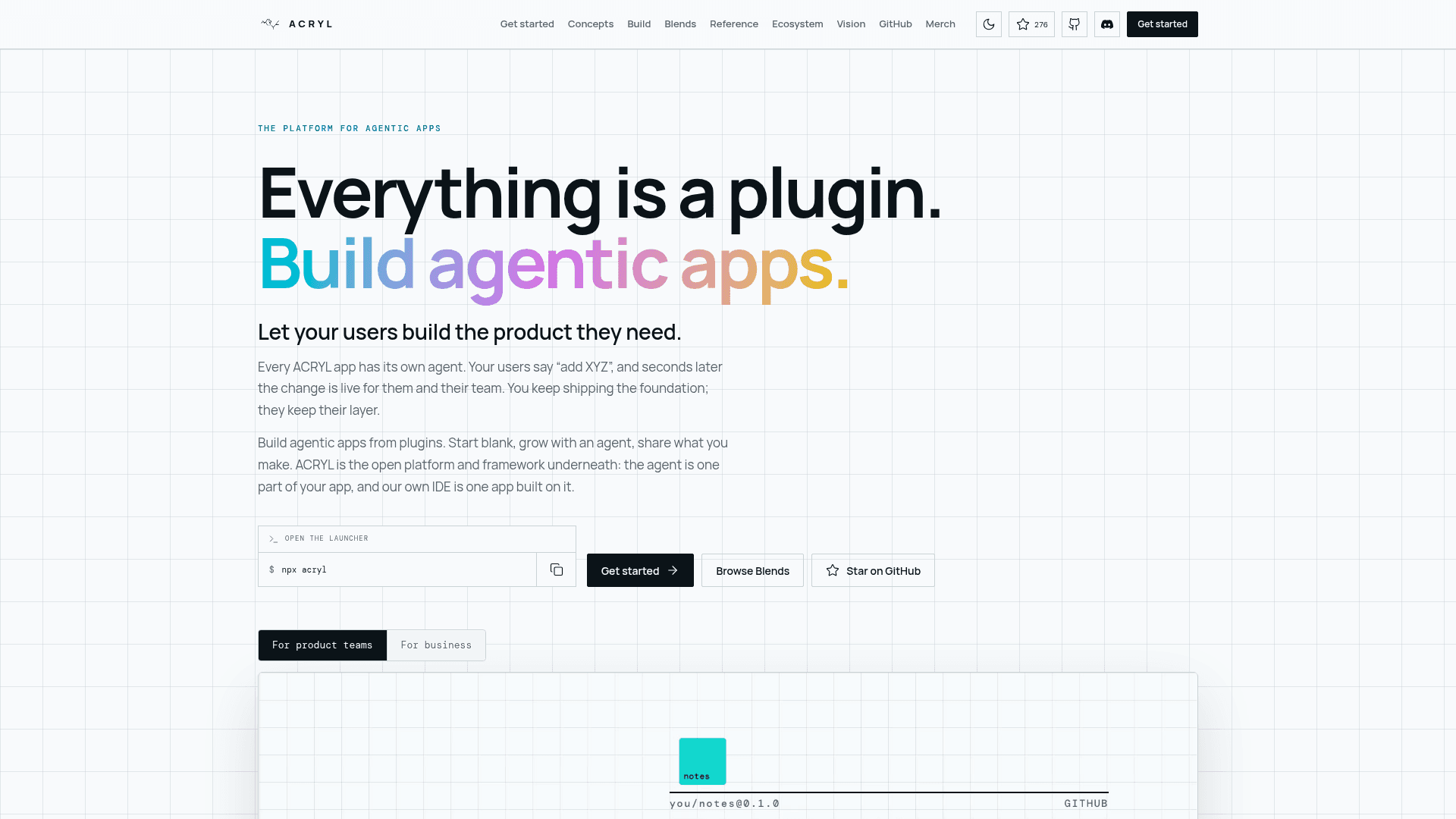
ACRYL is an open platform and framework for building agentic apps out of plugins, published by the acryldev organization under the MIT license. Every app has its own agent, so users can ask for a change such as "add XYZ" and have it applied to their own layer while the app's foundation keeps shipping. It runs from the command line via npx acryl, with a desktop app (v0.2.7) also offered for Linux, macOS and Windows.
What It Is
ACRYL is a framework for assembling apps from Cordis plugins, where a plugin is the only unit of capability: a page, a tool or a service. Its model has five parts: an App (a folder containing blend.yaml, plugins and data), a Host (one process per app that loads and swaps plugins live), Plugins, Surfaces (Web or Desktop) and Drivers (agents working inside the app). The built-in chat is one driver; Claude Code, Codex, Pi, Cursor CLI, Qwen Code, Amp and Goose are listed as agents that have built plugins into running apps.
How Users Build on an App
The agent writes plugins into the running app, and the page appears without a restart. Each app runs in its own sandboxed instance, on the user's machine or in a WebBox. A user's changes are saved as a versioned layer called a Blend, which can be rolled back, shared to GitHub and listed in a store. Running npx acrylblends update merges new foundation releases beneath the user's layer. Plugins can also be published to GitHub and pulled into other apps by address, and an outside agent can drive an app through command-line and MCP commands.
Ways to Start
Node.js 22.19 or newer, npm and git are required. npx acryl opens the launcher, npx acryl new my-app creates a blank app with an agent inside, and --from creates an app from a catalog Blend. Catalog entries include ACRYL ADE (an agentic development environment with projects, worktrees, chats, terminals and diffs), ACRYL Control Center, ACRYL SDE and various example apps. The project also offers ACRYL microVMs for running untrusted agent-written code. The site marks a terminal surface and hosted WebBoxes as coming.
Community Discussions
Be the first to start a conversation about ACRYL
Share your experience with ACRYL, ask questions, or help others learn from your insights.
Pricing
Open Source (MIT)
ACRYL framework, launcher, and ADE are MIT-licensed open source; run locally on your own machine. Model provider keys are an external cost.
- MIT licensed framework, launcher, ADE and registries
- Run on Web and Desktop (macOS, Windows, Linux)
- Built-in agent builds plugins live
- Share and pull plugins and Blends
- Bring your own agent (Claude Code, Codex, pi, etc.)
Capabilities
Key Features
- Agent inside every app that writes plugins into the running app without a restart
- Plugin-based architecture built on Cordis
- Blends: versioned, shareable app layers with rollback
- Update merging that preserves user changes under new foundation releases
- Share and pull plugins via GitHub
- Blends catalog and starter apps
- Per-app sandboxed instances
- Web and Desktop surfaces
- Command-line and MCP door so external agents can drive apps
- ACRYL ADE agentic development environment
- ACRYL microVMs for isolating untrusted code
- Bring your own coding agent