
Agent Governance Toolkit
Open-source toolkit for policy enforcement, identity, sandboxing, and SRE controls for autonomous AI agents.
At a Glance
About Agent Governance Toolkit
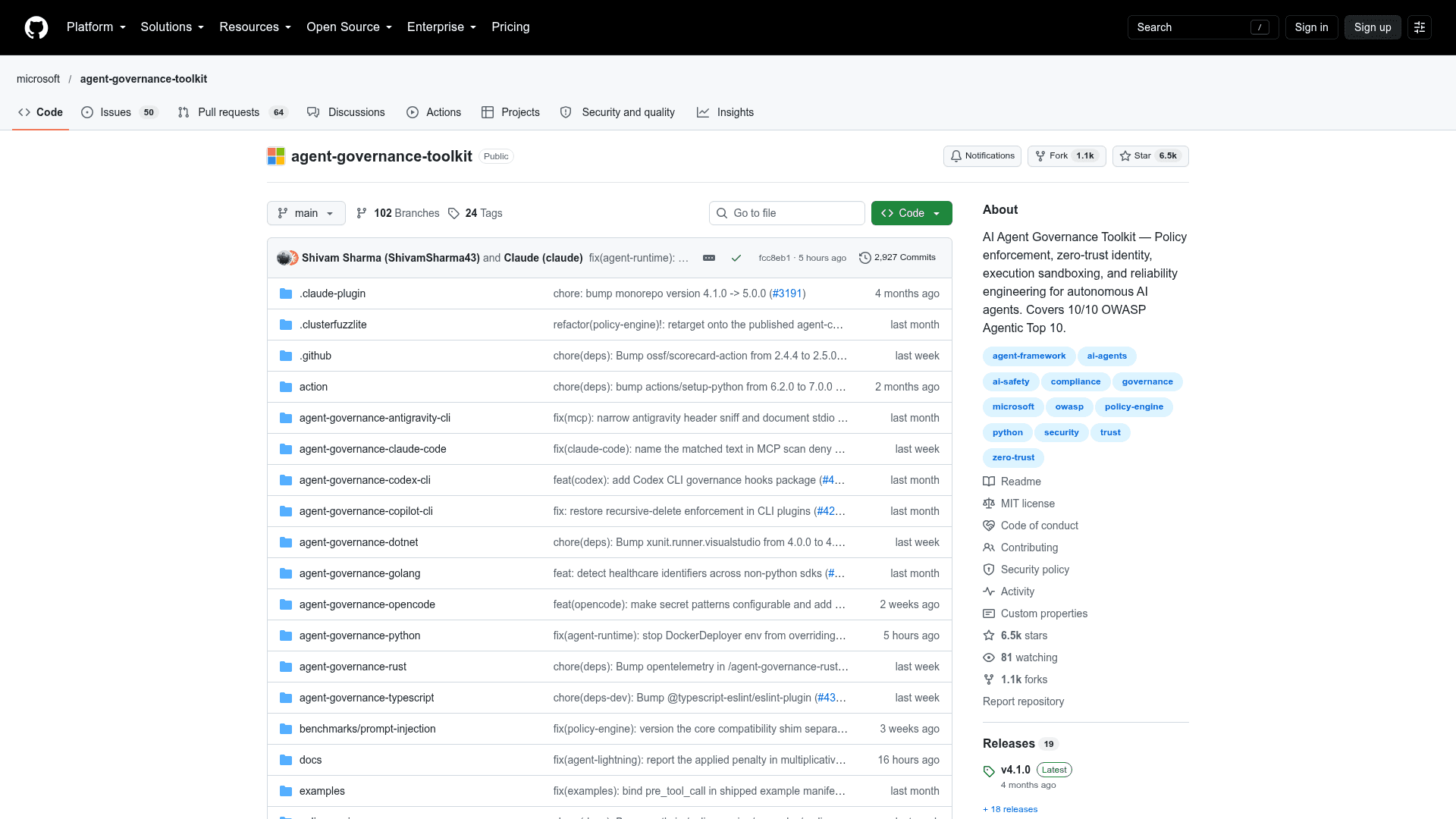
Agent Governance Toolkit (AGT) is an open-source project from Microsoft that adds policy enforcement, agent identity, audit logging, execution sandboxing, and reliability controls to autonomous AI agents. It is distributed as Python, TypeScript, .NET, Rust, and Go packages, and the project is in a public preview that may have breaking changes before GA.
What It Is
AGT is a governance layer for AI agents that call tools, query databases, and delegate to other agents. Every tool call, message send, and delegation is intercepted in deterministic application code before it executes, so denied actions are blocked rather than left to prompt-level instructions. Policies are written in YAML (the README also mentions OPA and Cedar), and a blocked call raises a GovernanceDenied error. Rules can also require human approval for actions such as sending email.
How the Governance Flow Works
An agent's action passes through a policy engine, then identity checks (SPIFFE, DID, mTLS), and is recorded in a tamper-evident audit log as a decision record. Each layer is optional, so teams can start with the govern() wrapper around a tool function and add layers as risk grows. The policy engine is based on the upstream Agent Control Specification, a stateless, fail-closed decision runtime with a Rust core.
Packages and Capabilities
- Agent OS: policy engine and governance gate.
- Agent Mesh: discovery, routing, and trust.
- Agent Runtime: sandboxing with four privilege rings.
- Agent SRE: kill switch, SLOs, and chaos testing.
- Agent Compliance: OWASP verification and policy linting.
- Agent Marketplace: plugin governance and trust scoring.
- Agent Lightning: governance for reinforcement-learning training.
- Agent Hypervisor: execution audit and command denylist enforcement.
- MCP security gateway: tool poisoning, drift, and typosquatting detection.
- Shadow AI discovery.
- Governance dashboard.
The agt CLI provides doctor, verify, red-team scan, and lint-policy commands.
Framework Support and Standards
The README lists integrations with Microsoft Agent Framework, Semantic Kernel, AutoGen, LangChain/LangGraph, CrewAI, OpenAI Agents SDK, Google ADK, LlamaIndex, Haystack, Mastra, Dify, and Claude Code, Copilot CLI, Codex CLI, and OpenCode installers. It publishes compliance mappings to the OWASP Agentic AI Top 10, NIST AI RMF, EU AI Act, and SOC 2.
Security Boundary
AGT enforces governance at the application middleware layer, not the OS kernel, with the policy engine and agents sharing a process boundary. The README recommends running each agent in a separate container for OS-level isolation in production.
Community Discussions
Be the first to start a conversation about Agent Governance Toolkit
Share your experience with Agent Governance Toolkit, ask questions, or help others learn from your insights.
Pricing
Open Source (MIT)
Agent Governance Toolkit core is released under the MIT License and can be used, copied, modified and distributed free of charge. Currently a public preview.
- MIT License
- Policy engine, capability model, audit, MCP gateway, zero-trust identity
- Privilege rings, saga orchestration, termination control
- SLOs, error budgets, chaos engineering, circuit breakers
- agt CLI, OWASP verification, policy linting
Capabilities
Key Features
- YAML policy enforcement with allow, deny, and require-approval actions
- govern() wrapper for tool functions
- Tamper-evident audit logging
- Zero-trust agent identity (SPIFFE/DID/mTLS)
- Execution sandboxing with privilege rings
- Kill switch, SLO monitoring, and chaos testing
- MCP security gateway for tool poisoning and drift detection
- Shadow AI discovery
- Governance dashboard
- OWASP, NIST AI RMF, EU AI Act, and SOC 2 compliance mapping
- agt CLI for verification, red-team scanning, and policy linting
- Multi-language SDKs (Python, TypeScript, .NET, Rust, Go)