
Agent-Native
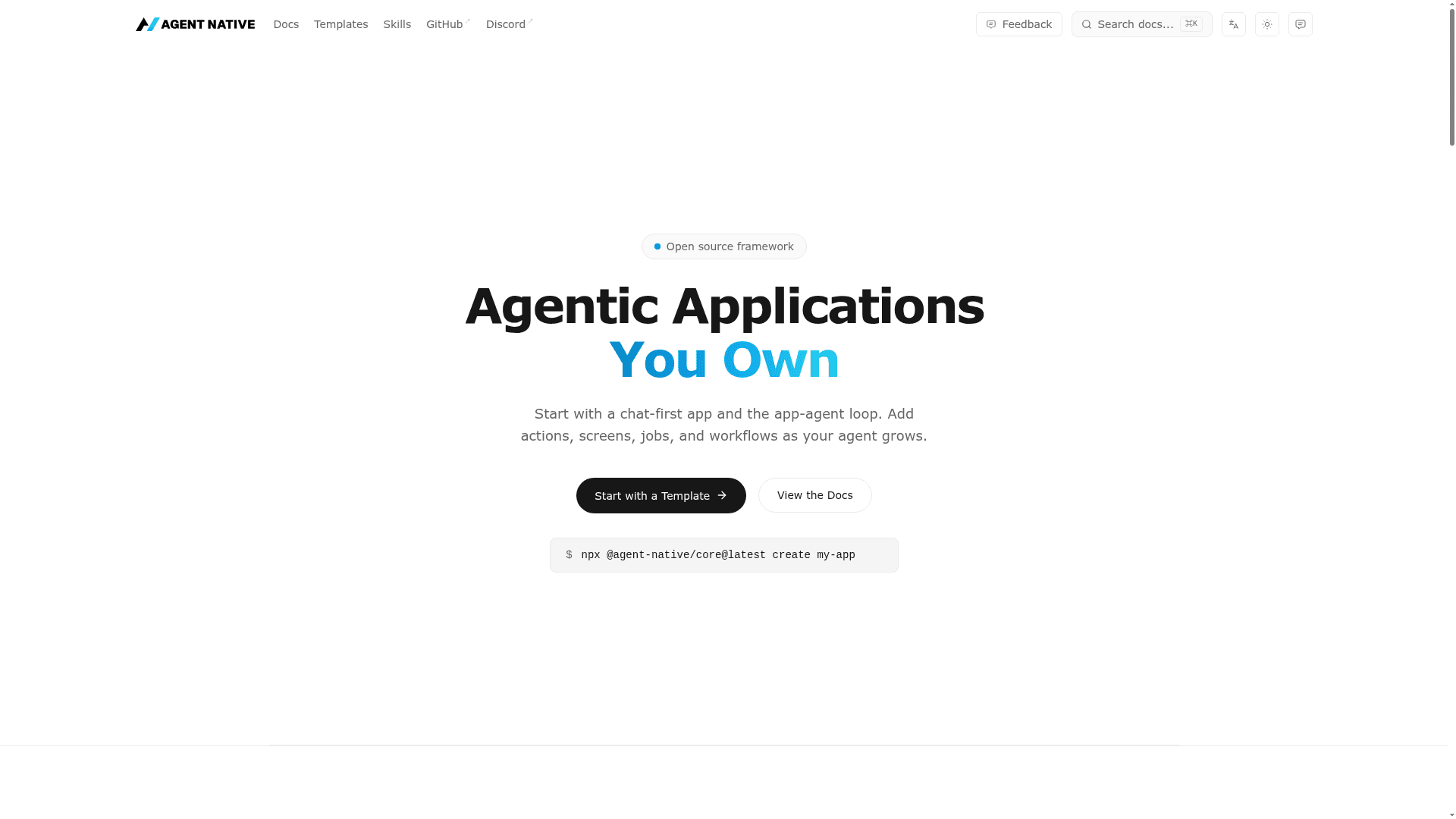
An open-source framework for building agent-native applications where AI agents and UIs share the same actions, state, and data.
At a Glance
About Agent-Native
Agent-Native is an open-source framework from BuilderIO for building agentic applications where the AI agent and the UI are equal citizens of the same system. It provides primitives for product-grade agentic software — shared actions, SQL-backed state, identity, tools, skills, jobs, observability, and UI surfaces — all working together. The project is hosted on GitHub under the BuilderIO organization and is available under the MIT license.
What It Is
Agent-Native is a TypeScript framework that lets developers define a single action once and have it automatically available from the chat UI, CLI, HTTP endpoints, MCP, A2A (agent-to-agent), scheduled jobs, and webhooks. Rather than bolting AI onto an existing app or building a raw agent with no UI, Agent-Native positions itself as a middle path: a full-featured, forkable application framework where the agent is a first-class peer alongside the user interface.
Core Architecture
The framework is built around three primitives:
- Actions: Typed, Zod-validated operations defined once with
defineAction(). A single action file fans out to every consumer — agent, UI, HTTP, MCP, A2A, CLI — with no extra wiring. - Agent runtime: Chat, tools, skills, memory, jobs, observability, and handoffs ship together. State is SQL-backed (SQLite locally, any Drizzle-supported database in production).
- Agent surfaces: Headless (no UI), chat, embedded sidebar, or full app — all sharing the same actions and state.
The framework is backend-agnostic: developers bring their own database, hosting provider, and model stack. The server layer is built on Nitro, and the frontend uses React Router and Vite.
Templates and Skills
Agent-Native ships with a gallery of complete, forkable open-source app templates — not scaffolds, but full SaaS-style applications the developer owns entirely:
- Clips: Screen recording with auto-transcripts and browser debug capture, positioned as an alternative to Loom and Granola.
- Plans: Visual planning mode for coding agents like Claude Code, Codex, and Cursor, with diagrams, wireframes, and review links.
- Design: HTML prototyping studio using Alpine/Tailwind, with variant comparison and export.
- Content: Local Markdown/MDX editor with AI drafting and publishing, positioned as an alternative to Obsidian.
- Slides: Prompt-driven presentation builder with 8 layouts and AI image generation.
- Analytics: Connect data sources, prompt for charts, and build reusable dashboards.
For developers who don't want to scaffold a full app, Agent-Native also offers installable skills — one-command additions to existing coding agents. The visual-plan skill adds /visual-plan and /visual-recap slash commands to Claude Code, Codex, Cursor, GitHub Copilot, and similar tools.
Batteries-Included Feature Set
The framework includes a broad set of production-ready building blocks: notifications, recurring jobs, RBAC, organizations, workspace secrets, observability, real-time sync, multi-tenancy, data loaders, live queries, MCP + A2A support, human handoff, durable resume, SSO, OAuth, audit logs, rate limits, queues, cron schedules, evals, file uploads, webhooks, and self-editing code capabilities.
Update: @agent-native/skills@0.2.144
The latest release as of late June 2026 is @agent-native/skills@0.2.144, published on June 26, 2026. The repository was created in March 2026 and has seen rapid iteration, with the GitHub repository accumulating over 2,500 stars and 243 forks according to GitHub metadata. The project is actively maintained with frequent pushes to the main branch.
Community Discussions
Be the first to start a conversation about Agent-Native
Share your experience with Agent-Native, ask questions, or help others learn from your insights.
Pricing
Open Source
Fully free and open-source framework available on GitHub under the MIT license.
- Full framework source code
- All templates (Clips, Plans, Design, Content, Slides, Analytics)
- Skills system
- MCP and A2A support
- SQL-backed state
Capabilities
Key Features
- Define actions once, use from UI, agent, HTTP, MCP, A2A, and CLI
- SQL-backed state with SQLite locally and any Drizzle-supported DB in production
- Chat UI, headless, embedded sidebar, and full app surfaces
- Forkable open-source SaaS templates (Clips, Plans, Design, Content, Slides, Analytics)
- Installable skills for existing coding agents (visual-plan, visual-recap)
- Agent runtime with tools, skills, memory, jobs, observability, and handoffs
- Real-time multiplayer with humans and agents as first-class peers
- RBAC, organizations, workspace secrets, SSO, OAuth
- MCP and A2A (agent-to-agent) support
- Recurring jobs, cron schedules, queues, rate limits
- Generative UI and tool calls
- Self-editing code — agent can modify the app itself
- Human handoff and durable resume
- Audit logs, observability, evals, feedback loops
- One-command project creation via npx