
Agnost AI
Agnost AI continuously analyzes production conversations to catch agent failures your evals miss, surfaces where users get stuck or frustrated, and opens reviewed PRs to fix your agent.
At a Glance
About Agnost AI
Agnost AI is a Y Combinator-backed production intelligence platform for AI agents. It continuously reads real production chat and voice conversations, identifies where users get stuck, frustrated, or fail to convert, and turns the highest-impact failure patterns into reviewed code fixes. Setup takes approximately two minutes and the tool is OpenTelemetry native, working with any LLM or agent framework.
What It Is
Agnost AI sits in the gap between offline evaluations and real-world agent performance. Traditional evals test against known scenarios, but production conversations surface failure modes that no eval suite anticipated — broken workflows, repeated retries, setup friction, and churn risk. Agnost AI ingests those live conversations, clusters them into intent and failure categories, and proposes concrete fixes that engineering teams can review and merge. The core loop is: connect → detect failures → review suggested PRs → ship improvements.
How the Workflow Operates
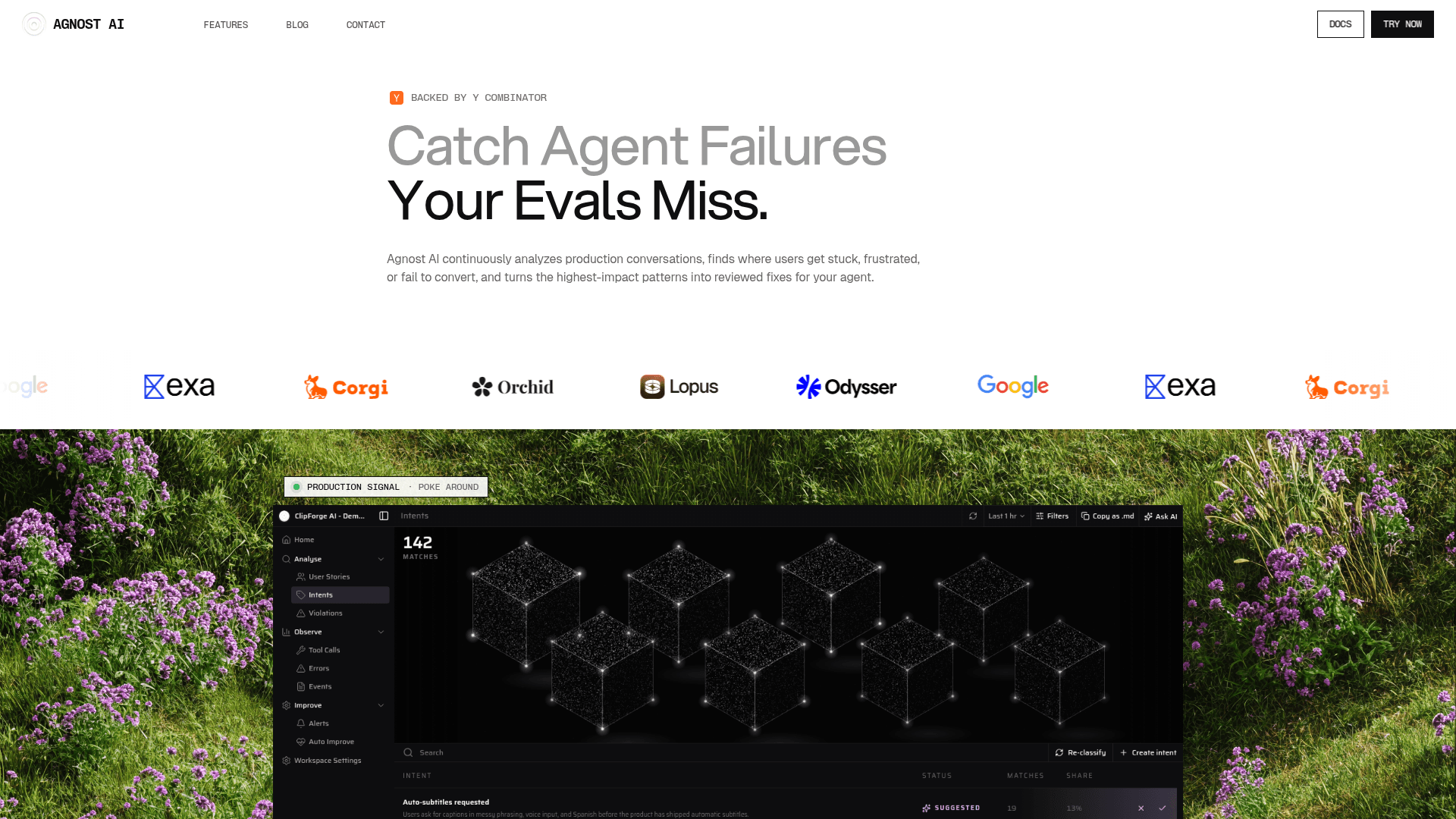
Once connected, Agnost AI automatically generates failure categories relevant to the product — things like "export/download confusion," "repeat prompt frustration," or "tool failed during render." Each category shows match counts, share of total conversations, and status (active or suggested). Teams can query the data in natural language, re-classify intents, and create custom intent definitions. The Improve section surfaces alerts and supports an "Auto Improve" mode that can open PRs autonomously overnight. According to the vendor, one customer (Lopus AI) had 16 of 18 autonomous PRs merged.
Architecture and Integration
Agnost AI is OpenTelemetry native and claims compatibility with any LLM and any agent framework. The vendor states setup takes about two minutes. The platform includes sections for analyzing intents and sentiment, observing tool calls, errors, and events, and an improvement layer for alerts and automated fixes. Google Cloud's MCP Toolbox for Databases team published a blog post describing their integration of Agnost AI observability features into that product.
Target Audience
Agnost AI is aimed at engineering and product teams building and operating AI agents in production — particularly those who have already shipped an agent and are seeing silent failures that offline evals do not catch. The platform is positioned for teams that need to iterate quickly on agent quality without a dedicated ML ops team.
Why It Got Attention
Agnost AI is backed by Y Combinator, which provides a notable signal for an early-stage developer tool. The homepage features testimonials from engineers at Google, Exa, Corgi Insure, Odysser, Comp AI, and Lopus AI, all attributed by name and role. The Odysser CTO is quoted saying the tool surfaced 1,247 feature requests from existing conversations that the team had no visibility into. These are vendor-published claims on the product homepage.
Community Discussions
Be the first to start a conversation about Agnost AI
Share your experience with Agnost AI, ask questions, or help others learn from your insights.
Pricing
Starter
Best for teams shipping agents that need to get better fast.
- Intent & sentiment signal extraction
- Automatic agent improvements
- Failure detection & resolution
- Natural language data queries
- Up to 1,000 messages / mo
Pro
Best for growing teams scaling agent volume without a sales call.
- Everything in Starter
- Up to 100,000 messages / mo
- 90-day data retention
- Priority support
- Founders Slack channel
Enterprise
Best for organizations running agents at scale.
- Custom data retention
- Audit logs
- Custom SLAs & SLOs
- Custom improvement workflows
- Priority feature requests
- Founders Slack channel
- Unlimited time with the founders
Capabilities
Key Features
- Production conversation analysis
- Intent and sentiment signal extraction
- Automatic agent improvement suggestions
- Failure detection and resolution
- Natural language data queries
- Autonomous PR generation for agent fixes
- Tool call and error observability
- Alert system for production failures
- OpenTelemetry native integration
- Works with any LLM and any agent framework
- 2-minute setup