
Apache APISIX
Open-source, cloud-native API gateway and AI gateway built on NGINX and etcd for routing, securing and observing API and LLM traffic.
At a Glance
About Apache APISIX
Apache APISIX is an open-source API gateway and AI gateway developed as a top-level project of the Apache Software Foundation. It handles dynamic routing, load balancing, authentication and observability for APIs, microservices and LLM workloads. The latest release listed is 3.19.0, published on September 28, 2026.
What It Is
APISIX is a traffic management layer built on NGINX and etcd. It can handle north-south traffic and east-west traffic between services, and can also act as a Kubernetes ingress controller. Configuration is distributed through etcd, and routes and plugins can be updated without restarts. It runs on bare metal or Kubernetes and supports ARM64.
Plugin Pipeline and Protocols
Requests flow through a plugin pipeline, and the project lists 100+ plugins. These cover authentication (key-auth, JWT, OpenID Connect, Keycloak, Casbin), rate limiting, CORS, request validation, logging and metrics exports. Supported protocols include HTTP, gRPC (with HTTP/JSON transcoding), WebSocket, TCP/UDP, Dubbo, MQTT and HTTP/3 with QUIC. Routing can match on paths and NGINX variables, enabling canary release, A/B testing and traffic splitting. Custom plugins can be written in Lua, or in Java, Go, Python and Node.js through external plugin runners, with experimental Wasm support.
AI Gateway Capabilities
Through its plugin system APISIX can proxy traffic to LLM providers and OpenAI-compatible endpoints, including OpenAI, Anthropic, AWS Bedrock, DeepSeek and Ollama. Documented AI features include multi-LLM load balancing, retry and fallback, token-based rate limiting, prompt guardrails and prompt templates. The 3.18.0 release notes mention AI response caching and semantic model routing. The 3.19.0 release notes mention OpenAPI-to-MCP conversion.
Setup Path
A quickstart script requires Docker and starts APISIX on port 9080 with its etcd store. Routes are created through the Admin API on port 9180. Other deployment options include Helm charts, Docker images and a standalone mode that loads route rules from a local YAML file.
Update: Releases 3.18 and 3.19
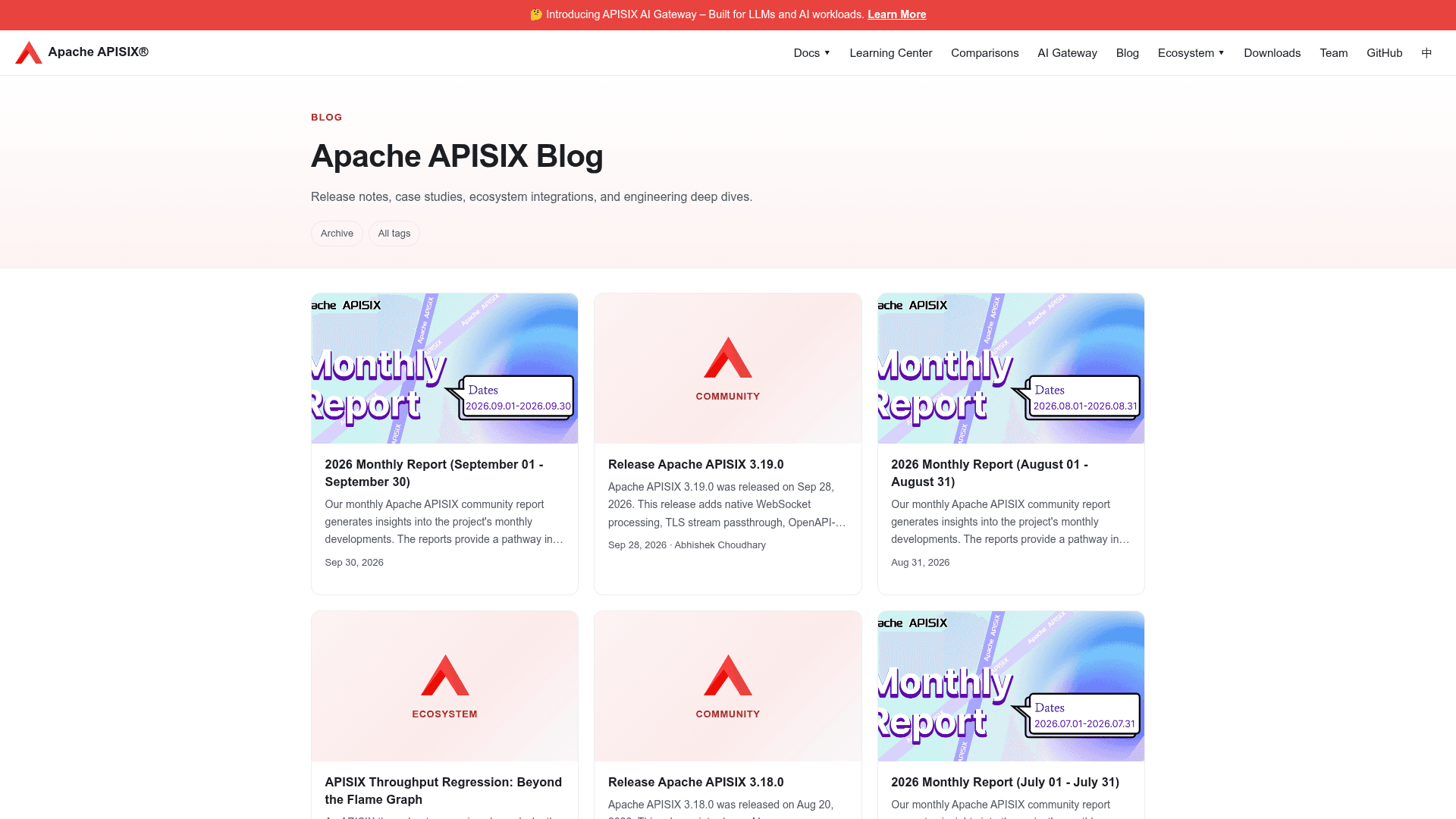
The blog lists 3.19.0 (September 28, 2026) as adding native WebSocket processing, TLS stream passthrough, OpenAPI-to-MCP conversion, upstream slow start and GraphQL cost-based rate limiting. Release 3.18.0 (August 20, 2026) introduced AI response caching, semantic model routing and new security plugins.
Community Discussions
Be the first to start a conversation about Apache APISIX
Share your experience with Apache APISIX, ask questions, or help others learn from your insights.
Pricing
Open Source
Apache APISIX core API/AI gateway released under the Apache License 2.0, free to use, modify and distribute; self-hosted.
- Apache 2.0 licensed
- 100+ open-source plugins
- AI Gateway capabilities via plugins
- Self-hosted
Capabilities
Key Features
- Dynamic routing and hot-reloadable plugins
- Load balancing, health checks and circuit breaking
- Canary release, A/B testing and traffic splitting
- 100+ plugins for authentication, security and observability
- Multi-protocol proxy (HTTP, gRPC, WebSocket, TCP/UDP, Dubbo, MQTT, HTTP/3)
- AI proxy for multiple LLM providers with fallback and load balancing
- Token-based rate limiting and prompt guardrails
- Custom plugins in Lua, Java, Go, Python, Node.js and Wasm
- Kubernetes ingress controller and Helm charts
- Admin REST API and standalone YAML mode