
Apache Burr
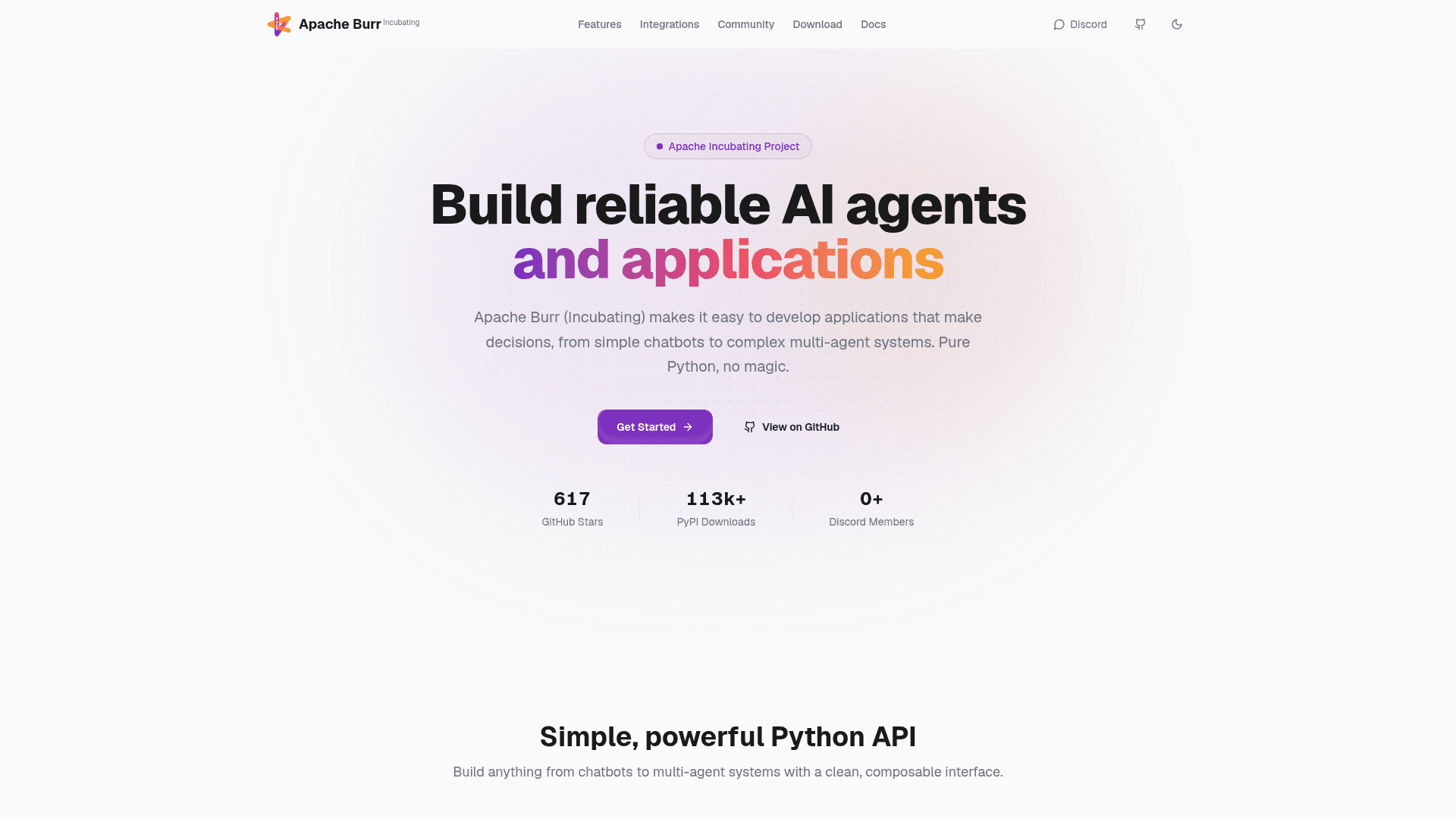
Apache Burr (Incubating) is an open-source Python framework for building reliable, stateful AI applications and agents using a simple state machine model.
At a Glance
About Apache Burr
Apache Burr (Incubating) is a pure-Python, open-source framework for building applications that make decisions — from simple chatbots to complex multi-agent systems. It is currently undergoing incubation at The Apache Software Foundation (ASF), sponsored by the Apache Incubator. The project is released under the Apache License 2.0 and is freely available on GitHub.
What It Is
Apache Burr is a state machine framework for AI and LLM-powered applications. Developers express their application as a graph of actions and transitions using plain Python functions and decorators — no DSL, no YAML, no proprietary abstractions. The core library is dependency-free and designed to integrate with any LLM provider or Python framework. Burr also ships a built-in UI for real-time monitoring, tracing, and debugging of application state.
How the State Machine Model Works
Every Burr application is built around the ApplicationBuilder API. Developers annotate Python functions with @action(reads=[...], writes=[...]) to declare which parts of state each step reads and modifies. Transitions between actions are declared explicitly, making the control flow of even complex multi-agent systems easy to follow and test. The framework supports:
- Sequential and branching workflows
- Parallel fan-out / fan-in execution
- Sub-application composition for modular design
- Human-in-the-loop pauses at any step
- Automatic state persistence to disk, databases, or custom backends
Built-in Observability and Debugging
Burr includes a local telemetry UI that launches with a single burr CLI command. The UI displays real-time state changes, execution traces, and historical run data. Developers can replay past runs, unit test individual actions, and build evaluation cases from captured state snapshots — capabilities that the GitHub README highlights as differentiators versus frameworks like LangGraph, LangChain, and Temporal.
Integrations and Stack Compatibility
Burr is designed to be framework-agnostic. The homepage lists integrations with:
- LLM providers: OpenAI, Anthropic, Instructor
- Frameworks: LangChain, Apache Hamilton, Haystack
- Serving: FastAPI
- UI: Streamlit
- Validation: Pydantic
- Storage: PostgreSQL
Because Burr does not wrap or abstract these tools, developers retain full control over how they query APIs, manage data, and structure models.
Update: v0.42.0-incubating
The latest release as of May 2026 is v0.42.0-incubating, published on May 10, 2026. The GitHub repository shows active development with the last push in June 2026. The project roadmap (listed in the README) includes planned FastAPI integration for hosted deployment, first-class retry and exception management, additional storage integrations (MySQL, S3), and tooling for hosted execution on infrastructure like Ray and Modal. A Burr Cloud offering was mentioned on the roadmap with a waitlist signup, though no further details are available in the current sources.
Why It Got Attention
Burr originated as a harness for managing state between executions of Apache Hamilton DAGs — since DAGs lack cycles, Burr was built to handle the stateful, looping nature of agent workflows. It was subsequently released as a standalone framework. The GitHub README includes a comparison table showing Burr as one of the few frameworks that explicitly models a state machine, provides an open-source monitoring UI, and works with non-LLM use cases such as time-series simulations and hyperparameter tuning. The repository has accumulated over 2,300 GitHub stars and more than 242,000 PyPI downloads according to the project homepage.
Community Discussions
Be the first to start a conversation about Apache Burr
Share your experience with Apache Burr, ask questions, or help others learn from your insights.
Pricing
Open Source
Fully open-source under Apache License 2.0, free to use, modify, and distribute.
- Full state machine framework
- Built-in telemetry UI
- State persistence
- Human-in-the-loop support
- All integrations
Capabilities
Key Features
- State machine-based application model
- Pure Python API with no DSL or YAML
- Built-in telemetry and monitoring UI
- Automatic state persistence to disk, databases, or custom backends
- Human-in-the-loop support for approval workflows
- Parallel execution with fan-out/fan-in
- Sub-application composition for modular design
- Run replay and unit testing of individual actions
- Framework-agnostic LLM integration
- CLI launcher for local UI server
- Pluggable persisters for memory and state management
- Real-time state change visualization