
Apache Ossie
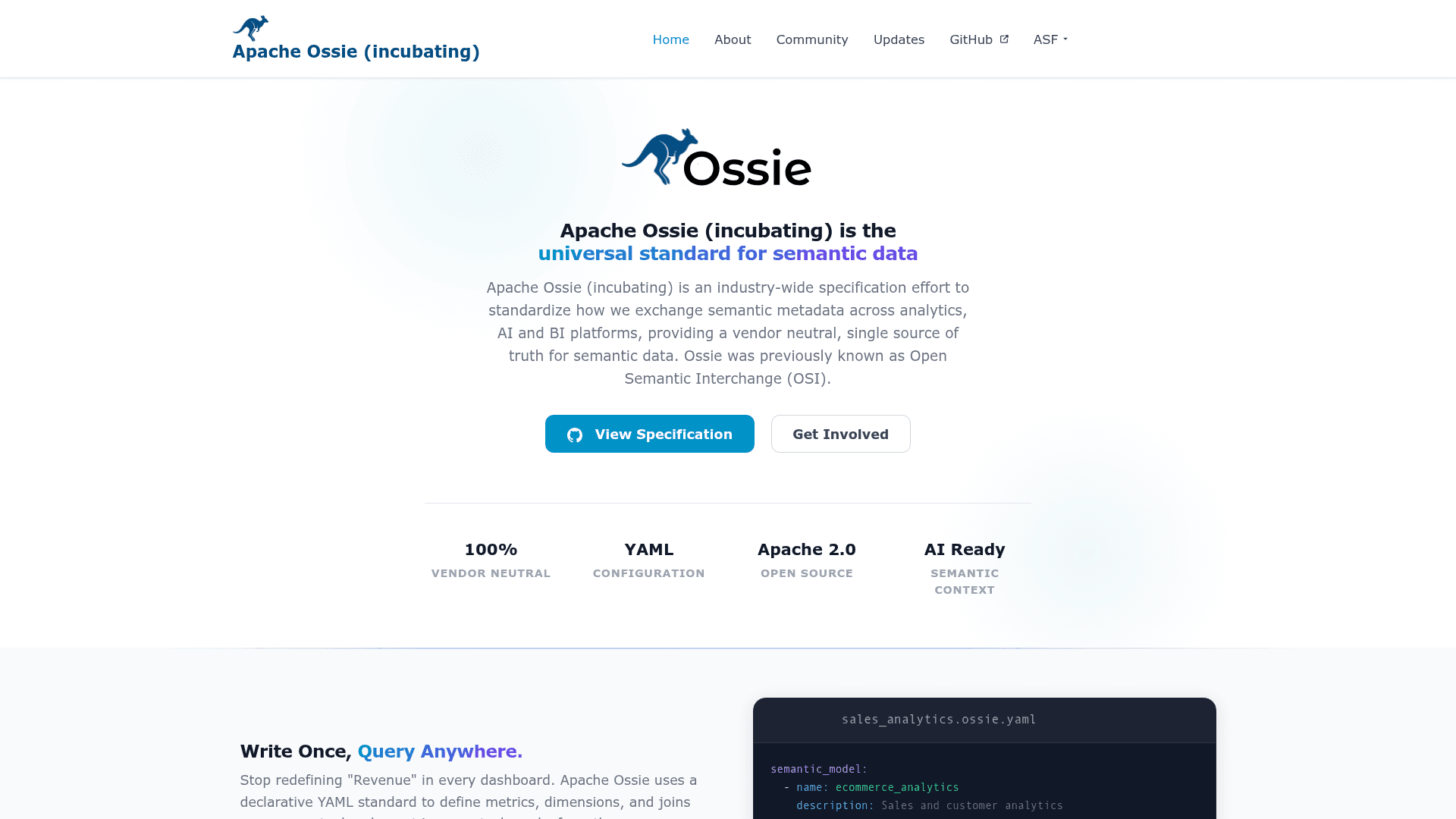
Apache Ossie (incubating) is a vendor-neutral, open-source YAML/JSON specification for standardizing semantic metadata exchange across analytics, AI, and BI platforms.
At a Glance
About Apache Ossie
Apache Ossie (incubating) is a collaborative, open-source specification project under The Apache Software Foundation that defines a common standard for exchanging semantic metadata across data analytics, AI, and BI tools. Formerly known as Open Semantic Interchange (OSI), the project entered the Apache Incubator in July 2026 and is governed under the Apache License 2.0. Its core deliverable is a declarative YAML/JSON specification that any tool can read and write, giving every platform in a data stack a single, consistent source of truth for metrics, dimensions, and business logic.
What It Is
Apache Ossie addresses a problem the project calls "semantic fragmentation" — the same KPI defined differently across dashboards, AI agents producing unreliable outputs because they are grounded in inconsistent business logic, and engineering teams spending significant effort manually reconciling definitions between proprietary tools. The specification defines a set of core building blocks — Semantic Models, Datasets, Fields, Metrics, Dimensions, and Relationships — expressed in YAML, so that any compliant tool can import, export, and validate models without custom integration work.
Core Specification Structure
The repository is organized into several key areas:
core-spec/— The canonical specification (spec.md), a machine-readable schema (spec.yaml,osi-schema.json), and accompanying documentation.converters/— Reference converters that translate between Ossie and other semantic formats, including dbt, GoodData, Polaris, and Salesforce.examples/— Example semantic models, including a complete TPC-DS model.validation/— Tooling for validating semantic models against the Ossie schema.
The specification's ai_context field is designed to give LLMs the semantic grounding they need to answer business questions accurately, reducing hallucinations caused by conflicting data logic.
Working Groups and Community Structure
The initiative is organized into focused working groups, each tackling a specific area of the specification:
- Advanced Metrics & Expression Language — Complex metric calculations and a portable expression syntax
- Composability — Enabling semantic models to reference and extend one another
- Catalog Integration — Bridging Ossie models with data catalog and governance platforms
- Ontology Representation — Mapping Ossie concepts to formal ontology standards
- Model Converters & Developer Tools — Tooling for importing, exporting, and validating models
- Financial Services Semantic Working Group — A domain-specific group that held its first formal meeting in June 2026, focused on banking, insurance, asset management, and market infrastructure
The project's homepage lists a broad set of organizations that have affiliated as working group contributors, including Databricks, Snowflake, dbt Labs, Salesforce, Oracle, Cloudera, Informatica, Collibra, ThoughtSpot, Metabase, and many others. These affiliations are vendor-published claims on the project website.
Update: Apache Incubator Entry (July 2026)
The project was accepted into the Apache Incubator in July 2026 under the name Apache Ossie, replacing its prior identity as Open Semantic Interchange (OSI). According to the project's own announcement, the specification, community, and mission remain unchanged — only the name, governance home, and long-term trajectory have shifted. The GitHub repository shows active development as of July 2026, with 1,233 stars and 151 forks. An April 2026 community update noted that 14 new participants had joined the initiative and that working groups were actively taking shape.
Why It Matters for AI and BI Interoperability
The specification's design explicitly targets the AI grounding problem: when LLMs query business data, inconsistent metric definitions across tools lead to unreliable answers. By providing a single, governed semantic layer in a portable format, Ossie aims to let AI agents reason accurately from a shared business logic foundation. The ai_context block in the YAML schema is a first-class citizen of the spec, not an afterthought, signaling that AI-readiness is a core design goal alongside traditional BI interoperability.
Community Discussions
Be the first to start a conversation about Apache Ossie
Share your experience with Apache Ossie, ask questions, or help others learn from your insights.
Pricing
Open Source
Fully free and open-source under the Apache License 2.0. Use, modify, and distribute freely.
- Full core specification (YAML/JSON)
- Reference converters (dbt, GoodData, Polaris, Salesforce)
- Schema validation tooling
- Example semantic models including TPC-DS
- Community support via GitHub Discussions, Slack, and mailing lists
Capabilities
Key Features
- Declarative YAML/JSON semantic model specification
- Vendor-neutral, Apache 2.0 licensed
- Defines Semantic Models, Datasets, Fields, Metrics, Dimensions, and Relationships
- AI context block for LLM grounding
- Reference converters for dbt, GoodData, Polaris, and Salesforce
- Schema validation tooling
- Example models including TPC-DS
- Multi-dialect SQL expression support (e.g., ANSI_SQL)
- Composable semantic models
- Catalog integration support
- Community working groups for advanced metrics, composability, ontology, and developer tools