
Be-Ambitious Harness
A Claude Code skill and markdown workflow that uses a planner, worker and independent verifier to make AI agents tackle more ambitious tasks with a cheap gate check.
At a Glance
Be-Ambitious Harness, a Claude Code skill and markdown workflow, is released under the MIT License, which permits use, copying, modification and distribution free of charge.
Engagement
Available On
Listed Oct 2026
About Be-Ambitious Harness
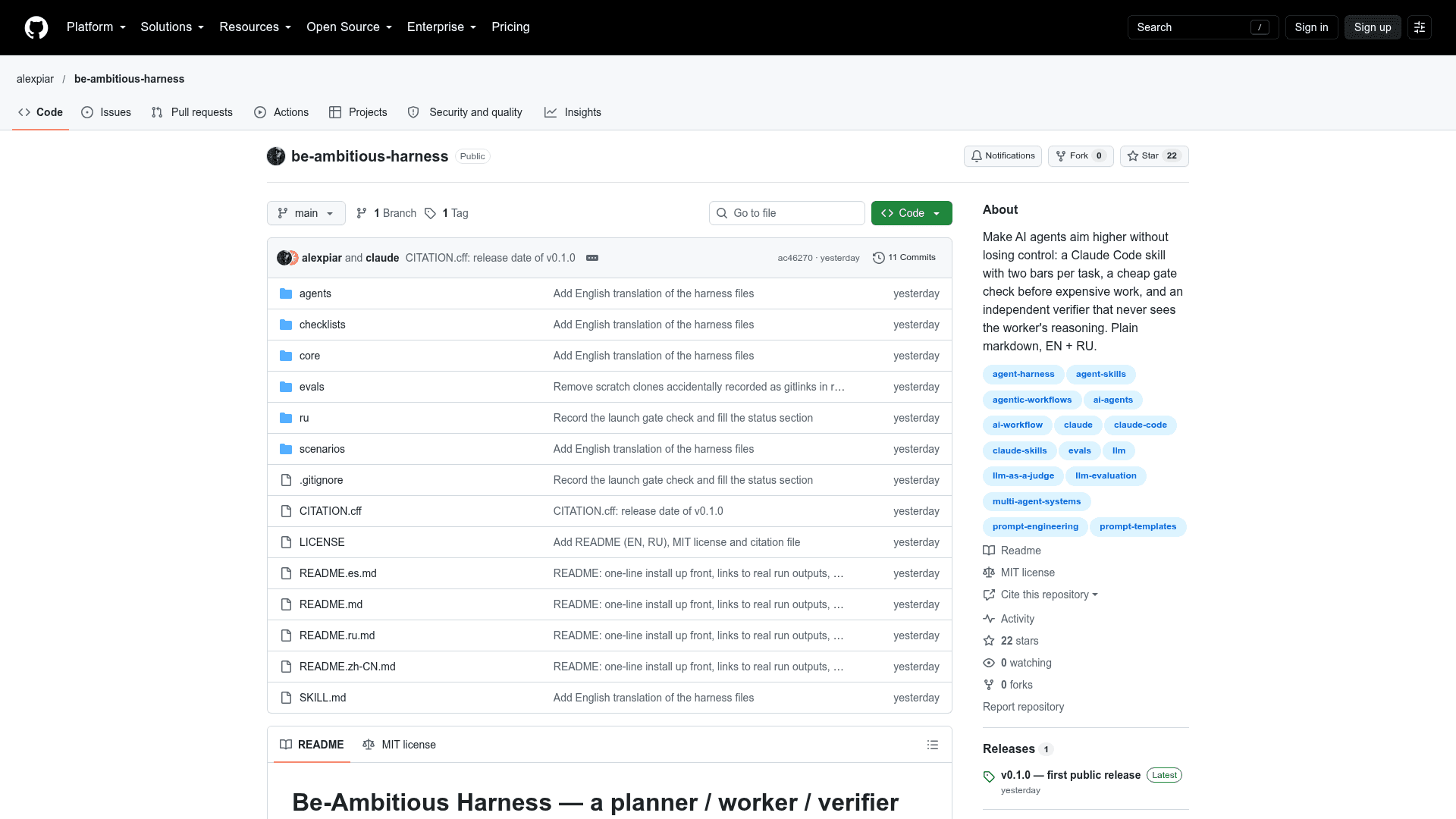
Be-Ambitious Harness is an open-source prompt engineering framework and multi-agent workflow published by alexpiar (Chernov Alexandr). It turns a task into a seven-section prompt with a baseline bar, an ambitious bar and a gate check, then routes execution through separate planner, worker and verifier roles. It ships as a Claude Code skill in English and Russian, and v0.1.0 is the first public release.
What It Is
The harness is a folder of plain markdown files (agent instructions, core templates, scenario playbooks and checklists) rather than executable code. A human gives the planner a task, context, a mode (keep scope, ambitious extension or recommend) and an option to stop after analysis. The planner produces a short analysis, up to three questions and a prompt with seven fixed sections.
It installs by cloning the repository into the Claude Code skills directory and invoking /be-ambitious-harness. The README states that any agent able to read a folder of markdown files can use SKILL.md as an entry point.
How the Workflow Operates
- Two bars: a baseline result and a more ambitious one, with the extra work and main uncertainty named. For unfamiliar tasks the ambitious bar is phrased as a learning goal.
- Gate check: a cheap, observable test with a pass criterion fixed before it runs and defined actions for three outcomes: passed, failed, insufficient data.
- Role isolation: the worker runs in a fresh session without the planner's analysis, and the verifier sees only requirements, acceptance criteria, the result and the evidence log, preferably on a different model.
- Human ownership: scope and budget decisions stay with the human, and a passed gate with no budget returns the baseline plus a cost estimate.
Scenario Playbooks and Evals
Six scenario playbooks cover design/UX, data analysis, code engineering, writing/research, decision/plan and generic tasks, each with domain-specific gates and traps. An eval suite of eight tasks and a 30-criteria scorecard checks whether the harness itself holds up. The README reports that two tasks have been run so far, describes them as a smoke test rather than a benchmark, and notes that the single-skill comparison produced deeper results while the harness showed more discipline.
Current Status
The README documents a known defect, that the verifier does not receive the gate criterion, with a fix pending. It also lists gaps: no multimodal scenario and no multi-gate support for multi-day tasks. The project states it is not affiliated with or endorsed by Anthropic.
Community Discussions
Be the first to start a conversation about Be-Ambitious Harness
Share your experience with Be-Ambitious Harness, ask questions, or help others learn from your insights.
Pricing
Open Source (MIT)
Be-Ambitious Harness, a Claude Code skill and markdown workflow, is released under the MIT License, which permits use, copying, modification and distribution free of charge.
- MIT License
- Planner / worker / verifier workflow
- Six scenario playbooks
- Eval suite with 8 test tasks and a 30-criteria scorecard
- English and Russian files
Capabilities
Key Features
- Two-bar task framing (baseline and ambitious)
- Gate check with pre-fixed pass criterion and three outcomes
- Planner, worker and verifier role isolation
- Seven-section prompt template
- Six scenario playbooks
- Eval suite with 8 tasks and 30-criteria scorecard
- Pre-flight and post-run checklists
- English and Russian files