
Omnigent
An open-source AI agent meta-harness that orchestrates Claude Code, Codex, Cursor, Pi, and custom agents with unified policies, sandboxing, and real-time collaboration from any device.
At a Glance
About Omnigent
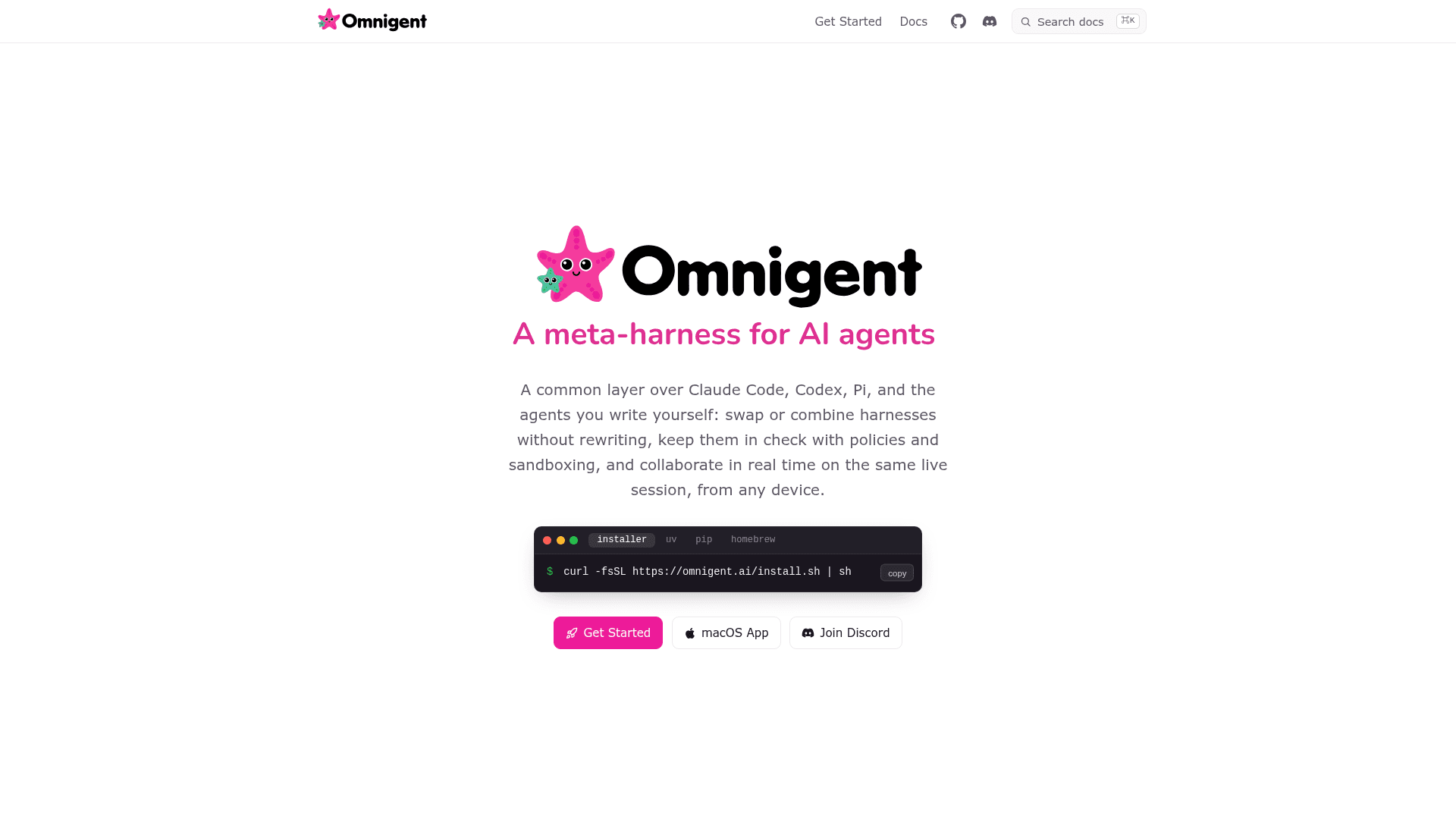
Omnigent is an open-source AI agent framework and meta-harness built under the Apache 2.0 license. It provides a common orchestration layer over Claude Code, Codex, Cursor, Pi, and agents you write yourself, letting you swap or combine harnesses without rewriting code. The project is currently in alpha and is described on its homepage as "built in the open," with contributors from the Databricks AI team and Neon.
What It Is
Omnigent sits between you and any AI coding agent runtime, acting as a meta-harness: a single control plane that wraps multiple agent harnesses in a sandboxed, uniform session. Rather than locking you into one vendor's agent, it lets you run Claude Code, Codex, Pi, Cursor, or a custom YAML-defined agent through the same interface, enforce the same policies, and share the same session history. The core concepts are Composition (combine models and harnesses), Control (stateful policies and OS-level sandboxing), and Collaboration (share live sessions via URL).
Architecture and Deployment Model
Omnigent's architecture has two main layers: a runner that wraps any agent in a sandboxed, uniform session, and a server that adds policies and shared history. The server exposes every session over the terminal, a web UI, a native macOS app, mobile browsers, and a REST API. Deployment options include:
- Local:
omnigent server startlaunches a web UI athttp://localhost:6767 - Docker Compose on any VPS or home server
- One-click deploys to Render, Fly.io, Railway, Hugging Face Spaces, and Modal
- Cloud sandboxes per session via Modal, Daytona, or Islo (managed hosts)
The CLI installs via curl, uv, pip, or Homebrew, and requires Python 3.12+.
Agent Composition and Custom Agents
Omnigent ships two built-in example agents: Polly, a multi-agent coding orchestrator that delegates to parallel sub-agents in separate git worktrees and routes diffs to cross-vendor reviewers, and Debby, a dual-headed brainstorming agent that runs Claude and GPT side by side and can trigger structured debate rounds. Custom agents are defined in short YAML files specifying a prompt, tools (local Python functions or sub-agents), and an executor harness. Supported harnesses include claude-sdk, claude-native, codex, codex-native, cursor, cursor-native, openai-agents, pi, pi-native, and antigravity.
Governance and Policy System
Policies in Omnigent are stateful and data-centric, enforced at the meta-harness layer rather than via prompts. They stack across three levels — server-wide (admin), per-agent (developer), and per-session (user) — with stricter session rules checked first. Built-in policy types include:
ask_on_os_tools: pause for approval before shell commands or file writesmax_tool_calls_per_session: cap the number of tool calls per sessioncost_budget: hard spend cap with configurable soft-warning thresholds
Policies can be toggled in the web UI, set via chat, or declared in YAML config.
Collaboration Features
Omnigent supports multi-user accounts with invite-only signup (no email server required). Teams can share a live session via URL so teammates can watch and chat with an agent in real time, co-attach to a running session to co-drive it on the host machine, or fork a conversation to continue independently. SSO via Google, GitHub, Okta, and Microsoft is supported on deployed servers through OIDC configuration.
Update: v0.2.0
The latest release is v0.2.0, published on June 19, 2026. The repository was created in June 2026 and has seen active development, with the last push recorded on June 23, 2026. The project self-describes as alpha, and the homepage invites users to try it and give feedback on Discord.
Community Discussions
Be the first to start a conversation about Omnigent
Share your experience with Omnigent, ask questions, or help others learn from your insights.
Pricing
Open Source
Fully open-source under Apache 2.0. Free to use, modify, and distribute.
- Meta-harness over Claude Code, Codex, Cursor, Pi, and custom agents
- OS-level sandbox
- Stateful contextual policies
- Real-time session sharing and collaboration
- Multi-user accounts
Capabilities
Key Features
- Meta-harness over Claude Code, Codex, Cursor, Pi, and custom agents
- Swap or combine agent harnesses without rewriting code
- OS-level sandbox (filesystem and network access restriction)
- Stateful contextual policies: spend caps, model routing, risk-based escalation
- Real-time session sharing via URL
- Co-drive and fork sessions for team collaboration
- Multi-user accounts with invite-only signup
- SSO via Google, GitHub, Okta, Microsoft (OIDC)
- Built-in Polly (multi-agent coding orchestrator) and Debby (dual-model debate) agents
- Custom agents defined in YAML
- Cloud sandbox support via Modal, Daytona, Islo
- REST API and web UI
- macOS native desktop app
- Mobile-friendly web UI
- Session history and shared context across devices
- Policy stacking: server-wide, per-agent, per-session
- Support for API keys, subscriptions, gateways (OpenRouter, Ollama, LiteLLM, Azure), and Databricks