
Peer-to-peer desktop and mobile app that syncs projects between your machines and runs coding agents like Claude Code and Codex on any of them.
At a Glance
Beep is released under the Mozilla Public License 2.0 (OSI-approved). No account is needed. Coding agents run on the user's own subscriptions or API keys, which Beep does not resell.
Engagement
Available On
Alternatives
Listed Nov 2026
About Beep
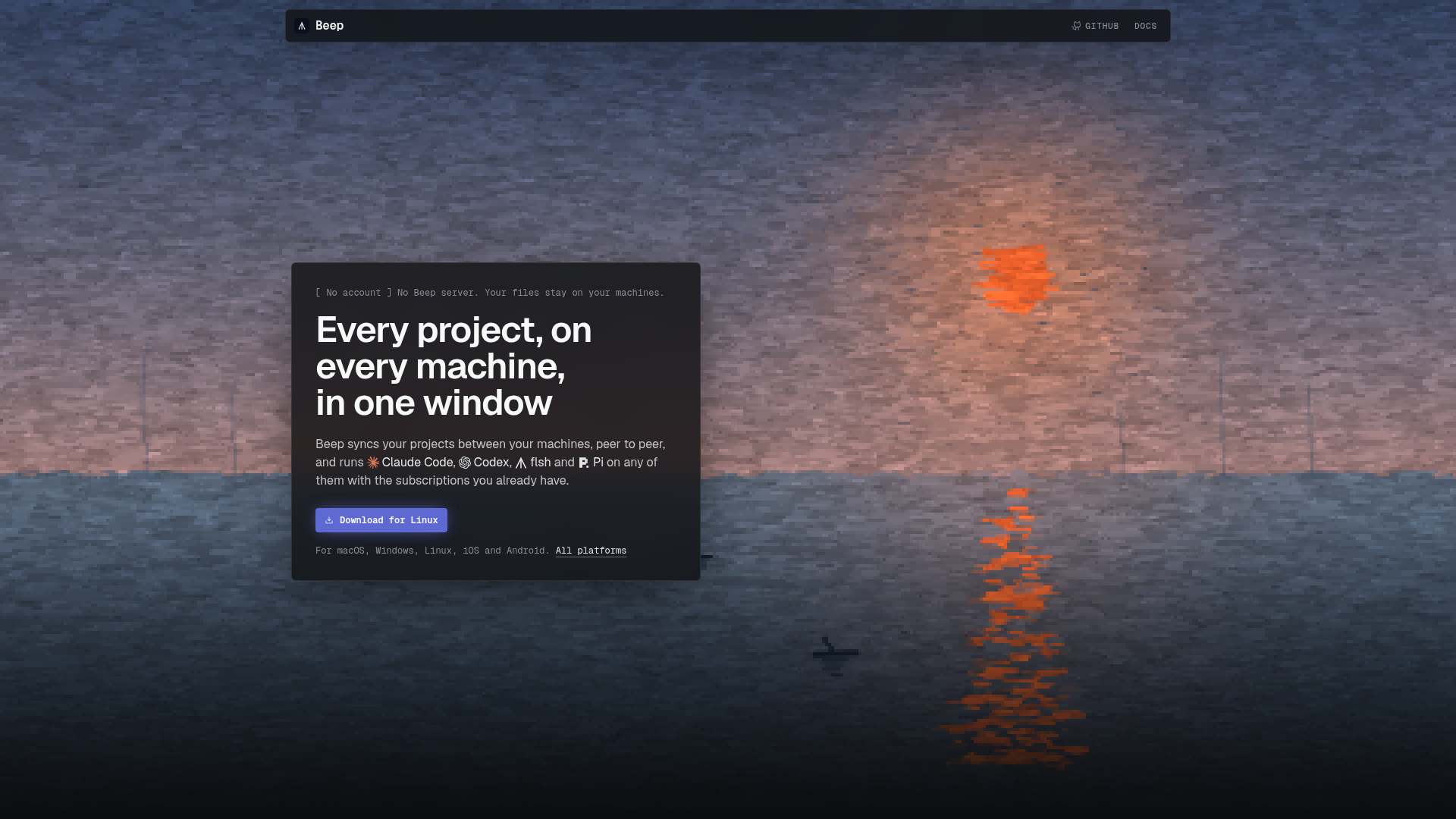
Beep is made by Flashmind and is a desktop app, with phone companions, for running coding agents across all of your own machines from one window. It syncs projects peer to peer with no Beep account or server, and runs Claude Code, Codex, flsh and Pi using the subscriptions already signed in on each machine. The source is published under MPL-2.0, and the latest listed desktop release is 0.10.8.
What It Is
Beep is an agent development environment that treats every machine you own as part of one mesh. A Tauri desktop app for macOS, Windows and Linux, the same app on iOS and Android, and a headless beep-node for servers and containers join a signed, end-to-end encrypted network built on iroh (QUIC). A home board collects sessions, terminals, reviews, pull requests and issues from every machine, including items that need your attention, running work and finished tasks.
How Sync and Agents Work
Every project is a Git repository. Commits move between machines, selected ignored folders follow as plain files, and build output and dependency folders stay out. Uncommitted edits stay in place until you bring them over. When a file is edited on two machines at once, Beep keeps a conflict copy that you can compare, fix with an agent, or resolve by keeping one version. Sync is not a backup. Beep detects folders already shared by Syncthing and leaves them alone.
Agents run on the machine you choose, using that machine's sign-in, files and tools, so Beep does not resell model access. The app shows Claude and Codex plan usage next to your work.
Privacy Model
Project files travel directly between devices over encrypted links. A relay forwards encrypted packets only when no direct path exists, and it cannot read them. Beep says the desktop does not send projects, prompts or credentials to a Beep server; it contacts your code host and agent providers, downloads tools and updates, and sends a problem report only if you choose.
Setup Path
Install Beep and choose Set up all, which installs missing tools such as Git, Claude Code and Codex. Then add a machine by running the two commands shown on your server or build box, using a one-use ticket, and start an agent on a project. beep-node is also available as a Docker image. Phones pair as observers: they host no projects and run no code.
Community Discussions
Be the first to start a conversation about Beep
Share your experience with Beep, ask questions, or help others learn from your insights.
Pricing
Open Source
Beep is released under the Mozilla Public License 2.0 (OSI-approved). No account is needed. Coding agents run on the user's own subscriptions or API keys, which Beep does not resell.
- Licensed under MPL-2.0
- No Beep account or server needed
- Peer-to-peer sync of projects between machines
- Runs Claude Code, Codex, flsh and Pi with your own subscriptions
- Desktop for macOS, Windows and Linux; iOS and Android phones pair as observers
Capabilities
Key Features
- Peer-to-peer encrypted mesh between machines with no Beep account or server
- Git commit sync across machines plus selected ignored folders as plain files
- Conflict copies with compare, fix with an agent, and keep options
- Run Claude Code, Codex, flsh and Pi on any linked machine
- Unified board of sessions, terminals, reviews, pull requests and issues
- Claude and Codex plan usage display
- Syncthing folder detection
- beep-node for servers and containers, including Docker image
- iOS and Android observer apps paired via phone code