
blue-harness
Build-time audit, hardening and verification harness that makes native binaries harder to reverse-engineer, including with AI agents.
At a Glance
Free under the GNU AGPL-3.0 for everyone, including businesses, provided AGPL terms are met. Evaluation and testing are free.
Engagement
Available On
Alternatives
Listed Nov 2026
About blue-harness
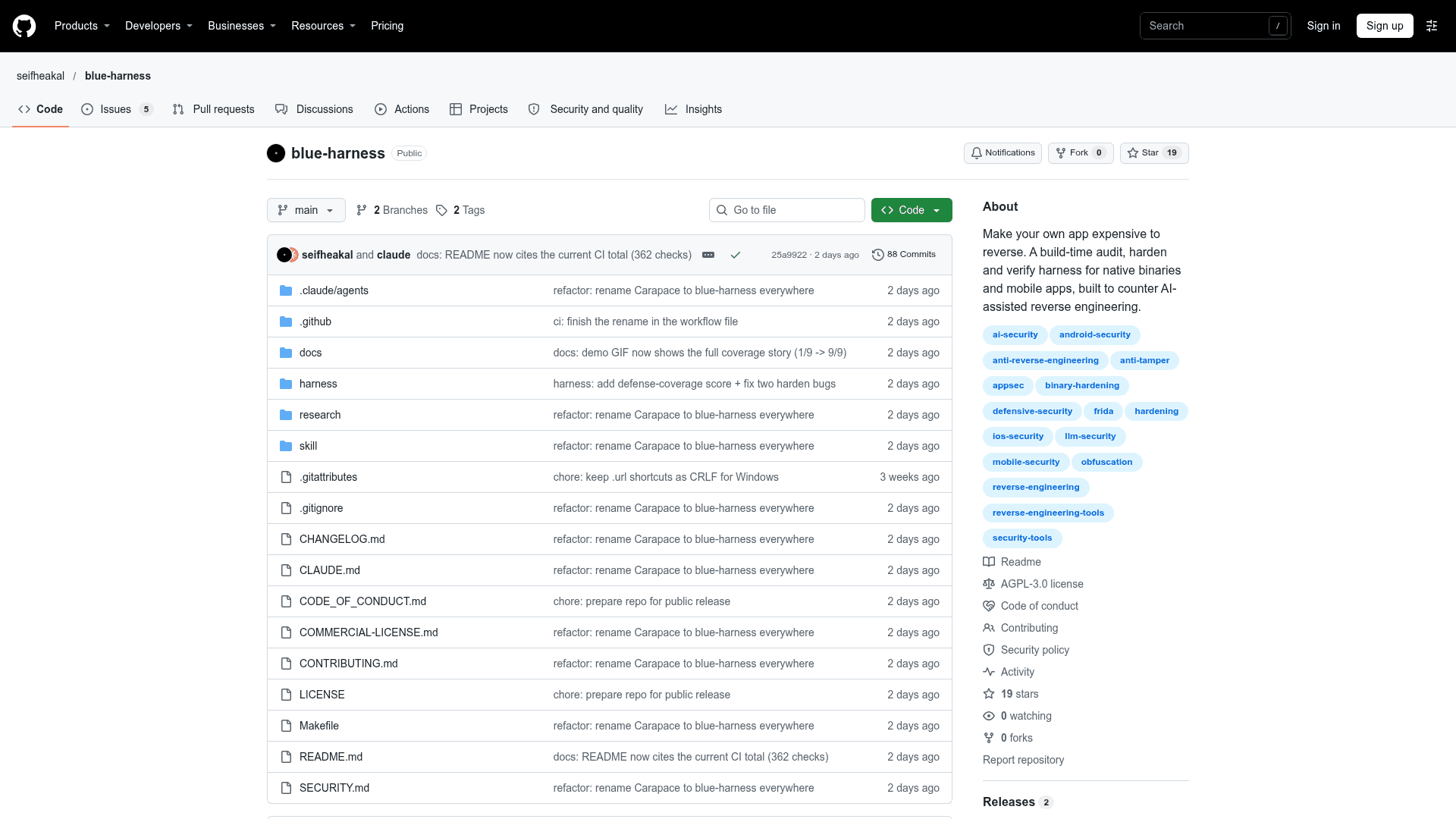
blue-harness is an open-source defensive toolkit from GitHub user seifheakal for making software you own harder to reverse-engineer, especially by AI agents. It audits a native build, applies countermeasures, and runs tests to verify each defense fires. The latest listed release is v0.1.1, and the README marks the project status as Active.
What It Is
blue-harness is a build-time anti-reverse-engineering hardening and audit harness for native binaries (Linux ELF, Windows PE, macOS/iOS Mach-O) that the operator owns or is authorized to protect. It works in three steps: audit scores how exposed a build is (symbols, strings, entropy, hardening flags, present self-defense guards), harden applies countermeasures, and prove verifies each countermeasure actually fires. The README states it is not an offensive tool and not an uncrackable wrapper.
Workflow and Outputs
It needs a C toolchain, make, and Python 3. make demo audits a sample build, shows its hardening plan, and proves each defense fires; make verify runs every check and prints a posture summary. For your own binary, make report BIN=... produces an exposure audit and ordered hardening plan, and make harden BIN=... applies post-build hardening. A bundled Claude skill reads the posture and recommends the next highest-value hardening, with its strength tier and named bypass.
Countermeasures
The README lists countermeasures including anti-debug/anti-ptrace, string encryption, identity stripping/renaming/decoys, an anti-Frida detector, code-integrity with server attestation, core-dump suppression, analysis-surface exhaustion, and honeytokens, plus Mach-O symbol strip and decoy segments. Each carries a strength tier and a named bypass.
Measured Result and Limits
The README reports a single run (N=1) using a 4-bit 7B local model: the unprotected build was cracked in 3 steps, while the hardened build was not cracked after 13 steps and about 13x the tokens. The honeytoken layer never fired in that run. Build-time hardening for PE and Mach-O, string-encryption codegen for those formats, and mobile (Android/iOS) reach are listed as not done yet.
Community Discussions
Be the first to start a conversation about blue-harness
Share your experience with blue-harness, ask questions, or help others learn from your insights.
Pricing
Open Source (AGPL-3.0)
Free under the GNU AGPL-3.0 for everyone, including businesses, provided AGPL terms are met. Evaluation and testing are free.
- Licensed under GNU AGPL-3.0
- Free for businesses as long as AGPL is complied with
- Evaluation and testing are free for everyone
- Audit, harden and verify harness for ELF, PE and Mach-O binaries
- Self-hosted; requires a C toolchain, make, and Python 3
Capabilities
Key Features
- Read-only exposure audit and score for ELF, PE and Mach-O
- One-command post-build hardening
- Anti-debug and anti-Frida detection
- String encryption
- Symbol strip, rename and decoys
- Honeytokens and canaries
- Code-integrity with server attestation
- Tests proving each defense fires
- Claude skill recommending next hardening
- Reproducible empirical before/after run