
Blume
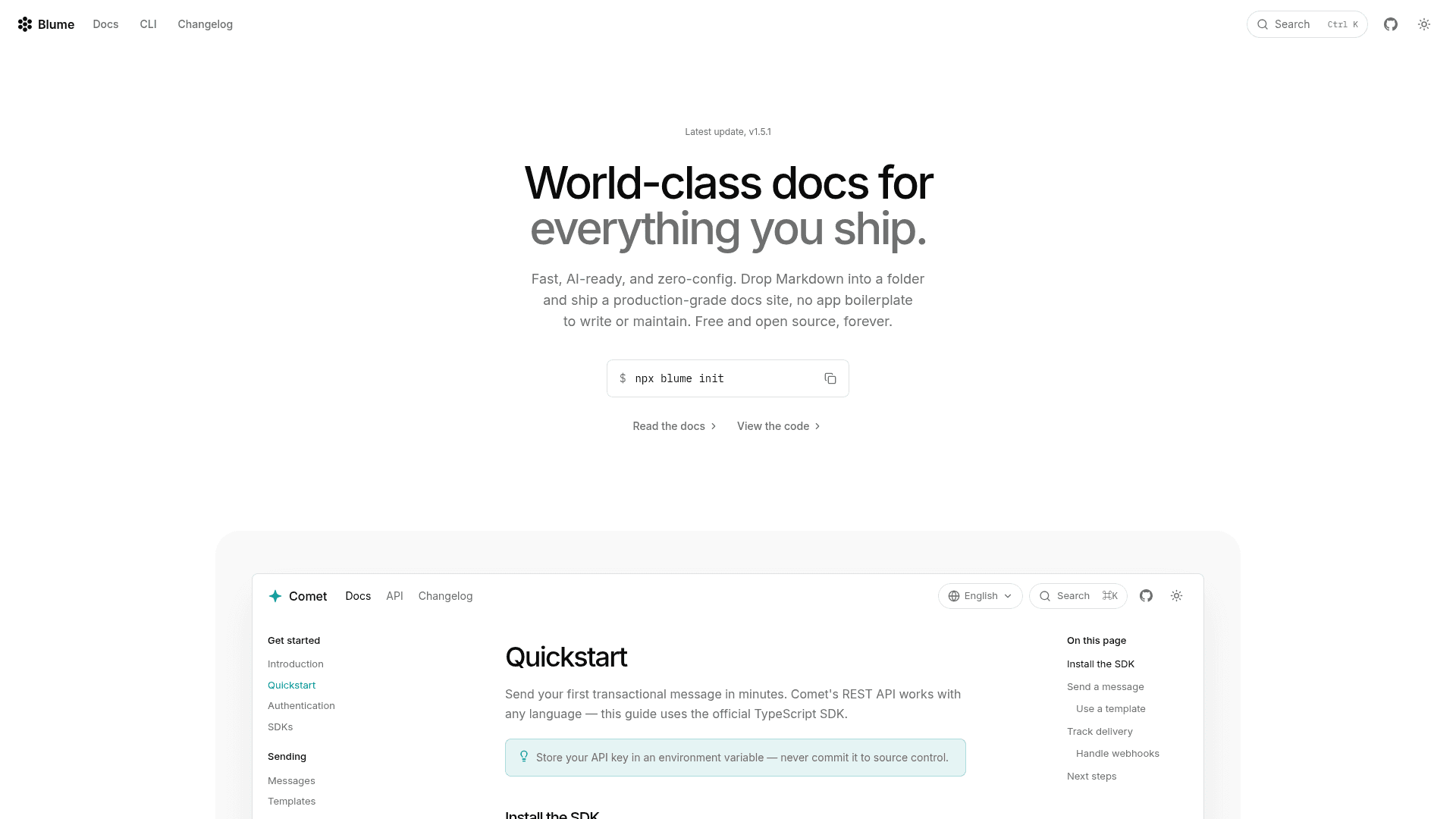
An open-source, markdown-first documentation framework built on Astro and Vite that turns a folder of Markdown into a production-grade docs site with zero configuration.
At a Glance
Free and open source forever under the MIT license.
Engagement
Available On
Alternatives
Listed Aug 2026
About Blume
Blume is a free, open-source documentation framework created by Hayden Bleasel, licensed under MIT and available on GitHub. It builds on Astro and Vite to turn a folder of Markdown or MDX files into a fully featured, production-ready docs site — with navigation, search, theming, Open Graph images, and a rich component library — without any app boilerplate to write or maintain. The project reached v1.5.1 as of August 2026 and has accumulated over 1,200 GitHub stars since its creation in June 2026.
What It Is
Blume is a CLI-driven documentation framework in the same category as Mintlify, Fumadocs, and Docusaurus, but with a distinct philosophy: the framework itself is the template. There is no starter repository to clone and no upstream template to keep in sync. Developers drop Markdown files into a folder, run npx blume init, and get a complete docs site. The CLI generates a hidden Astro project under .blume/ and drives it for both development and production builds. Running blume eject promotes that hidden project into a standalone Astro app whenever full control is needed.
Zero-Config Architecture
The zero-config approach extends beyond setup. Navigation is inferred automatically from the file system. Search (powered by Orama) works in both dev and production without a hosted service. Theming is controlled by a handful of tokens. The single configuration file, blume.config.ts, is fully TypeScript-typed with defineConfig, so editors autocomplete every option and catch mistakes before a build. Folder-level metadata uses meta.ts files with defineMeta for the same type-safe experience.
AI-Ready by Default
Every Blume site ships machine-readable outputs with no extra configuration:
llms.txtandllms-full.txtfor coding agents and chat assistants- Raw Markdown accessible by appending
.mdto any page URL - Copy as Markdown and Open in chat actions on every page (pre-filled for ChatGPT, Claude, v0, and others)
- An optional in-page Ask AI assistant backed by the Vercel AI SDK, OpenRouter, Inkeep, or any OpenAI-compatible endpoint
- A hosted MCP server so tools like Claude Code and Cursor can search and read docs directly via four read-only tools (
search_docs,get_page,list_pages,get_navigation)
Content Sources and Component Library
Blume reads local files by default but supports mixing multiple content backends in a single site via blume.config.ts: local filesystem, remote MDX from GitHub repositories, Sanity, Notion, and custom adapters. The built-in component library includes 30+ accessible, theme-aware components — cards, steps, tabs, accordions, badges, code groups, file trees, type tables, diffs, and live component previews — all usable in any .mdx page with no imports required. OpenAPI and AsyncAPI specs render as interactive references with a live "Try it" playground via Scalar.
CLI Lifecycle Tools
The Blume CLI covers the full documentation lifecycle beyond scaffold and build:
blume validate— checks internal, anchor, asset, and external linksblume audit— audits the built site for SEO and health issuesblume eval— runs an agent that answers questions using only the documentation to test coverageblume translate— translates docs into configured locales using a local agent CLIblume version— freezes the current docs as an archived version
Update: blume@1.5.1
The latest release is blume@1.5.1, published on August 16, 2026. The project was created in June 2026 and has moved quickly through minor and patch releases. The GitHub repository is a monorepo: the published npm package lives in packages/blume, and apps/docs is Blume's own documentation site, built with Blume itself. Node.js 22.12 or newer is required, and the framework supports Bun, pnpm, npm, and yarn as package managers. Deployment targets include Vercel, Netlify, Cloudflare Pages, GitHub Pages, and any static CDN, with server adapters available for request-time features like Ask AI and the MCP server.
Community Discussions
Be the first to start a conversation about Blume
Share your experience with Blume, ask questions, or help others learn from your insights.
Pricing
Open Source
Free and open source forever under the MIT license.
- Full framework with zero-config setup
- All CLI commands
- All components
- AI features (llms.txt, MCP server, Ask AI)
- Local search
Capabilities
Key Features
- Zero-config setup — navigation inferred from files
- Markdown and MDX support
- Built on Astro and Vite with static HTML output
- 30+ accessible MDX components with no imports required
- Local search via Orama (no hosted service)
- AI-ready: llms.txt, raw Markdown URLs, Copy as Markdown, Open in chat
- Optional in-page Ask AI assistant
- Hosted MCP server for coding agents (Claude Code, Cursor, VS Code)
- Interactive API reference via OpenAPI/AsyncAPI and Scalar
- Built-in changelog with GitHub Releases integration and RSS feed
- Multiple content sources: filesystem, GitHub, Notion, Sanity, custom
- Internationalization with 36 locales and RTL support
- SEO: OG images, sitemaps, RSS, JSON-LD
- TypeScript-typed config with defineConfig and defineMeta
- CLI tools: validate, audit, eval, translate, version
- blume eject to standalone Astro project
- Deployment to Vercel, Netlify, Cloudflare Pages, GitHub Pages
- Agent skills for scaffolding and maintaining docs
- PDF and EPUB export (client-side)
- Tailwind v4 theme tokens and component overrides