
boxd
Composable, persistent Linux VMs for developers and AI agents — spin up hardware-isolated KVM machines in under 10ms, fork running stacks, and pay nothing while idle.
At a Glance
Start with $30 of free credits, then pay only for what your machines use. Credit-based, no monthly plan, no per-seat fee.
Engagement
Available On
Alternatives
Listed Oct 2026
About boxd
boxd provides composable, persistent Linux virtual machines designed for developers and AI agents. Each machine is a real KVM virtual machine running Ubuntu 24.04 with its own kernel, a public IPv4 address, and an automatic HTTPS domain — not a container or shared-kernel sandbox. The company raised €2M and positions the product as a replacement for localhost development.
What It Is
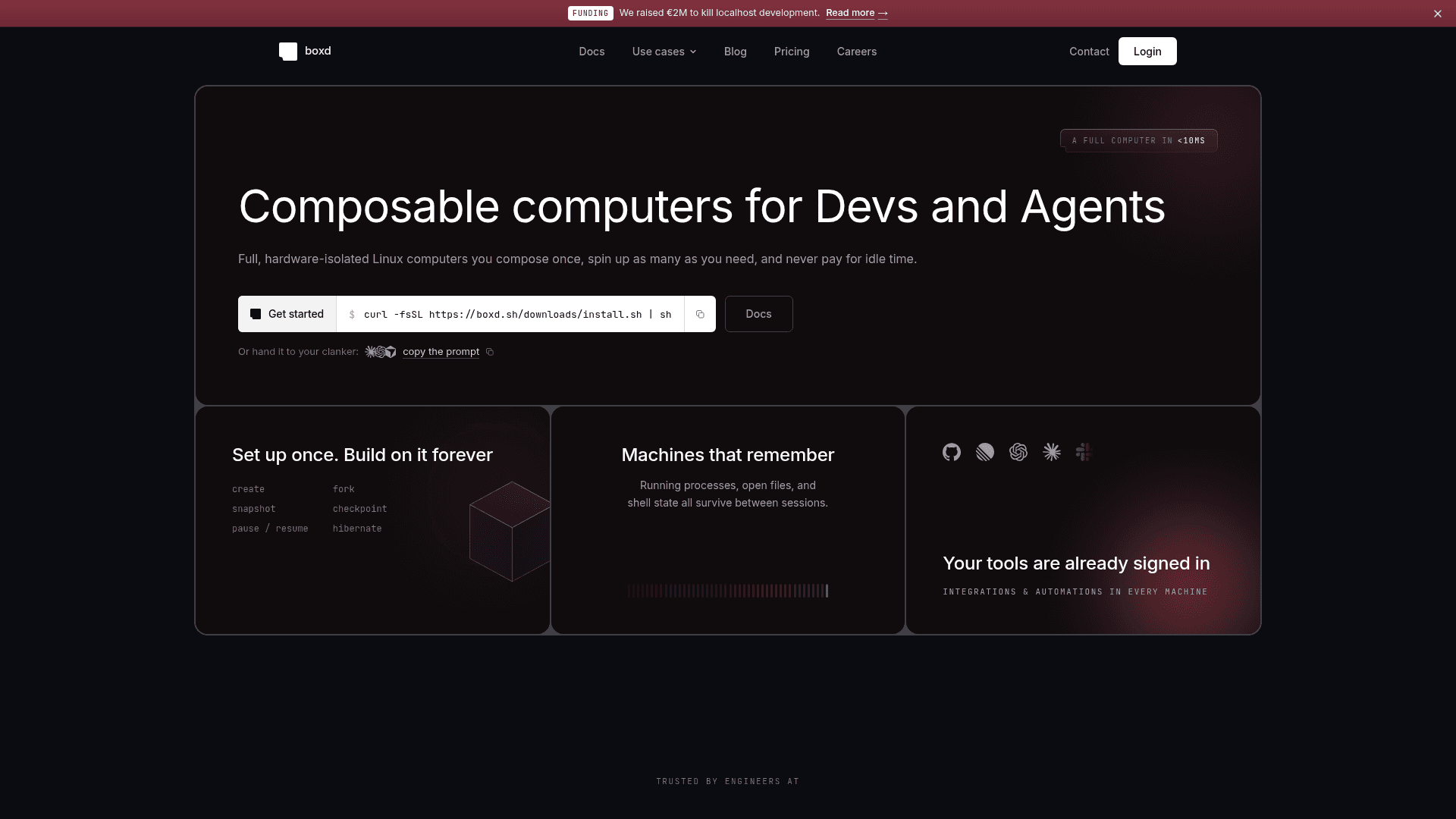
boxd is a cloud platform that gives every developer, agent, or pull request its own full Linux computer. Machines boot in under 10ms, persist their state across sessions (running processes, open files, shell state), and cost nothing while hibernated. The core primitive is a persistent, forkable KVM VM that can be created, forked, snapshotted, checkpointed, paused, resumed, and hibernated through a CLI, API, or SDK.
How the Machine Model Works
Unlike containers or CI runners, boxd machines are real KVM virtual machines with their own Linux kernel. Key behaviors:
- Persistence by default: closing the terminal does not stop the machine; builds, background jobs, and agent tasks continue running.
- Hibernation: machines automatically suspend to disk when network activity stops and resume in sub-millisecond on the next connection.
- Forking: a live memory fork copies the entire running machine — kernel, filesystem, processes, disk — in under 200ms. The fork is a real machine, not a layer on top.
- Snapshots and checkpoints: freeze a machine and restore it later, or roll back in place to a save point without creating a new machine.
- Default shape: 2 vCPU, 8 GiB RAM, 100 GiB disk per machine; up to 50 machines per organization by default.
Use Cases and Audiences
boxd targets three overlapping audiences: individual developers who want a persistent cloud dev box, engineering teams who want per-PR preview environments with real services and databases, and AI agent builders who need isolated, stateful machines for coding agents, personal assistants, sandboxes, and agent swarms. The platform ships preinstalled with Claude Code, Codex, Docker, Python 3, Go, git, headless Chrome, ffmpeg, and other common tools.
Specific use cases documented on the site include:
- Development workspaces (persistent editor, dotfiles, running processes)
- Preview environments (full stack per pull request)
- Coding agents (Claude Code, OpenAI Codex, each with their own machine)
- Sandboxes for untrusted agent-generated code
- Agentic SaaS (machines created and destroyed via SDK per end user)
- Reproducible RL environments (fork from one prepared machine per rollout)
- Agent swarm intelligence (fan out to many parallel machines)
Architecture and Self-Hosting
The platform is built as nine Rust crates compiled into a single binary: control plane, worker, proxy, DNS, Raft consensus, CLI, per-VM VMM, in-VM agent, and a single-node combined binary. RocksDB holds the Raft log; embedded SQLite holds materialized state. There are no external dependencies — no Kubernetes, no Postgres, no Redis, no queue.
Self-hosting is a first-class deployment model: drop the binary on any KVM-capable Linux host. The open-source microVM engine underneath is called Ignition and lives at github.com/lttle-cloud/ignition. Self-hosted installs support EU data residency, SSO + audit logs, and BYOC (bring your own cloud).
Integrations and Agent Interface
boxd connects to GitHub, Linear, Slack, Tailscale, OpenAI Codex, Claude Code, and Cursor. An MCP server installs directly into Claude Code, Codex, or opencode. Every VM ships with an in-VM boxd CLI that auto-authenticates by source IP, so agents can create, fork, exec on siblings, or open a proxy using only shell commands — no SDK injection required. Environment variables and secrets are scoped to the organization and available in every machine.
Billing Model
Billing is credit-based and meters actual usage rather than provisioned capacity. RAM bills on memory actually resident (sampled every second), disk bills on bytes written (not provisioned size), and vCPU bills only while the machine is running. A hibernated machine pays only for disk written. New accounts receive $30 of free credits on adding a payment method. A custom tier covers bigger machines, volume pricing, self-hosting, EU data residency, SSO, audit logs, and dedicated support.
Community Discussions
Be the first to start a conversation about boxd
Share your experience with boxd, ask questions, or help others learn from your insights.
Pricing
Pay as you go
Start with $30 of free credits, then pay only for what your machines use. Credit-based, no monthly plan, no per-seat fee.
- 50 machines included (raiseable on request)
- 2 vCPU · 8 GiB RAM · 100 GiB disk per machine
- Fork, snapshots, and checkpoints
- Suspend, resume, and hibernate
- HTTPS, proxies, and custom domains
Custom
Bigger machines, volume pricing, or boxd on your own hardware. For companies of any size.
- Everything in Pay as you go
- Bigger machines and higher quotas
- Volume pricing
- Self-host on your own hardware or BYOC
- EU data residency
- SSO + audit logs
- Dedicated support
Capabilities
Key Features
- Persistent KVM Linux VMs (Ubuntu 24.04) with own kernel
- Sub-10ms cold boot
- Live memory forking in under 200ms
- Snapshots and checkpoints
- Automatic hibernation with sub-millisecond resume
- SSH access from any device
- Automatic HTTPS subdomain per machine
- Custom domain support
- Organization-scoped environment variables and secrets
- MCP server for Claude Code, Codex, and opencode
- Preinstalled Claude Code, Codex, Docker, Python 3, Go, git, headless Chrome
- GitHub, Linear, Slack, Tailscale integrations
- VM sharing and VM-to-VM networking
- Self-host as a single Rust binary
- EU data residency
- SSO and audit logs (Enterprise)
- Credit-based billing on actual memory and disk used
- CLI with --json flag for scripting and agents
- gRPC API
- 50 machines per organization (raiseable)