
CodexLoom
A working environment for long-running Codex Agents that turns one-off Codex conversations into a governed team of domain agents with durable responsibility and explicit collaboration.
At a Glance
Source-available under Elastic License 2.0; self-hosted and local-first with no cost to run.
Engagement
Available On
Alternatives
Listed Aug 2026
About CodexLoom
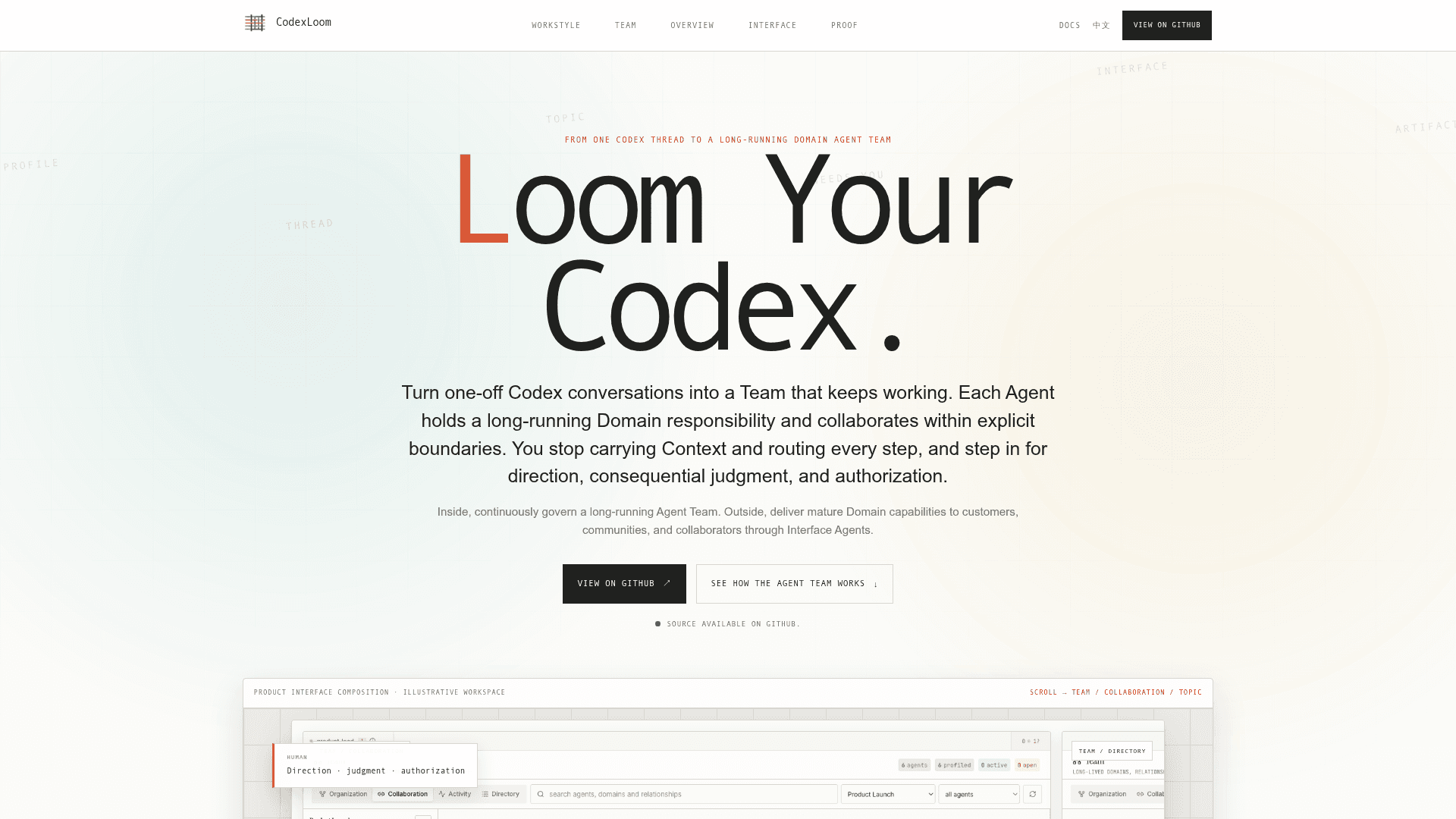
CodexLoom is a local-first, self-hosted working environment built on top of OpenAI Codex that transforms single-use Codex threads into a governed organization of long-running Domain Agents. Created by yan5xu and licensed under the Elastic License 2.0 (source-available, not OSI open source), the project is written in Go with a React frontend and is under active development as of mid-2026.
What It Is
CodexLoom sits on top of Codex — it does not reimplement the agent runtime or duplicate thread history. Instead, it gives each Codex thread a durable identity, a Profile declaring Domain and Scope, and a stable primary Thread that persists across work sessions. The result is a Domain Agent: an agent that keeps responsibility for a subject area over time rather than being discarded after a single task. Multiple Domain Agents can be organized into a Team with explicit collaboration contracts, bounded handoffs, and a governed external interface for customers and collaborators.
The project's own tagline captures the organizing metaphor: "Codex provides the threads; CodexLoom weaves them into an agent organization."
How Domain Agents Differ from Task Agents
The core design bet is that cold-start cost is real and underappreciated. A conventional task agent starts a new thread for each assignment, forcing the user to restate background, recover earlier decisions, and rebuild working context every time. CodexLoom makes a different choice:
- Keeps responsibility — work in the same Domain returns to the same long-running Agent and its accumulated thread context.
- Coached over time — the human corrects methods, judgment, and boundaries through real work, and those corrections carry forward.
- Explicit handoffs — files needed by another Domain Agent move through managed Artifacts; other Agents do not resume a peer's primary Thread.
- Compaction preserves continuity — after older history is compressed, a new context epoch re-covers the current Agent Prompt, complete Profile, and relationship snapshot, so the Agent does not lose durable declarations.
Team Governance and Observability
CodexLoom adds a layer of organizational structure above individual agents:
- Profile — declares Identity, Domain, Scope, and stopping points for each Agent.
- Collaboration — defines how two Domains exchange inputs, results, and responsibility.
- Topic — preserves a bounded brief, waiting condition, evidence, and result across turns and time.
- Needs You — persists a fact, choice, review, or authorization that genuinely requires the human.
- Overview — Status, Capacity, and Token Usage views show which Agents are carrying work, whether work is flowing, and where computational effort is distributed across the team.
The README explicitly notes that these signals explain how a team is actually being used; they are not performance rankings and do not automatically prescribe organization changes.
External Interface and Platform Integrations
Beyond internal governance, CodexLoom supports a pattern called the Interface Agent — an organizational boundary that lets the outside world interact with a governed Domain Agent Team through existing messaging platforms. Supported platforms as of the current release include Feishu (Lark), Slack, and Parall, with Microsoft Teams listed as a TODO item. An Interface Agent receives external requests, clarifies scope, routes work to responsible Domain Agents, pauses at human authorization boundaries, and returns results through the original conversation. The README is explicit that external Membership does not automatically grant direct access to internal Agents, Threads, tools, or credentials.
Deployment Model and Setup Path
CodexLoom is currently local-first and self-hosted. Users install the codex CLI, sign in with a ChatGPT account, build from source with make release, and run the codex-loom binary. The WebUI is served at http://localhost:4870. The same Agent setup can be performed through the loom CLI for scripted or automated workflows. The project's README notes that features depending on experimental Codex APIs may change between Codex releases, and that CodexLoom is an independent project not affiliated with or endorsed by OpenAI.
Current Status
The GitHub repository was created in July 2026 and last pushed in August 2026, with 279 stars and 21 forks at the time of indexing. The project is under active development. The source is available under the Elastic License 2.0, which permits use, copying, and derivative works but prohibits providing the software as a hosted or managed service. The canonical owner documentation is maintained in Simplified Chinese; the English README and guide are translations.
Community Discussions
Be the first to start a conversation about CodexLoom
Share your experience with CodexLoom, ask questions, or help others learn from your insights.
Pricing
Free
Source-available under Elastic License 2.0; self-hosted and local-first with no cost to run.
- Long-running Domain Agents with durable identity
- WebUI, CLI, and multi-surface Codex access
- Agent-to-agent messaging and Topics
- Feishu, Slack, and Parall integrations
- Overview Status, Capacity, and Token Usage
Capabilities
Key Features
- Long-running Domain Agents with durable identity and primary Thread
- Agent Profile declaring Identity, Domain, Scope, and stopping points
- Multi-surface access: Codex Desktop, Mobile, WebUI, and CLI
- Agent-to-agent messaging with delivery state and reply history
- Bounded coordination via Topics across turns, time, and Agents
- Needs You: persists human decisions, reviews, and authorizations
- Managed Artifact handoffs between Domain Agents
- Team Directory, Organization Map, Collaboration Map, and Activity Map
- Overview Status, Capacity signals, and Token/Cache/Context usage views
- Interface Agent pattern for governed external delivery
- Feishu (Lark), Slack, and Parall platform integrations
- Conversation Membership with per-conversation role and disclosure boundaries
- Schedules, durable external Triggers, and graceful restart
- On-demand backups and global runtime state inspection
- CLI (loom) for agent discovery, message delivery, and status inspection
- Epoch Context Coverage after compaction to preserve durable declarations