
cosh
Open-source terminal coding agent written in Rust that edits code, operates graphical apps, and orchestrates external agents like Claude Code, Codex and Goose.
At a Glance
Self-hosted single Rust binary for the terminal, licensed under Apache-2.0. Provider/model costs (BYOK) are external.
Engagement
Available On
Alternatives
Listed Nov 2026
About cosh
cosh is an open-source, general-purpose coding agent for the terminal, maintained by Diego Zaluski and written in Rust. It edits code, runs commands, and can operate desktop applications through computer tools. Its distinguishing feature is multi-agent coordination: external agents run beside it in the same TUI, each with its own session and model, all driven from a single prompt. It is released under Apache-2.0, and the GitHub release listing shows v0.2.2 as the latest version.
What It Is
cosh is a single local binary providing a terminal user interface built from scratch with Ratatui, inspired by OpenCode's UX. It combines software engineering tools with computer tools that let the agent interact with graphical applications. Providers, models and operating modes are configured inside the interface rather than through external config files.
How multi-agent orchestration works
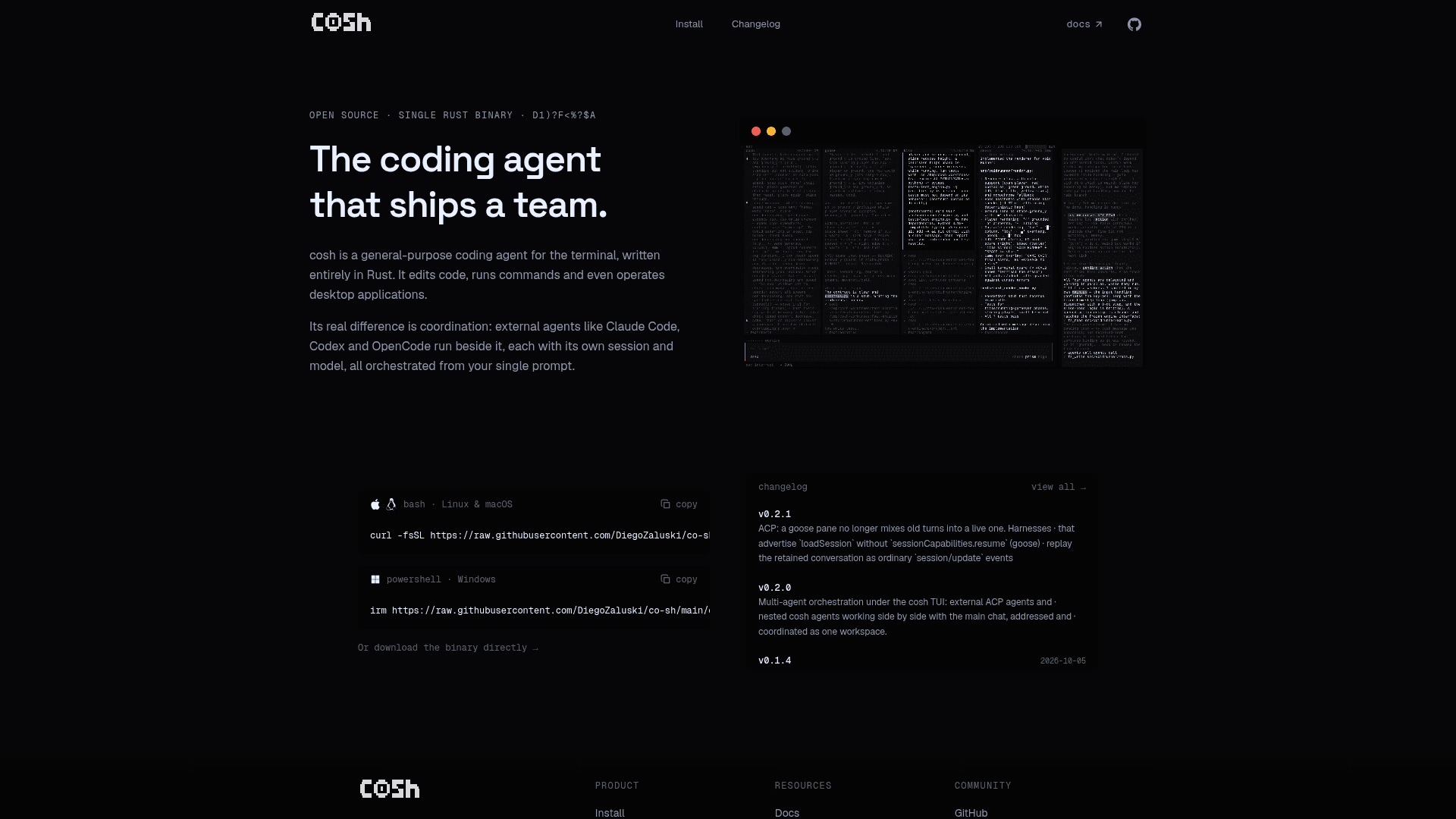
The /agents mode runs external agents such as Gemini, Claude, Codex and Cline in split panes alongside the main agent. Each agent keeps its own session, model and optional git worktree. The main agent dispatches tasks and collects reports, so the group works as one team in a shared workspace. The project positions cosh as an orchestration layer that works alongside established coding agents rather than replacing them. The changelog also mentions ACP support for external agents such as goose and nested cosh agents.
Computer tools and provider support
Computer tools read and operate graphical interfaces through a structured accessibility-tree representation, falling back to screenshots only when needed, which the README says reduces images processed and tokens consumed. The changelog lists providers including Amazon Bedrock, GitHub Copilot and Charm via OAuth device sign-in, and a free gateway offered when credentials are missing or broken.
Setup path
Installation is via a shell script on Linux and macOS, or a PowerShell script on Windows, or by downloading a binary from releases. The README states it was tested on Linux and Windows, with macOS not yet tested. Optional variables set the install directory, version, and a variant with local RAG via fastembed. After install, run cosh in the terminal.
Modular crates
The development tools, TUI widgets, SDK and memory recall are published as independent crates (cosh-tools, cosh-tui, cosh-sdk, cosh-recall, cosh-onnx) that can be reused as libraries. The roadmap lists an ONNX decision engine and graph-based harness orchestration.
Community Discussions
Be the first to start a conversation about cosh
Share your experience with cosh, ask questions, or help others learn from your insights.
Pricing
Open Source
Self-hosted single Rust binary for the terminal, licensed under Apache-2.0. Provider/model costs (BYOK) are external.
- Apache-2.0 licensed core
- Single Rust binary
- Multi-agent orchestration (/agents)
- Computer tools via accessibility tree
- Linux, macOS and Windows install scripts
Capabilities
Key Features
- Terminal TUI coding agent written in Rust
- Multi-agent mode (/agents) with split panes
- Orchestrates external agents (Claude, Gemini, Codex, Cline, Goose)
- Per-agent session, model and optional git worktree
- Computer tools via accessibility tree with screenshot fallback
- In-app configuration of providers, models and modes
- Amazon Bedrock, GitHub Copilot and Charm provider support
- OAuth 2.0 device sign-in with OS keyring storage
- Optional local RAG variant via fastembed
- Modular reusable crates (tools, TUI, SDK, recall, ONNX)