
DAWN Core
An open-source Python library providing an AI music agent that controls Ableton Live through consent-gated, verified OSC writes.
At a Glance
DAWN Core, an open-source AI music agent library for Ableton Live, licensed under Apache-2.0 and free to use, modify and distribute.
Engagement
Available On
Alternatives
Listed Nov 2026
About DAWN Core
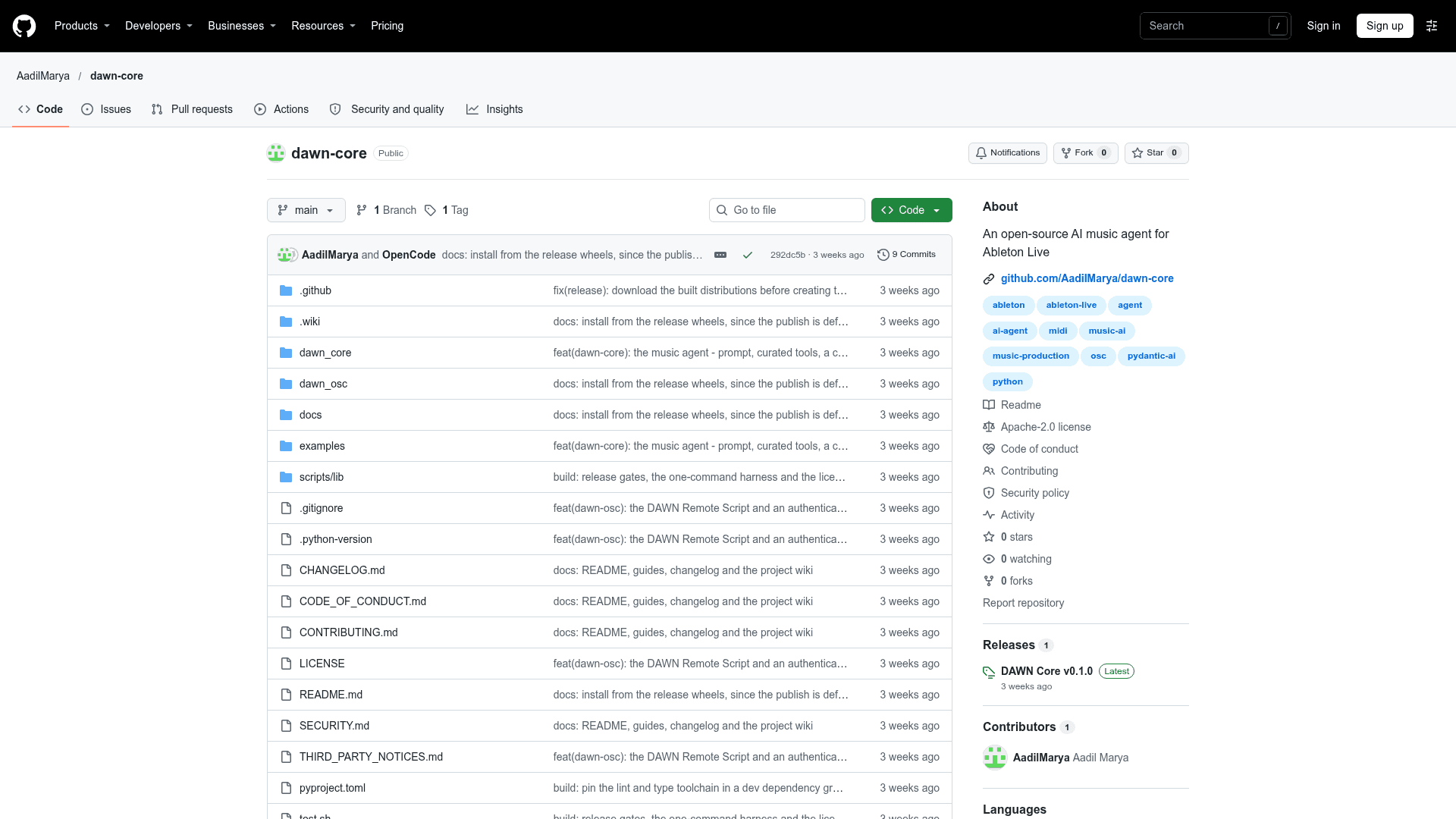
DAWN Core is an open-source Python library that provides an AI music agent for Ableton Live, published by AadilMarya on GitHub under the Apache-2.0 license. It combines a producer-style system prompt, a curated set of Ableton tools, and a consent-gated OSC session that reads back every write. The repository lists version 0.1.0 as the current release.
What It Is
DAWN Core is a library, not a UI. Developers embed it in their own app, run it from a notebook, or use it as the base for their own music agent. The README names the DAWN desktop app as the reference host it is built for, though any Python app can embed it.
The core piece is MusicAgent, a pydantic-ai agent with a producer's system prompt and Ableton tools. The prompt is split into six doctrine sections: persona, production, arrangement, mixing, sound design, and Ableton. The tools package holds 27 curated musical tools plus catalog_call for less common operations. OscSession links to Live, and MiniLive is an offline Live double for tests and development.
How a Call Works
A prompt goes to the agent, which calls a tool, which goes through OscSession. The session checks the address against a catalog, so unknown addresses never leave. It then type-checks the arguments and applies a consent level of read, write, or destructive. Destructive calls are refused unless confirmed.
Approved calls travel as authenticated OSC to the DAWN Remote Script inside Ableton. Transport is loopback only (127.0.0.1), using an HMAC-SHA256 datagram envelope with a replay window, and credentials are kept in an owner-only session file. Every write is read back, and results are reported as OK, MISMATCH, SENT, NOT VERIFIED, REFUSED, or ERROR, so the model can report accurately what happened.
Model Choice and Customization
The model is configurable: examples in the README use OpenAI, Anthropic, and Ollama, and install extras exist for openai, anthropic, google, ollama, and all. Users can limit the prompt to chosen expertise areas, replace the system prompt, or add their own pydantic-ai tools next to the curated ones. The tools and prompt can also be used without the agent loop.
Setup Path
It requires Python 3.11 or newer. The 0.1.0 release is distributed as wheels from GitHub releases, or installed from a repository checkout, and is not on PyPI yet. Two distributions, dawn-core and dawn-osc, must both be installed. The Remote Script is installed with a helper function, after which DAWN is selected as a control surface in Live's settings. A check_install helper verifies the install, session file, and Live.
Current Status
The README states version 0.1.0 is complete for the agent, curated tools, and offline test double. The event/listener stream and arrangement/automation tools are listed as next.
Community Discussions
Be the first to start a conversation about DAWN Core
Share your experience with DAWN Core, ask questions, or help others learn from your insights.
Pricing
Open Source
DAWN Core, an open-source AI music agent library for Ableton Live, licensed under Apache-2.0 and free to use, modify and distribute.
- Apache License 2.0 (OSI-approved)
- MusicAgent built on pydantic-ai
- 27 curated musical tools plus catalog_call
- Consent-gated OscSession with read-back verification
- MiniLive offline test double
Capabilities
Key Features
- Pydantic-ai MusicAgent with producer system prompt
- Six prompt doctrine sections: persona, production, arrangement, mixing, sound design, Ableton
- 27 curated musical tools plus catalog_call for the long tail
- Catalog-gated, consent-checked OSC session
- Read-back verification of every write with OK/MISMATCH/SENT, NOT VERIFIED/REFUSED/ERROR results
- Loopback-only authenticated OSC with HMAC-SHA256 and replay window
- Destructive calls refused unless confirmed
- MiniLive offline Live double for tests
- Bring-your-own model, prompt, and tools
- Remote Script installer and install health check