
deeepSpace
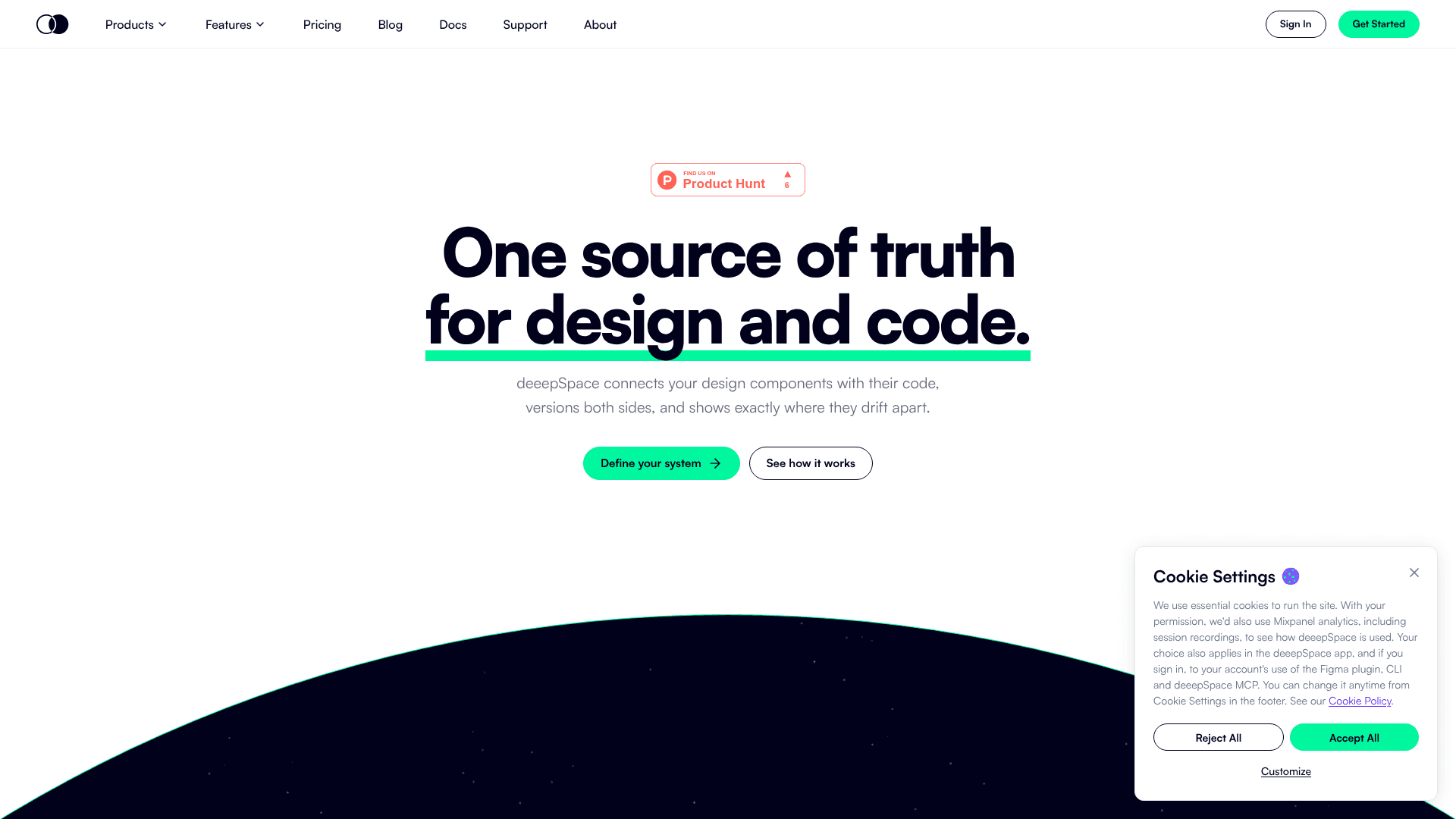
Connects Figma design components to their code, versions both sides, detects drift, and exposes the design system to AI agents over MCP.
At a Glance
7-day free trial of Crew, starts when you verify your email; covers every workspace you create.
Engagement
Available On
Alternatives
Listed Nov 2026
About deeepSpace
deeepSpace, made by DEEEP LTD, links design components in Figma to their code counterparts so designers, developers and AI agents work from one versioned design system. It consists of a Figma Plugin, deeepCLI, the Web Space app and a deeepSpace MCP server.
What It Is
deeepSpace is a design-system alignment layer, which it calls the Space Layer. Designers use the Figma Plugin to selectively sync components, including variants, properties, styles and tokens. Developers run deeepCLI in their repository to analyze UI components, props, styles and Storybook configuration. In Web Space, teams map each design component to its code counterpart. The result is a persistent component-level connection that drives version history, comparison and drift detection.
How Drift Detection and Verification Work
Web Space renders each mapped component for every design variant and compares it with the design. It reports structural differences, styling and token discrepancies, and visual differences shown as a pixel diff. It also lists design properties not yet mapped to a code prop and variants that could not be compared, with a reason. Storybook is not required; when present, deeepCLI uses stories for realistic example data.
Version History
Design and code keep separate histories. Design versions record what changed and who pushed them, while code versions record commit, author and message. Each difference can be traced back to the version or commit where it started, and teams can leave a note when a difference is intended.
AI Agents Through MCP
The deeepSpace MCP server gives external AI coding assistants such as Cursor, Claude Code and Windsurf access over HTTP to components, design specifications, tokens, design-to-code mappings and the latest comparison results. The vendor states that this lets agents generate code that follows the actual design system.
Setup and Scope
deeepCLI supports React and Next.js, Vue 3 and Nuxt 3 and 4, and Svelte 5, in JavaScript or TypeScript, and normalizes CSS, SCSS, LESS and Tailwind styling. Running deeep init only adds a small deeep.json config file, and deeepCLI does not edit source code. The Figma Plugin does not change designs.
Community Discussions
Be the first to start a conversation about deeepSpace
Share your experience with deeepSpace, ask questions, or help others learn from your insights.
Pricing
Free trial
7-day free trial of Crew, starts when you verify your email; covers every workspace you create.
- One 7-day trial per person
- Without a subscription, workspaces become read-only
Crew
For anyone from a solo builder to a team of 25. Each workspace has its own subscription, billed per person.
- 1 to 25 people per workspace, billed per person
- Unlimited projects
- Figma and code component sync
- Full version history for components, tokens and style guides
- Change detection when design and code drift
- Design-system context for AI agents through MCP
- deeepCLI and Figma plugin
- Owner, creator and viewer roles
Enterprise
For organizations with more than 25 people. Custom pricing, billed yearly.
- Everything in Crew
- More than 25 people
- Custom pricing, billed yearly
- Payment by invoice
- Direct support and onboarding
Capabilities
Key Features
- Design and code component mapping
- Selective Figma component sync
- Code component and Storybook discovery
- Version history on design and code sides
- Drift detection for structure, styling, tokens and variants
- Visual verification with pixel diff
- MCP server for AI agents
- Workspaces and projects