
DeepSeek Harness
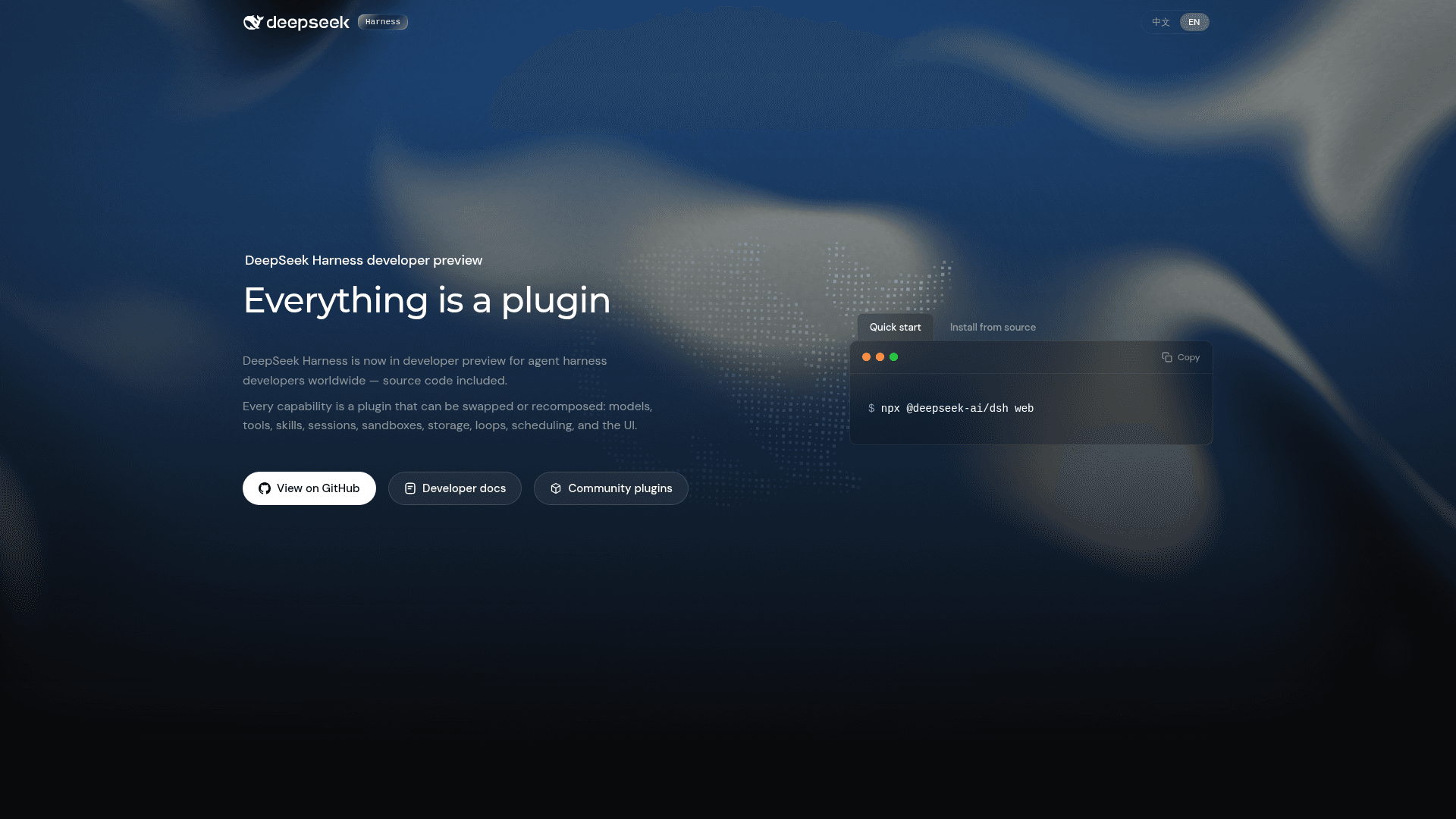
An open-source, plugin-based agent harness by DeepSeek AI where every capability—models, tools, skills, sessions, sandboxes, and UI—is a swappable plugin.
At a Glance
About DeepSeek Harness
DeepSeek Harness (dsh) is an open-source agent harness developed by DeepSeek AI and released under the MIT license. It is currently in developer preview, iterating rapidly with compatibility-breaking changes expected. The project is built on the Cordis plugin kernel and is written primarily in TypeScript, launchable via npx @deepseek-ai/dsh web or by cloning the repository directly.
What It Is
DeepSeek Harness is a framework for building and running AI agents in real-world environments. Rather than baking capabilities into a monolithic core, it treats every agent capability—models, tools, skills, sessions, sandboxes, storage, loops, scheduling, and the UI—as an independently mountable and swappable plugin. The design philosophy is captured in the tagline "Everything is a plugin," and the underlying architecture is described in the Cordis paper A Programming Paradigm for Spatiotemporal Composability.
Plugin-First Architecture
The Cordis kernel manages plugin mounting, unmounting, and dependency resolution. Cordis services and events coordinate plugins at runtime, so developers can select, swap, or extend any capability through configuration without modifying the DeepSeek Harness source code. Community plugins can be published to GitHub with the dsh-plugin topic for discoverability. Four built-in runtime modes ship out of the box:
- Standard mode — full toolset including file editing, shell, file and web search, skills, planning, goals, subagents, and workflows.
- Code mode — all Standard capabilities, with tools exposed through the Code Mode SDK so the model can combine multi-step operations in a single TypeScript program.
- Minimal mode — a two-tool coding agent with persistent bash and
str_replace_editor, designed for benchmarking models in a stripped-down environment. - Creator mode — Standard capabilities plus runtime inspection, in-memory plugin experiments, and preset-authoring guidance for building custom agent presets.
Full Traceability via Session Logs
Every run is recorded in an append-only session log that captures system prompts, reasoning traces, tool calls and results, subagent scheduling, and every context injection. The Trajectory view lets developers inspect these records by source. Resume, fork, search, and replay all operate on the same event stream, making it possible to reconstruct a complete run from a single log file.
Setup Path
DeepSeek Harness requires Node.js. The quickest path is:
npx @deepseek-ai/dsh web
This starts the Web UI at http://127.0.0.1:3080 by default. Alternatively, developers can clone the repository, install dependencies with pnpm, build, and run pnpm dsh web for a full source checkout. Developer documentation is hosted at the official docs site, and community plugins are indexed via the dsh-plugin GitHub topic.
Current Status: Developer Preview
The project was created in August 2026 and is explicitly described as a developer preview with rapid iteration and expected breaking changes. The GitHub repository accumulated over 71,000 stars and 6,000 forks shortly after launch, according to the repository metadata. DeepSeek states it looks forward to "exploring the limits of intelligence with developers worldwide using open-source infrastructure that is reusable and composable." Community support is available through GitHub Discussions and a dedicated Discord server.
Community Discussions
Be the first to start a conversation about DeepSeek Harness
Share your experience with DeepSeek Harness, ask questions, or help others learn from your insights.
Pricing
Open Source
Fully open-source under MIT license. Free to use, modify, and distribute.
- Full plugin-based agent harness
- Standard, Code, Minimal, and Creator runtime modes
- Append-only session logs and Trajectory view
- Community plugin ecosystem
- Web UI via npx or source install
Capabilities
Key Features
- Everything is a plugin (models, tools, skills, sessions, sandboxes, storage, loops, scheduling, UI)
- Cordis kernel for plugin mounting, unmounting, and dependency management
- Standard mode with full toolset including file editing, shell, web search, subagents, and workflows
- Code mode with TypeScript-based multi-step tool orchestration via Code Mode SDK
- Minimal mode for benchmarking with persistent bash and str_replace_editor
- Creator mode for building custom agent presets with runtime inspection
- Append-only session logs capturing all model inputs, tool calls, and context injections
- Trajectory view for inspecting, resuming, forking, searching, and replaying runs
- Community plugin ecosystem via dsh-plugin GitHub topic
- Web UI served locally via npx or source install
- MIT-licensed open-source source code included