
Demucs
Open-source music source separation model and command-line tool that splits songs into stems such as drums, bass, and vocals.
At a Glance
Demucs source code released under the MIT license; self-hosted. Model weights license is unclear (MusDB research-only data, Meta internal dataset).
Engagement
Available On
Listed Nov 2026
About Demucs
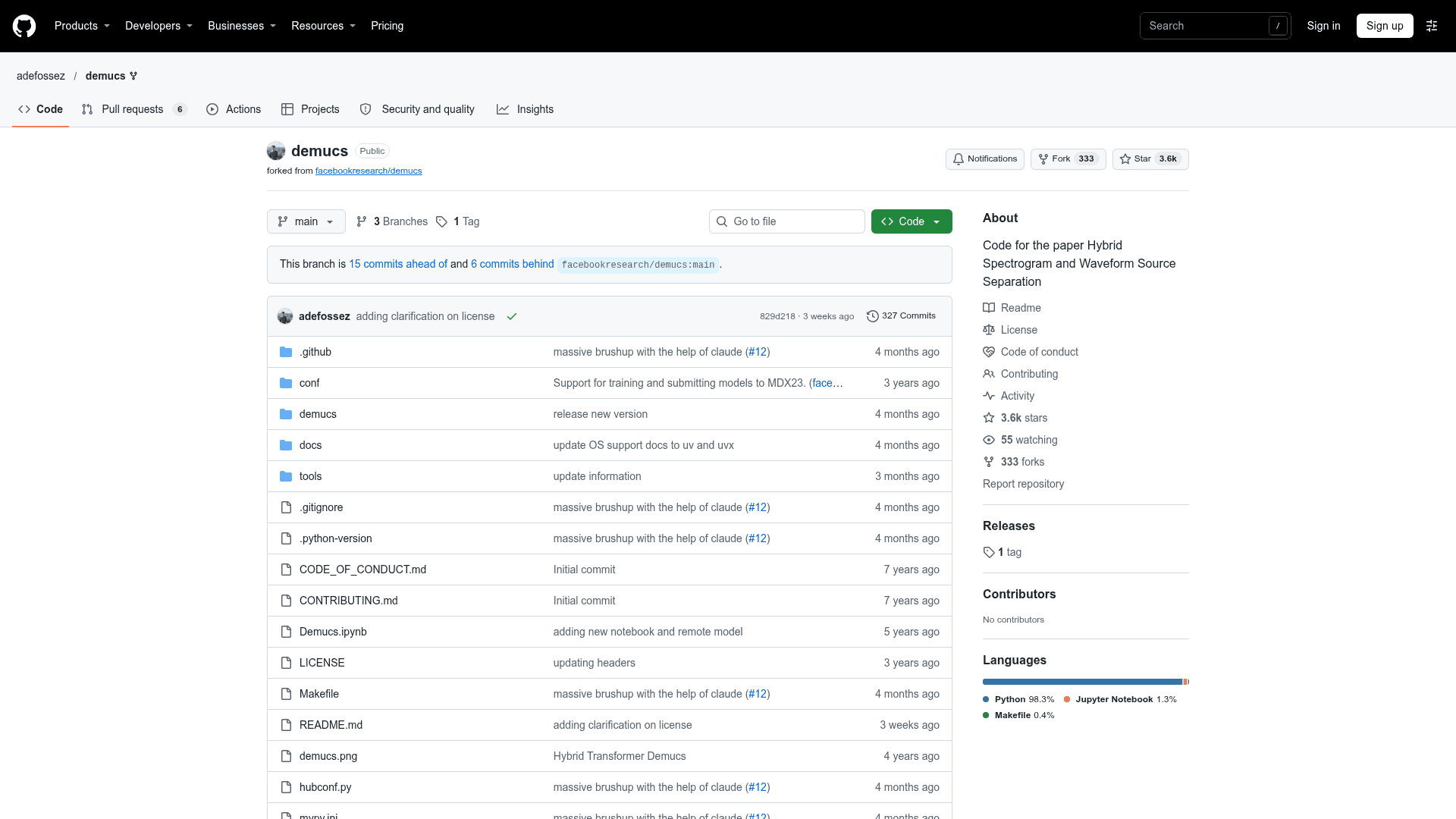
Demucs is a music source separation model and toolkit maintained by Alexandre Défossez, who says he has left Meta for Kyutai and is no longer actively working on it, so slow replies and no new features should be expected. It separates a song into stems such as drums, bass, vocals, and other accompaniment. The README describes v4 as featuring Hybrid Transformer Demucs, and lists v4.1.0 with modernized packaging, lighter inference dependencies, and pretrained models hosted on Hugging Face.
What It Is
Demucs is a Python package and command-line tool for splitting audio tracks into individual sources. It is based on a U-Net convolutional architecture, and v4 uses a hybrid spectrogram/waveform model with a cross-domain Transformer encoder. The README reports 9.00 dB SDR on the MUSDB HQ test set for the HT Demucs fine-tuned model in its comparison table.
How Separation Works
Users run demucs on one or more audio files and get stereo 44.1 kHz stems in a separated/MODEL_NAME/TRACK_NAME folder. Default output is four stems: drums, bass, other, and vocals. Options include:
- Pretrained model selection with
-n, includinghtdemucs,htdemucs_ft,htdemucs_6s,hdemucs_mmi,mdx,mdx_extra, and quantized variants. --two-stemsfor karaoke-style separation of a single source against the rest.- Output as int16, float32, or int24 WAV, as MP3, or as FLAC (FLAC requires ffmpeg).
- Segment length, overlap, shifts, and parallel job settings to trade speed, memory, and quality.
- CPU or GPU processing; the README says GPU use needs at least 3 GB of GPU memory.
The experimental 6-source model adds guitar and piano; the README notes the piano source has significant bleeding and artifacts.
Setup Path
Python 3.10 or newer is required. It can be run without installation through uvx demucs, installed with uv tool install demucs or pip, or used from Google Colab and a Hugging Face Spaces demo. A Python API is available through demucs.separate.main, and training instructions are provided for researchers. Third-party GUIs and online services are mentioned in the README.
Licensing Notes
The code is released under the MIT license. The README states that the license of the pretrained weights is unclear because of MusDB research-only data and Meta internal data.
Community Discussions
Be the first to start a conversation about Demucs
Share your experience with Demucs, ask questions, or help others learn from your insights.
Pricing
Open Source
Demucs source code released under the MIT license; self-hosted. Model weights license is unclear (MusDB research-only data, Meta internal dataset).
- Code under MIT license
- Self-hosted music source separation (drums, bass, vocals, other)
- Hybrid Transformer Demucs v4 models
- Pretrained model weights license is not clear (MusDB research-only data; 6-source model likely CC-BY-NC)
Capabilities
Key Features
- Hybrid Transformer Demucs (v4) source separation
- Separates drums, bass, vocals, and other stems
- Experimental 6-source model adding guitar and piano
- Two-stem karaoke mode
- Multiple pretrained models including quantized variants
- Output as WAV (int16, int24, float32), MP3, or FLAC
- CPU and GPU inference with segment, overlap, and shift options
- Python API for calling separation programmatically
- Training support and MDX challenge reproduction