
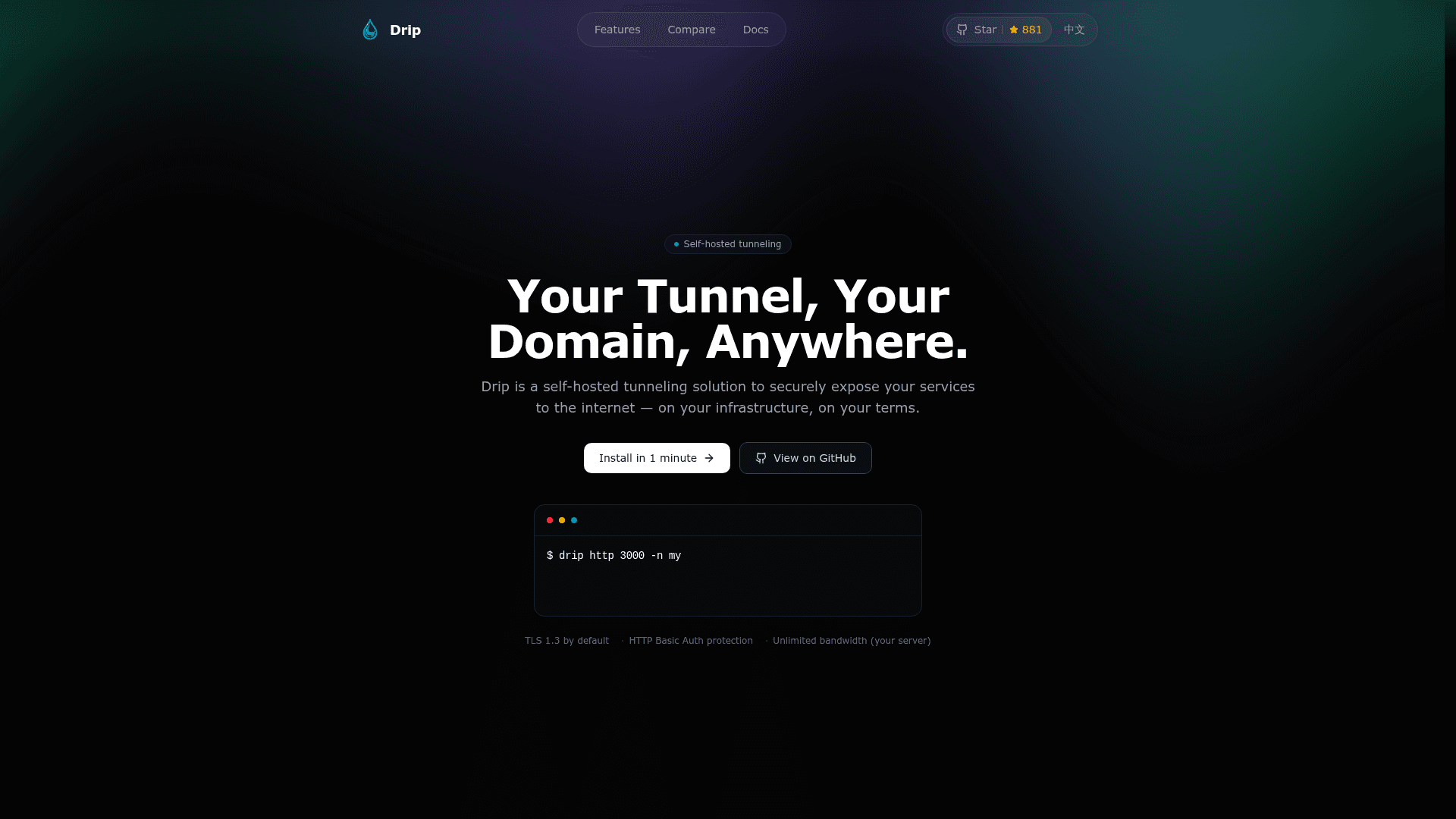
A self-hosted tunneling solution to securely expose local services to the internet using your own domain and infrastructure, with no bandwidth limits or third-party servers.
At a Glance
Fully free and open source under BSD-3-Clause. Self-host on your own infrastructure with no limits.
Engagement
Available On
Listed Aug 2026
About Drip
Drip is an open-source, self-hosted tunneling tool written in Go that lets you expose local services to the internet through your own domain and server infrastructure. Licensed under BSD-3-Clause, it is developed by Gouryella and available on GitHub with 881 stars as of the latest data. The project positions itself as a privacy-respecting alternative to managed tunneling services like ngrok, where all traffic stays between your client and your own server.
What It Is
Drip is a CLI-based tunneling solution in the same category as ngrok or Cloudflare Tunnel, but designed for self-hosters who want full control over their infrastructure. Instead of routing traffic through a third-party provider's servers, Drip runs a server component on your own VPS or cloud instance and a client binary on your local machine. You expose services via your own domain (e.g., https://myapp.your-domain.com) with TLS 1.3 enabled by default. It supports HTTP, HTTPS, and TCP tunnels, making it suitable for web apps, APIs, databases, SSH, and other services.
How It Works
The setup follows a client-server model:
- Server: Deployed on a Linux machine (AMD64 or ARM64), configured via
/etc/drip/config.yaml, and managed as a systemd service. - Client: Installed on macOS, Linux, or Windows, configured once with
drip config init, then used to open tunnels with simple commands likedrip http 3000 -n myapp. - Transport: Uses WebSocket over TLS (WSS) as the tunnel transport, which works through CDNs like Cloudflare and restrictive firewalls.
- Forwarding: Supports forwarding to localhost, LAN devices, Docker containers, or any network interface — not just
127.0.0.1.
Key Capabilities
- HTTP Basic Auth: Built-in username/password protection for tunnels, included at no cost.
- Bearer Token Authentication: Added in January 2025 for token-based tunnel access control.
- Bandwidth Limiting (QoS): Per-tunnel bandwidth control using a token bucket algorithm, with the server enforcing
min(client, server)as the effective limit (added February 2025). - Background mode: Run tunnels as background daemons, list active sessions, attach to logs, and stop cleanly.
- Unlimited tunnels and bandwidth: Constrained only by your own server's resources.
Tradeoffs vs. Managed Tunneling
The homepage directly compares Drip to ngrok's free tier. Drip offers unlimited bandwidth, unlimited active endpoints, unlimited tunnels per agent, and no request caps — but requires you to operate your own server. Managed services like ngrok handle infrastructure for you but impose quotas, route traffic through their servers, and charge for features like HTTP Basic Auth. Drip's self-hosted model means you bear the operational responsibility but gain privacy, no artificial limits, and no recurring service fees.
Update: v0.7.11
The latest release is v0.7.11, published on July 9, 2026. Recent changelog activity includes bandwidth limiting with QoS controls (February 2025), bearer token authentication (January 2025), and ongoing code refactoring for maintainability. The repository shows active development with 56 forks and regular pushes to the main branch, signaling a healthy open-source project trajectory.
Community Discussions
Be the first to start a conversation about Drip
Share your experience with Drip, ask questions, or help others learn from your insights.
Pricing
Open Source
Fully free and open source under BSD-3-Clause. Self-host on your own infrastructure with no limits.
- Unlimited tunnels
- Unlimited bandwidth (your server)
- Use your own domain
- HTTP Basic Auth built-in
- Bearer Token Authentication
Capabilities
Key Features
- Self-hosted tunneling with your own domain
- HTTP, HTTPS, and TCP tunnel support
- TLS 1.3 by default
- WebSocket over TLS (WSS) transport
- HTTP Basic Auth protection built-in
- Bearer Token Authentication
- Per-tunnel bandwidth limiting (QoS) with token bucket algorithm
- Forward to LAN devices, Docker containers, or any interface
- Background daemon mode with session management
- Unlimited tunnels, bandwidth, and requests
- Works through CDNs like Cloudflare and restrictive firewalls
- Single-command installation script
- Build from source with Go 1.21+