
env
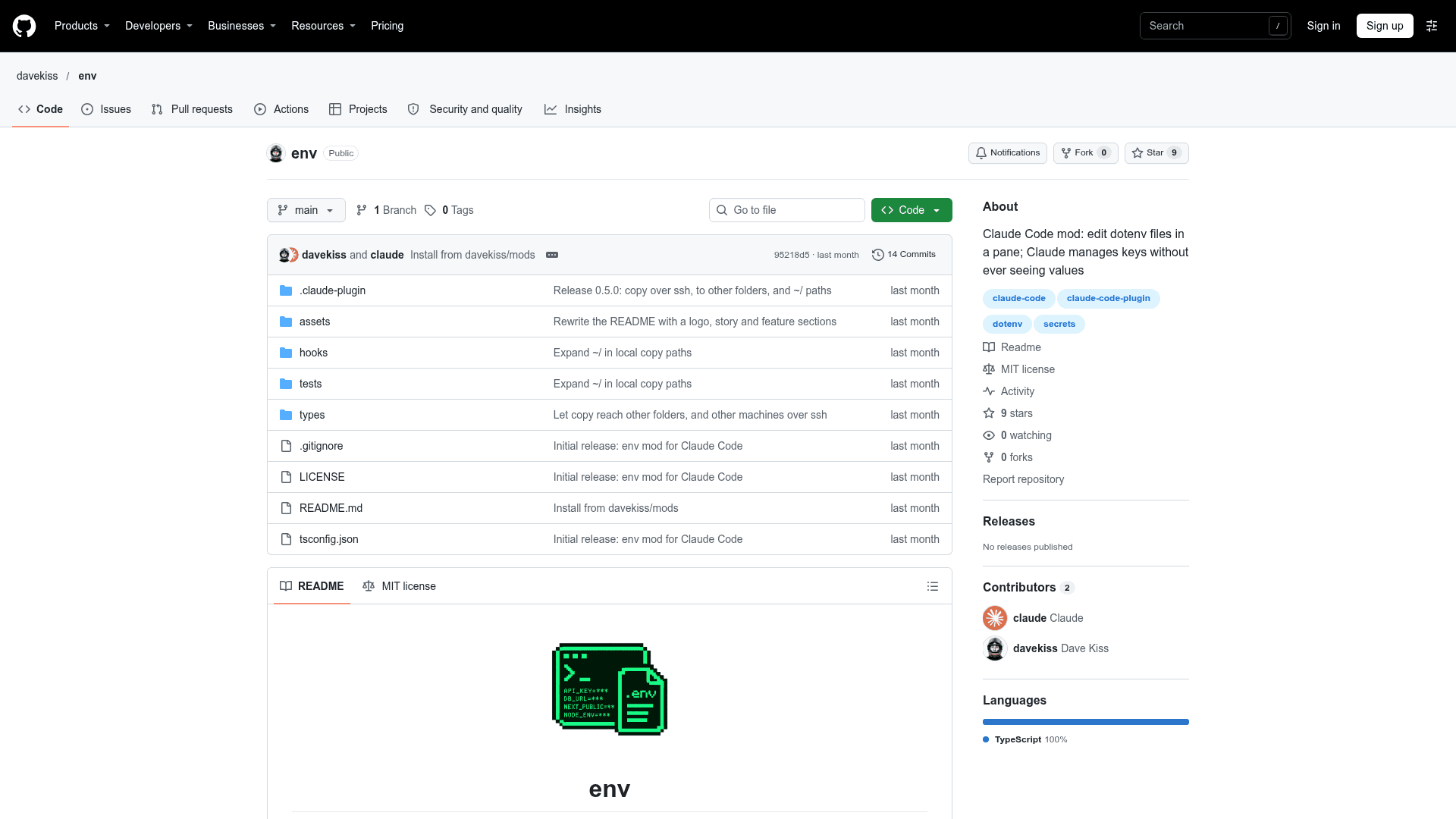
A Claude Code plugin that lets Claude manage .env keys and request secret values through a private pane without ever seeing the values.
At a Glance
Claude Code plugin for managing .env files, released under the MIT License and free to use, copy, modify and distribute.
Engagement
Available On
Alternatives
Listed Nov 2026
About env
env is a Claude Code mod by Dave Kiss for working with .env files. Claude knows which keys exist and asks the user for values through a card; the user pastes them into a pane Claude cannot read, and Claude is only told the key is now set. It is MIT-licensed and installed through the Claude Code plugin marketplace.
What It Is
env is a Claude Code plugin that separates secret handling from the conversation. When Claude needs a value, such as a Cloudflare account ID, it shows a card with what it needs, why, steps to find it, and a link to the exact page. The user pastes the value and presses Enter, and it is written to the env file rather than the transcript. The card can also check the paste as you type when Claude knows what a valid value looks like.
How Values Stay Out of the Conversation
Two layers protect values. The fence blocks Claude's Read, Edit, Write and Grep from opening .env* files and refuses Bash commands such as cat .env, source .env and printenv, while templates like .env.example stay readable. The scrubber replaces any value of 8 characters or longer in env files with [env:KEY] in tool results, messages and prompts before they are stored or sent. The README describes the fence as best-effort and the scrubber as the guarantee. Programs that load .env themselves, such as npm run dev, run normally.
Tools and Host Integration
Claude gets MCP tools to list keys (showing kind, length and known prefix, never the value), request values, generate random secrets, copy values or whole files between env files, worktrees, folders or machines over ssh, and comment keys out. It can also push values to hosting CLIs such as vercel, gh and wrangler with {{KEY}} placeholders after the user approves the command, and pull values from CLIs like vercel env pull, doppler and op read into the env file. Output from these CLIs is redacted before Claude reads it.
The /env Pane and Limits
The /env command opens a pane with a tab per .env* file in the project root, with masked values and buttons to copy, edit, show or delete keys, plus an add-key option and a list of keys missing compared to .env.example. Comments, ordering and quoting are preserved. Documented limits: the paste field is not masked, values shorter than 8 characters, booleans and numbers are not scrubbed, only the project root is scanned, and the VS Code extension and claude -p have no pane.
Community Discussions
Be the first to start a conversation about env
Share your experience with env, ask questions, or help others learn from your insights.
Pricing
Open Source (MIT)
Claude Code plugin for managing .env files, released under the MIT License and free to use, copy, modify and distribute.
- MIT-licensed Claude Code mod
- Fence blocks Claude from reading .env* files
- Scrubber redacts values of 8+ characters
- Tools: list, request, generate, copy, remove, push, pull
- /env pane for editing dotenv files
Capabilities
Key Features
- Card-based secret requests with steps and links to the exact page
- Live format check of pasted values
- Fence blocking Claude from reading .env files
- Scrubber redacting values of 8+ characters as [env:KEY]
- List keys without revealing values
- Generate random secrets without returning them
- Copy values or files across env files, worktrees, folders, or ssh machines
- Comment out keys for easy restoration
- Push values to hosting CLIs with approved placeholder commands
- Pull values from hosting and secrets CLIs into env files
- /env pane with masked values and per-file tabs
- Preserves comments, ordering, and quoting
- Warns if env file is not in .gitignore