
envsave
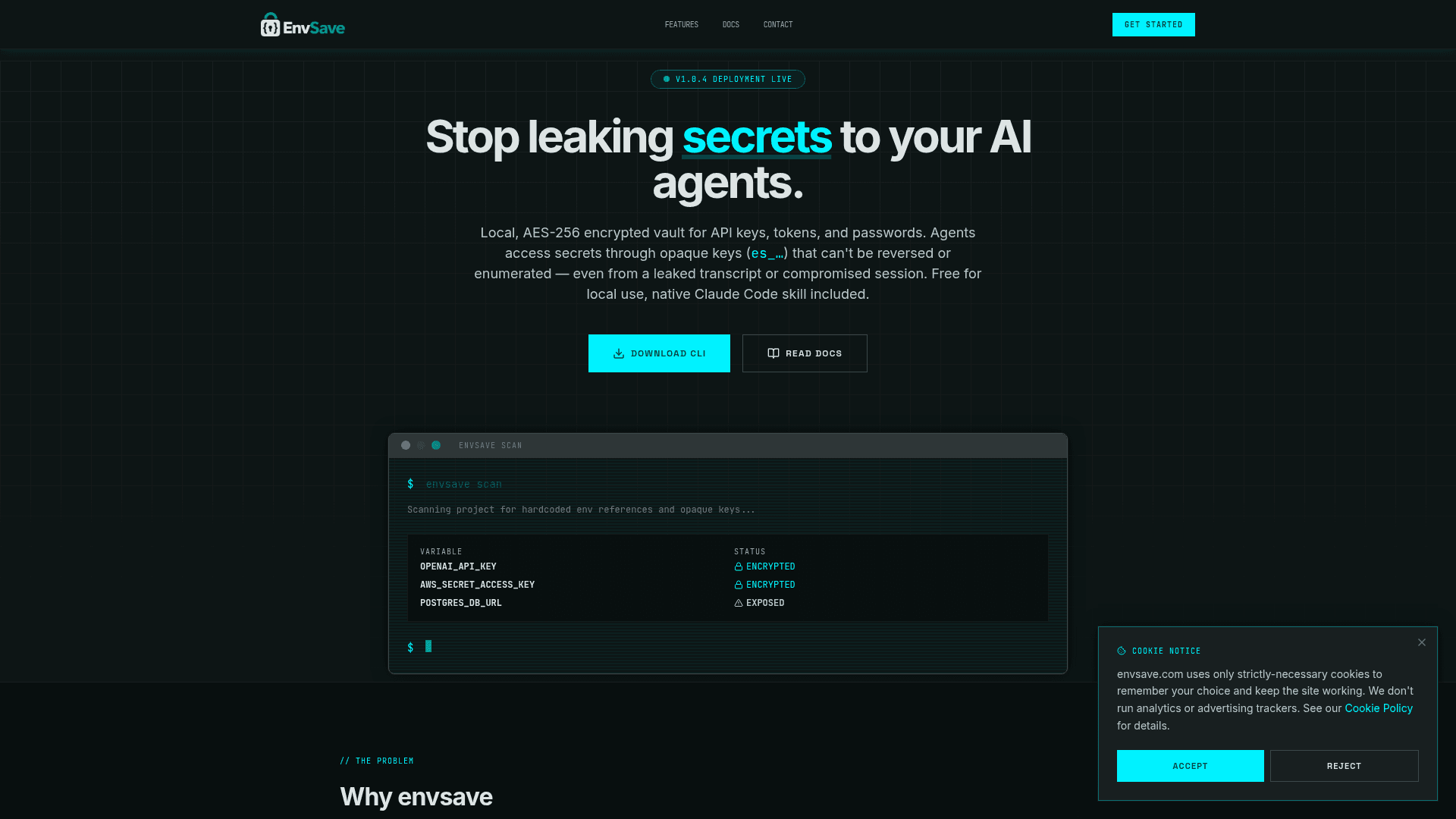
A local AES-256 encrypted secrets vault that gives AI agents opaque keys instead of real API keys, tokens, and passwords.
At a Glance
About envsave
envsave is a local encrypted vault for API keys, tokens, and passwords, built by AI Agents Lab so that LLM coding agents never see real secret values. Instead of reading plaintext keys or a .env file, agents use opaque identifiers (es_...) that resolve to the real value only through the vault on the user's machine. It ships as a CLI and library for Node.js/Bun and Python, with a Claude Code skill, and is released under the MIT license.
What It Is
envsave is a command-line secrets manager aimed at developers who run AI assistants or coding agents on their codebases. Secrets are stored in a single AES-256-GCM encrypted vault file at ~/.envsave/vault.enc, with PBKDF2 key derivation and an optional SSH key as a second factor. Key names are stored as HMAC-SHA256 hashes, so the opaque keys carry no trace of the original names and, per the project, cannot be reversed or enumerated without the master password.
How the Workflow Works
A user installs the CLI via npm or pip, runs envsave init to create the vault, and stores a secret with envsave set NAME value. The command returns an opaque key such as es_7a3f..., which code then passes to get() in Node.js/Bun or Python to retrieve the real value at runtime. Further commands cover revealing, searching, listing, renaming, deleting, importing from and exporting to .env files, and scanning a project for hardcoded environment references. Re-running set on an existing name updates the value while keeping the same opaque key, so code does not need to change.
Safeguards Against Agent Access
envsave getis rate-limited, with a configurable maximum per minute, to blunt scraping from a compromised session.- On macOS, Touch ID can approve vault commands; AI agents cannot approve the prompt, so password-gated commands still need the user.
- A session cache keeps decrypted secrets in memory so repeated reads do not require the password each time.
Deployment, Backup and Agent Skill
envsave vercel pushes selected secrets to a Vercel project under both the opaque id and the clean name, so deployed code works without a local vault. Cloud backup, restore, and sync of the encrypted vault across machines require a license; the server stores only encrypted bytes. An envsave skill can be installed for Claude Code via npx skills add or envsave install-skill, so the agent uses opaque keys when it touches secrets.
Community Discussions
Be the first to start a conversation about envsave
Share your experience with envsave, ask questions, or help others learn from your insights.
Pricing
Local (Open Source)
Free and unlimited local personal use of the MIT-licensed CLI vault; no license required.
- Free and unlimited local personal use
- Store as many secrets as you want, on as many machines as you want
- No license required for local use
- AES-256-GCM encrypted local vault
- Opaque es_ keys for agents
Capabilities
Key Features
- AES-256-GCM encrypted local vault
- Opaque HMAC-based es_ keys that cannot be reversed or enumerated
- Node.js/Bun and Python libraries
- Project scan for hardcoded env references
- Import from and export to .env files
- Rate-limited get command
- Touch ID unlock on macOS
- Optional SSH key second factor
- Push secrets to Vercel
- Encrypted cloud backup and sync
- Claude Code skill installation