
FAROS
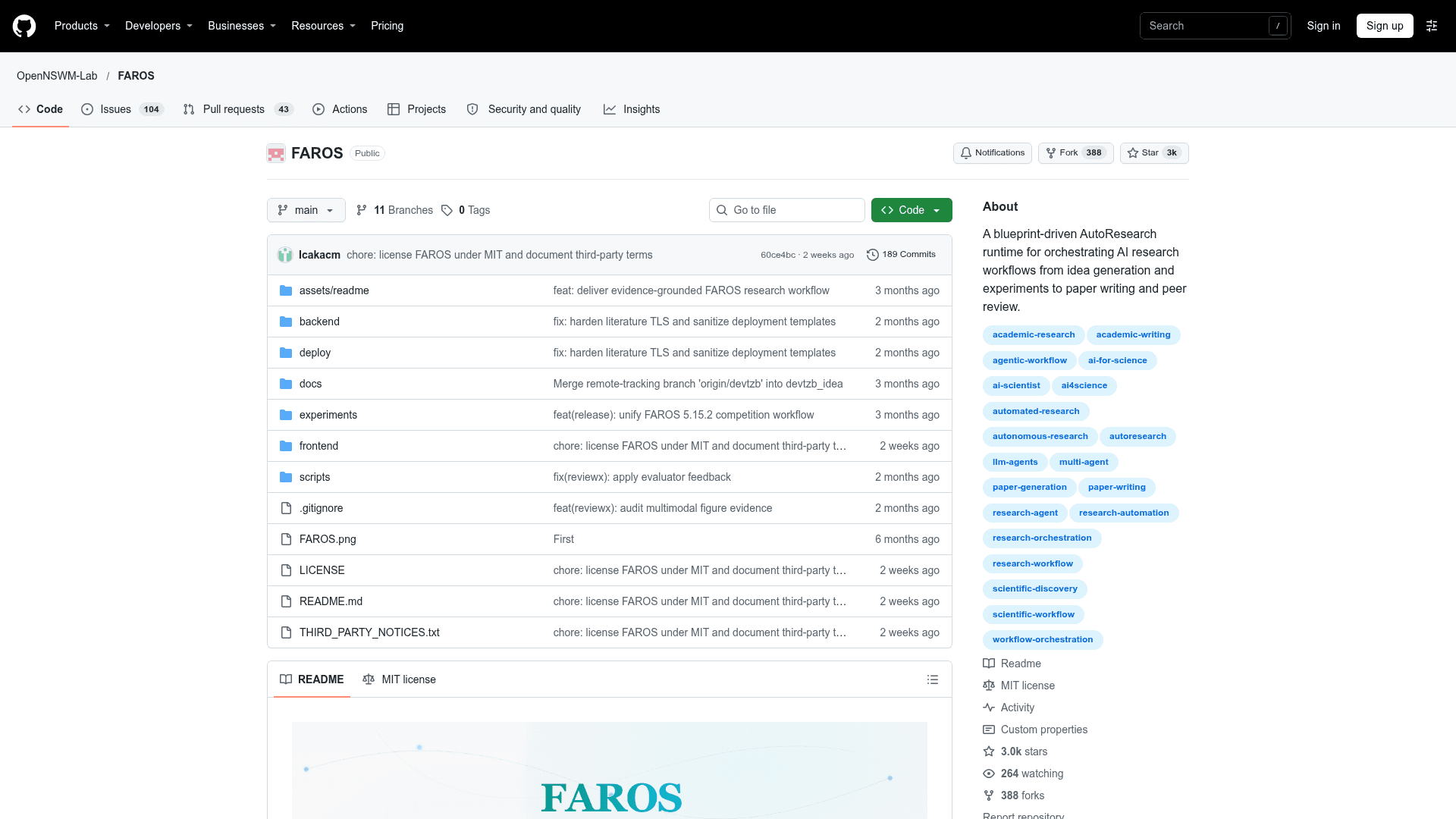
A blueprint-driven AutoResearch runtime that orchestrates AI research workflows from idea generation and experiments to paper writing and peer review.
At a Glance
Original FAROS source and documentation are MIT licensed. Hosting, model/API access, compute and third-party resources are separate costs and may have their own terms.
Engagement
Available On
Alternatives
Listed Nov 2026
About FAROS
FAROS (Foundation AutoResearch Operating System) is an open-source multi-agent system from OpenNSWM-Lab that covers research topic selection, literature retrieval, planning, code generation, experiment tracking, paper writing and peer review. It keeps provenance, decisions, artifacts and human feedback at each stage.
What It Is
FAROS is a research-workflow runtime and web workbench for running an AI-assisted research loop. A user starts from a research interest, and the system moves through Idea, PlanPackage, Code, Experiment, Paper and ReviewX stages, ending in human approval or an evidence-driven revision. Its runtime uses a Blueprint + Capability + Profile + Provider design so new workflows and tools can be added.
How the research loop works
- Idea: topic coaching turns a rough interest into a task, method, dataset and evaluation target; literature retrieval, semantic filtering and deep reading run before ideation.
- PlanPackage: a structured contract carrying hypotheses, variables, steps, acceptance criteria and evidence references, with reviewer checks and human approval.
- Code and Experiment: project generation, sandboxed execution, static and dynamic evaluation, metric ingestion, dataset upload and publication-style figures.
- Paper: brief, outline, section drafting, citation management and LaTeX/PDF generation linked to plans and experiments.
- ReviewX: extracts claims, aligns them with evidence, checks consistency and reliability, and produces revision actions.
Setup path
The backend is a FastAPI app (Python 3.11+) and the frontend is a React/TypeScript app (Node.js 18+). Models are configurable per user through provider settings or environment variables; the README lists OpenAI, Anthropic, DeepSeek, Moonshot, Zhipu and MiniMax adapters and compatible endpoints. Docker Engine is required for the formal Code/Experiment sandbox, and formal PDF output needs latexmk, XeLaTeX, ctex and a CJK font. The README also describes user-scoped provider settings with encrypted API key storage, a bilingual UI and recoverable background jobs.
License and deployment
The current repository licenses original source and documentation under MIT. Setup instructions target Linux or WSL Bash, with Python 3.11+ and Node.js 18+. Model/API and compute costs are separate. Important scientific conclusions still require human verification against their evidence.
Community Discussions
Be the first to start a conversation about FAROS
Share your experience with FAROS, ask questions, or help others learn from your insights.
Pricing
MIT self-hosted source
Original FAROS source and documentation are MIT licensed. Hosting, model/API access, compute and third-party resources are separate costs and may have their own terms.
- MIT-licensed original source and documentation
- Self-hosted research workflow and web workbench
Capabilities
Key Features
- Configurable model-based research topic coaching
- Literature retrieval with semantic and evidence quality gates
- PlanPackage structured cross-module contract
- Code generation with sandboxed execution and automated repair
- Experiment metric ingestion, dataset upload and figure generation
- Paper drafting with citations and LaTeX/PDF output
- ReviewX claim-evidence-experiment consistency review
- Human approval gates
- Recoverable long-running background jobs
- Bilingual UI with per-user provider configuration and encrypted API keys