
FFmpeg
Open-source multimedia framework of libraries and command-line tools to record, convert, filter, stream and play audio and video.
At a Glance
FFmpeg is distributed as free software; the codebase is mainly LGPL-licensed with optional GPL components.
Engagement
Available On
Alternatives
Listed Nov 2026
About FFmpeg
FFmpeg is an open-source multimedia project that provides a collection of libraries and command-line tools for processing audio, video, subtitles and related metadata. Developers embed its libraries in applications, while end users run the ffmpeg, ffplay and ffprobe tools to convert, play and inspect media. Its latest release listed on the site is FFmpeg 8.1 "Hoare", announced March 16th, 2026.
What It Is
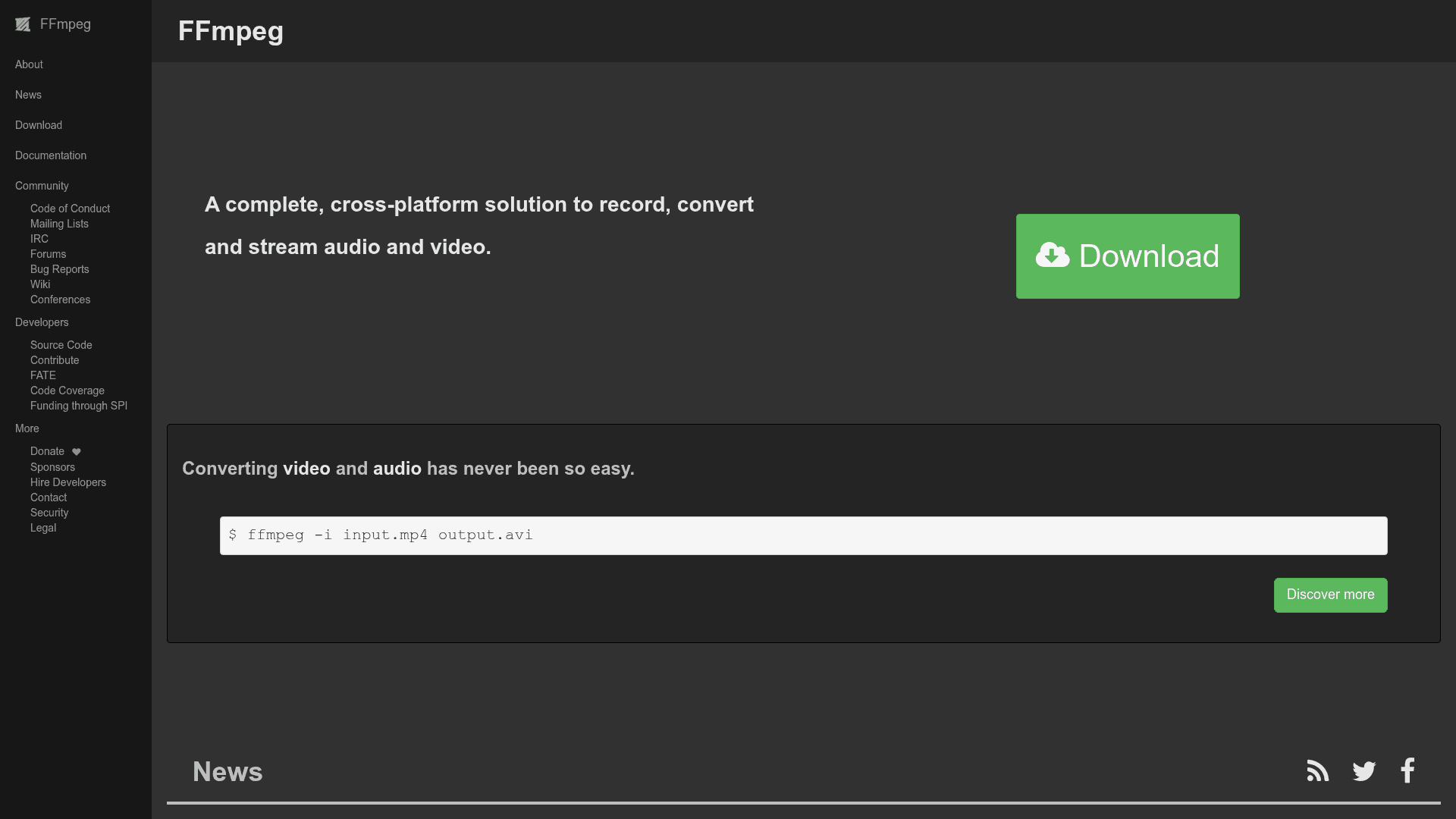
FFmpeg is a multimedia framework able to decode, encode, transcode, mux, demux, stream, filter and play a wide range of formats. A basic conversion is a single command such as ffmpeg -i input.mp4 output.avi. The project says it compiles and runs across Linux, Mac OS X, Microsoft Windows, the BSDs and Solaris, and is tested through its FATE infrastructure.
Tools and Libraries
The end-user tools are ffmpeg (a command-line converter), ffplay (a minimal SDL-based player) and ffprobe (a stream analyzer). For developers, the libraries are libavcodec (codecs), libavformat (containers and protocols), libavfilter (filter graphs), libavdevice (capture and playback devices), libswscale (scaling and color conversion), libswresample (audio resampling) and libavutil (utilities). Examples live in doc/examples.
Recent Direction
Recent release notes describe new native decoders, Vulkan compute-based codecs (FFv1, ProRes RAW, ProRes, DPX), hardware-accelerated encoding and decoding paths, and new filters. The 8.0 release introduced the Vulkan compute-based codec class, and 8.1 extended it. Earlier releases added a native VVC decoder and a multi-threaded ffmpeg CLI where demuxers, decoders, filters, encoders and muxers run in parallel.
Build and Licensing
The codebase is mainly LGPL-licensed with optional GPL components. Platform documentation covers building with GNU Make on Unix-like systems, MinGW-w64/MSYS2 or MSVC on Windows, and cross-compilation. Patches are submitted through Forgejo or the ffmpeg-devel mailing list rather than GitHub pull requests.
Community Discussions
Be the first to start a conversation about FFmpeg
Share your experience with FFmpeg, ask questions, or help others learn from your insights.
Pricing
Free
FFmpeg is distributed as free software; the codebase is mainly LGPL-licensed with optional GPL components.
- Mainly LGPL-licensed codebase with optional components licensed under GPL (see LICENSE file)
- Libraries: libavcodec, libavformat, libavutil, libavfilter, libavdevice, libswresample, libswscale
- Tools: ffmpeg, ffplay, ffprobe
Capabilities
Key Features
- Decode, encode, transcode, mux, demux, stream, filter and play audio and video
- ffmpeg command-line converter
- ffplay minimal media player
- ffprobe multimedia stream analyzer
- Libraries for codecs, containers, filters, devices, scaling and resampling
- Hardware-accelerated encoding and decoding
- Vulkan compute-based codecs
- Multi-threaded transcoding pipeline
- Wide range of audio and video filters
- Cross-platform builds